What Is the Best Initial Imaging for Suspected Hypertrophic Cardiomyopathy?
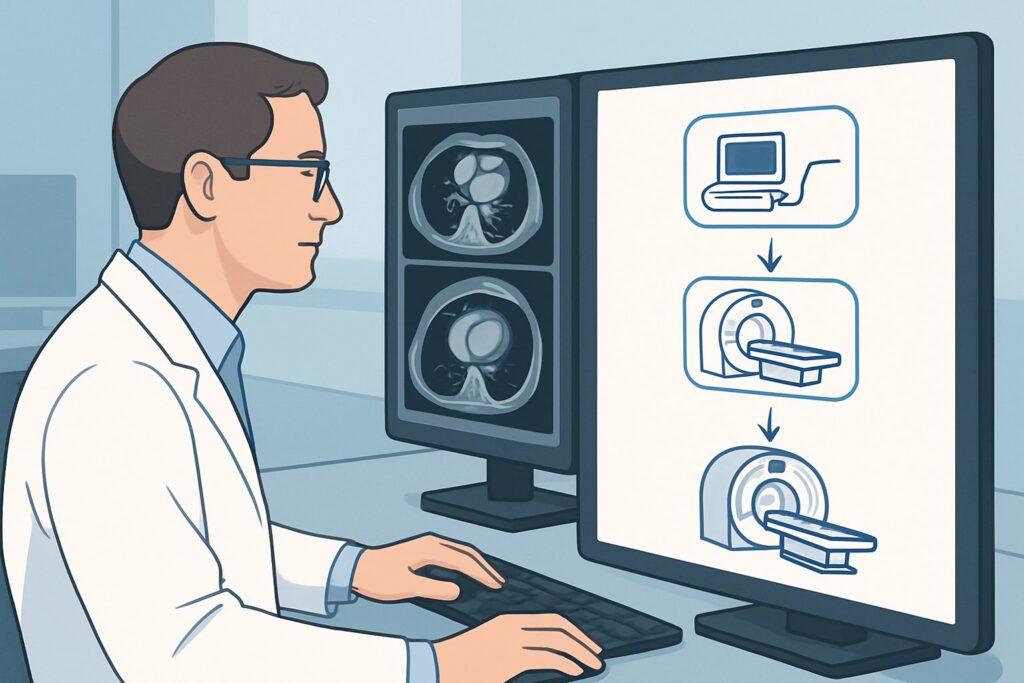
A 45-year-old male presents to your clinic with several months of progressive exertional dyspnea. His father died suddenly at age 50. An electrocardiogram (ECG) in the office shows left ventricular hypertrophy with deep T-wave inversions in the precordial leads. His blood pressure is normal, and a recent workup has effectively excluded ischemic heart disease as a cause for his symptoms. You suspect a primary myocardial disease, with hypertrophic cardiomyopathy (HCM) at the top of your differential. What is the most appropriate first imaging study to order to confirm your suspicion and guide management?
This article provides a detailed clinical workflow for the initial imaging of suspected hypertrophic cardiomyopathy, grounded in the American College of Radiology (ACR) Appropriateness Criteria. For this specific scenario, the ACR rates `US echocardiography transthoracic resting` as Usually Appropriate, making it the recommended first-line investigation.
Who Fits This Clinical Scenario for Suspected Hypertrophic Cardiomyopathy?
This guidance applies to patients where hypertrophic cardiomyopathy is a primary diagnostic consideration. The clinical picture is often built from a combination of findings, and it is critical that ischemic cardiomyopathy has already been reasonably excluded through prior history, ECG, biomarkers, or functional testing.
Inclusion criteria for this workflow:
- Symptoms: Patients presenting with exertional dyspnea, angina-like chest pain, palpitations, presyncope, or syncope, particularly with exertion.
- Physical Exam Findings: A harsh crescendo-decrescendo systolic murmur at the left sternal border that increases with Valsalva maneuver is a classic, though not universal, finding.
- ECG Abnormalities: Unexplained left ventricular hypertrophy (LVH), prominent Q waves, or deep T-wave inversions.
- Family History: A first-degree relative with a known diagnosis of HCM or a history of sudden cardiac death at a young age.
Exclusion criteria (patients who fit a different ACR variant):
- Suspected Inflammatory Cause: If the patient has a recent viral prodrome, fever, and elevated inflammatory markers suggesting myocarditis, the workup follows the suspected inflammatory cardiomyopathy scenario.
- Primary Arrhythmia: If the presentation is dominated by ventricular arrhythmias without clear signs of hypertrophy, the focus may shift to the suspected arrhythmogenic cardiomyopathy pathway.
- Signs of Systemic Disease: If the patient exhibits signs of a systemic infiltrative process like amyloidosis (e.g., macroglossia, periorbital purpura, peripheral neuropathy) or sarcoidosis, the suspected restrictive or infiltrative disease scenario is more appropriate.
What Diagnoses Are You Working Up in This Scenario?
When ordering initial imaging for suspected HCM, you are evaluating a specific set of differential diagnoses that can all present with increased left ventricular wall thickness. The goal of imaging is to differentiate between these etiologies.
Hypertrophic Cardiomyopathy (HCM)
This is the primary diagnosis of concern. HCM is a genetic disorder characterized by unexplained myocardial hypertrophy that is not secondary to another cardiac or systemic disease like hypertension or aortic stenosis. The hypertrophy is typically asymmetric, most commonly affecting the interventricular septum. Imaging is crucial to measure wall thickness, identify the pattern of hypertrophy, assess for dynamic left ventricular outflow tract (LVOT) obstruction, and evaluate for systolic anterior motion (SAM) of the mitral valve.
Hypertensive Heart Disease
Long-standing, severe systemic hypertension is a common cause of left ventricular hypertrophy. Unlike the classic asymmetric pattern of HCM, the hypertrophy in hypertensive heart disease is typically concentric and symmetric. While clinical history is key, imaging helps confirm the pattern of hypertrophy and assess for concomitant diastolic dysfunction, which is common in both conditions.
Athlete’s Heart
Intense, prolonged athletic training can lead to physiologic cardiac remodeling, including increased LV wall thickness. This is a benign adaptation. Key differentiating features on imaging include symmetric hypertrophy, normal or enhanced diastolic function, and associated enlargement of the LV cavity. The hypertrophy seen in athlete’s heart typically regresses with de-training, which is not a feature of HCM.
Cardiac Amyloidosis
While technically an infiltrative disease, cardiac amyloidosis can mimic HCM by causing significant biventricular wall thickening. It represents a critical “do-not-miss” diagnosis with different prognostic and therapeutic implications. Imaging may reveal a characteristic diffuse, symmetric thickening with a “sparkling” or granular texture on echocardiography, along with classic signs of restrictive physiology and often a pericardial effusion.
Why Is Transthoracic Echocardiography the Recommended First Study for Suspected HCM?
The ACR designates `US echocardiography transthoracic resting` as a Usually Appropriate initial imaging test for suspected hypertrophic cardiomyopathy. Its central role is due to its wide availability, non-invasive nature, lack of ionizing radiation, and its ability to provide comprehensive structural and functional information.
A resting transthoracic echocardiogram (TTE) is exceptionally well-suited to answer the primary clinical questions in this scenario. It can directly visualize and quantify:
- Left Ventricular Wall Thickness: The hallmark of diagnosis, allowing for measurement of the interventricular septum and posterior wall to identify asymmetric hypertrophy (a septal-to-posterior-wall ratio >1.3 is suggestive).
- Left Ventricular Outflow Tract (LVOT) Obstruction: Using Doppler, TTE can measure the pressure gradient across the LVOT at rest and with provocative maneuvers (like Valsalva), which is critical for guiding therapy.
- Systolic Anterior Motion (SAM) of the Mitral Valve: TTE can visualize the anterior mitral valve leaflet moving toward the septum during systole, a key mechanism of LVOT obstruction in HCM.
- Diastolic Function: Evaluation of diastolic parameters is standard and helps characterize the pathophysiology of the patient’s symptoms.
Comparison to Other Modalities
- Cardiac MRI (`MRI heart function and morphology without and with IV contrast`): This modality is also rated Usually Appropriate. While TTE is the ideal first test, cardiac MRI (CMR) is considered the gold standard for measuring myocardial mass and wall thickness. It is particularly valuable when echocardiographic images are suboptimal or when the diagnosis remains uncertain. Furthermore, the use of late gadolinium enhancement (LGE) with CMR can detect myocardial fibrosis, which is an important prognostic marker for risk-stratifying patients for sudden cardiac death. It is often the logical next step after an initial TTE.
- Cardiac CT (`CT heart function and morphology with IV contrast`): Rated as May be appropriate, cardiac CT is generally reserved for patients who cannot undergo CMR (e.g., due to incompatible devices). While it can assess morphology and wall thickness, it provides less information on tissue characterization and exposes the patient to significant ionizing radiation (ACR Relative Radiation Level: ☢☢☢☢).
For this initial evaluation, the combination of diagnostic power, safety (0 mSv radiation dose), and accessibility makes transthoracic echocardiography the definitive first choice.
What Is the Next Step After a Transthoracic Echocardiogram?
The results of the initial TTE will guide the subsequent diagnostic and management pathway. The workflow branches based on whether the findings are positive, negative, or equivocal for hypertrophic cardiomyopathy.
If the Echocardiogram is Positive for HCM
A study demonstrating unexplained asymmetric septal hypertrophy (typically defined as wall thickness ≥15 mm in the absence of other causes), with or without LVOT obstruction, supports the diagnosis of HCM. The downstream workflow includes:
- Comprehensive Risk Stratification: This often involves a cardiac MRI to quantify the extent of late gadolinium enhancement (fibrosis), which is a powerful predictor of arrhythmic risk. An ambulatory ECG monitor is also essential to screen for non-sustained ventricular tachycardia.
- Genetic Counseling and Testing: Patients should be referred for genetic counseling to discuss the implications for themselves and their family members. Cascade screening of first-degree relatives is recommended.
- Medical Management: Initiation of beta-blockers or calcium channel blockers for symptomatic patients, particularly those with LVOT obstruction.
If the Echocardiogram is Negative or Normal
In a patient with a low pre-test probability, a completely normal TTE makes HCM highly unlikely. Alternative causes for the patient’s symptoms should be investigated. In a patient with a high clinical suspicion (e.g., strong family history), a normal TTE may not be sufficient to rule out the disease, as some genetic variants have low penetrance or late onset. In these cases, cardiac MRI may be considered to leverage its higher spatial resolution.
If the Echocardiogram is Equivocal
When TTE findings are unclear—for example, due to poor acoustic windows, borderline wall thickness measurements, or difficulty distinguishing HCM from athlete’s heart—the next step is almost always `MRI heart function and morphology without and with IV contrast`. CMR can provide definitive measurements of wall thickness, accurately characterize the pattern of hypertrophy, and assess for fibrosis, resolving the diagnostic uncertainty.
Pitfalls to Avoid (and When to Get Help)
When working up suspected hypertrophic cardiomyopathy, several common pitfalls can delay diagnosis or lead to misinterpretation.
- Attributing LVH to Hypertension Prematurely: Do not assume that mild or well-controlled hypertension is the cause of significant LVH, especially if the hypertrophy is asymmetric. HCM can coexist with hypertension.
- Forgetting Provocative Maneuvers: A significant portion of patients with obstructive HCM only have a gradient with provocation. Ensure the echocardiogram report specifies whether maneuvers like Valsalva were performed to assess for a latent LVOT gradient.
- Stopping at a “Normal” Wall Thickness: In patients with a known pathogenic gene mutation, the absence of LVH on imaging does not rule out the disease; they are considered to have a non-penetrant or preclinical form of HCM and require ongoing surveillance.
- Ignoring the Right Ventricle: While HCM is primarily a disease of the left ventricle, right ventricular involvement can occur and has prognostic implications.
If the diagnosis remains ambiguous after both echocardiography and cardiac MRI, or if complex management decisions arise regarding risk stratification for sudden cardiac death, referral to a specialized center with expertise in cardiomyopathies is the appropriate next step.
Related ACR Topics and Tools
This article focuses on a single clinical scenario. For a comprehensive overview of imaging for other nonischemic cardiomyopathies, or to explore the tools used to make these recommendations, please refer to the following resources.
For breadth across all scenarios in Nonischemic Myocardial Disease with Clinical Manifestations (Ischemic Cardiomyopathy Already Excluded), see our parent guide: Nonischemic Myocardial Disease with Clinical Manifestations (Ischemic Cardiomyopathy Already Excluded): ACR Appropriateness Decoded.
- Imaging Appropriateness Selector — for adjacent scenarios
- Imaging Protocol Library — for technique on the recommended study
- Radiation Dose Calculator — for cumulative dose conversations
Frequently Asked Questions
Why is echocardiography preferred over cardiac MRI as the initial test if both are rated ‘Usually Appropriate’?
While both are highly valuable, transthoracic echocardiography is recommended as the initial test due to its lower cost, wider availability, and faster acquisition time. It can answer the primary diagnostic questions in the majority of cases. Cardiac MRI is often used as a second-line or problem-solving tool when echocardiography is inconclusive, for more precise measurements, or for prognostic risk stratification using late gadolinium enhancement to detect fibrosis.
What if my patient has a pacemaker or ICD and cannot get an MRI?
If a patient has a non-MRI-conditional device and further imaging is needed after an inconclusive echocardiogram, ‘CT heart function and morphology with IV contrast’ is rated as ‘May be appropriate’. While it involves radiation and provides less tissue characterization than MRI, it can offer excellent anatomical detail and confirm the extent and pattern of hypertrophy.
Is a stress echocardiogram necessary for the initial diagnosis of HCM?
A resting echocardiogram is the primary initial study. A ‘US echocardiography transthoracic stress’ study is rated as ‘May be appropriate’ and is typically used for a different clinical question: to assess the hemodynamic significance of an LVOT obstruction or to provoke a gradient that is not present at rest. It is a functional study used after the initial anatomical diagnosis has been made or is strongly suspected.
The patient’s EKG is normal. Can I still suspect hypertrophic cardiomyopathy?
Yes. While the vast majority of patients with HCM (over 90%) have an abnormal ECG, a normal ECG does not completely exclude the diagnosis. In a patient with a compelling clinical story or strong family history, imaging with echocardiography is still warranted even with a normal ECG.
How do I differentiate apical hypertrophic cardiomyopathy from other variants on imaging?
Apical HCM is a specific subtype where the hypertrophy is confined to the LV apex. This can sometimes be missed on standard echocardiogram views. If there is clinical suspicion (e.g., giant negative T-waves on ECG) and the initial echo is non-diagnostic, contrast-enhanced echocardiography or, more definitively, cardiac MRI can clearly delineate the apical anatomy and confirm the diagnosis.
Reviewed by Pouyan Golshani, MD, Interventional Radiologist — May 26, 2026