What Is the Best Next Imaging Study for an Indeterminate Mediastinal Mass on CT?
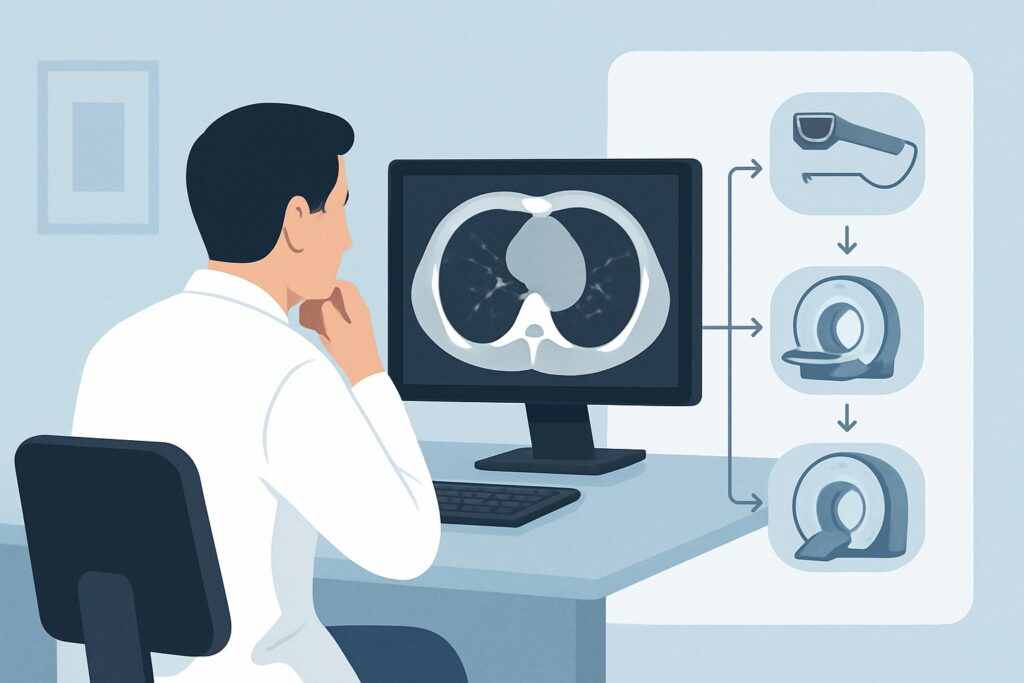
It’s late in the afternoon when the radiologist calls about the chest CT you ordered to rule out a pulmonary embolism. The good news: no PE. The unexpected news: an incidental, indeterminate 4 cm mass in the anterior mediastinum. The report notes it is ovoid and homogeneous but lacks definitive features of a simple cyst, fat, or calcification. Now, you face a critical decision: how do you safely and effectively characterize this finding to guide the next steps in patient care? This article provides a detailed clinical workflow for this exact scenario, explaining why the American College of Radiology (ACR) rates `MRI chest without and with IV contrast` as ‘Usually Appropriate’ for the workup of an indeterminate mediastinal mass found on CT.
Who Fits This Clinical Scenario for a Mediastinal Mass?
This guidance is for a specific, common clinical situation: a patient who has already undergone a computed tomography (CT) scan of the chest, which has revealed a mediastinal mass whose nature cannot be definitively determined from the CT images alone. The term “indeterminate” is key; it implies the mass lacks pathognomonic features (like macroscopic fat in a teratoma or simple fluid attenuation in a bronchogenic cyst) that would allow for a confident diagnosis.
This workflow applies if:
- A CT scan (with or without contrast) is the preceding imaging study.
- The mass is located in the anterior, middle, or posterior mediastinum.
- The CT findings are insufficient to confidently diagnose or dismiss the mass as benign.
This guidance does not apply if:
- The patient has not yet had any imaging. If you have a clinical suspicion of a mediastinal mass but no imaging, the workup starts differently. That scenario is covered in the ACR variant, “Clinically suspected mediastinal mass. Initial imaging.”
- The indeterminate finding was on a chest radiograph (X-ray). An indeterminate mass on a radiograph is a distinct clinical problem. The next step is almost always a CT for initial characterization, which is addressed in the variant, “Indeterminate mediastinal mass on radiography. Next imaging study.”
- The mass has definitive features on CT. If the CT clearly shows a simple pericardial cyst or a fat-containing thymolipoma, further advanced imaging for characterization may be unnecessary.
What Diagnoses Are You Working Up in This Scenario?
When a mediastinal mass is indeterminate on CT, the goal of the next imaging study is to narrow a broad differential diagnosis. The location of the mass (anterior, middle, or posterior mediastinum) is the primary clue, but significant overlap exists. The next study aims to identify tissue characteristics that CT cannot resolve.
Thymoma and Other Thymic Neoplasms: The thymus is the most common site of primary tumors in the anterior mediastinum in adults. Thymoma, thymic carcinoma, and thymic cysts are key considerations. MRI is particularly adept at evaluating the internal architecture of the thymus and assessing for a discrete mass versus diffuse hyperplasia, as well as looking for invasion of adjacent structures, a critical factor in management.
Lymphoma: Both Hodgkin and non-Hodgkin lymphoma frequently present with mediastinal masses, often in the anterior or middle compartments. While CT can show bulky adenopathy, MRI’s superior soft-tissue contrast can help differentiate matted nodes from a single confluent mass and better delineate the relationship with the great vessels, pericardium, and airways without ionizing radiation.
Germ Cell Tumors: Most common in young adults, these tumors (including teratomas, seminomas, and nonseminomatous types) are a primary concern for anterior mediastinal masses. MRI is exceptionally sensitive for detecting small amounts of macroscopic fat, which is diagnostic for a mature teratoma. It can also clearly define the cystic and solid components that are characteristic of these complex lesions.
Neurogenic Tumors: These are the most common masses of the posterior mediastinum, arising from nerve sheaths (schwannomas, neurofibromas) or ganglia (ganglioneuromas). MRI is the premier modality for evaluating these lesions, as it can clearly show their origin from a neural foramen and their relationship to the spinal cord and nerve roots.
Foregut Duplication Cysts: These congenital lesions, such as bronchogenic or esophageal duplication cysts, can appear as indeterminate soft-tissue masses on CT if their contents are proteinaceous. MRI can confirm their cystic nature by showing high signal intensity on T2-weighted images, often establishing a definitive benign diagnosis and preventing the need for biopsy.
Why Is MRI of the Chest the Recommended Study for This Presentation?
For an indeterminate mediastinal mass first identified on CT, the ACR Appropriateness Criteria designates `MRI chest without and with IV contrast` as ‘Usually Appropriate’. This recommendation is based on MRI’s unique ability to characterize tissue beyond the density measurements offered by CT.
The primary advantage of MRI is its superior soft-tissue contrast resolution. It can reliably distinguish between cystic and solid tissues, identify fat and hemorrhage, and visualize the internal architecture of a mass. For example, the high T2 signal of a bronchogenic cyst or the presence of fat within a teratoma are often definitive findings on MRI but ambiguous on CT. Furthermore, dynamic contrast-enhanced MRI can provide information about a lesion’s vascularity, helping to differentiate benign from potentially malignant processes.
Another key benefit is the absence of ionizing radiation (adult radiation relative level: O 0 mSv). This is especially important for younger patients and for any patient who may require future surveillance imaging. MRI’s ability to acquire images in any plane (axial, coronal, sagittal) without reconstruction is also crucial for assessing invasion into adjacent structures like the pericardium, chest wall, or great vessels.
Why are other studies rated lower for this specific scenario?
- FDG-PET/CT skull base to mid-thigh is rated ‘May be appropriate’. While indispensable for staging known malignancies, it is not the ideal next step for initial characterization. Its spatial resolution is lower than MRI’s, making it less effective for detailed local assessment. Furthermore, many benign and inflammatory conditions can be FDG-avid, leading to false positives. It also involves a significant radiation dose (adult RRL: ☢☢☢☢ 10-30 mSv).
- Image-guided transthoracic needle biopsy is also rated ‘May be appropriate’. While tissue is the ultimate answer, imaging characterization should precede biopsy whenever possible. A non-invasive diagnosis (e.g., confirming a teratoma or simple cyst with MRI) avoids procedural risks. Additionally, biopsy of certain tumors, like thymoma, can risk needle-tract seeding, and a pre-biopsy MRI provides a crucial roadmap for the interventionalist or surgeon.
- US chest and Radiography chest are rated ‘Usually not appropriate’ as they offer no additional characterization beyond the initial CT and are therefore not helpful in this context.
What’s Next After MRI? Downstream Workflow
The results of the chest MRI will guide the subsequent management plan, which typically branches into three main pathways: definitive diagnosis, persistent indeterminacy, or negative findings.
If the MRI provides a definitive benign diagnosis: If the MRI confidently identifies the mass as a simple foregut duplication cyst, a fat-containing teratoma, or typical thymic hyperplasia, further workup is often unnecessary. Depending on the specific finding and patient symptoms, the next step is typically clinical observation or surveillance imaging at a longer interval. This is a major success of the workflow, as it avoids invasive procedures for a benign condition.
If the MRI suggests a likely malignancy: If the findings are highly suspicious for a malignancy such as a thymoma, thymic carcinoma, lymphoma, or malignant germ cell tumor (e.g., a solid, enhancing mass showing local invasion), the next step is typically to obtain a tissue diagnosis. This may involve a CT-guided core needle biopsy, mediastinoscopy, or surgical excision (which can be both diagnostic and therapeutic). The MRI findings are critical for planning the safest and most effective approach to biopsy.
If the MRI is indeterminate or equivocal: In some cases, even MRI cannot provide a definitive answer. The mass may have nonspecific features that could represent several different pathologies. In this situation, the decision-making becomes more complex. The next step often involves a multidisciplinary discussion between radiology, pulmonology, and thoracic surgery. Options include proceeding to an `Image-guided transthoracic needle biopsy` (rated ‘May be appropriate’), using `FDG-PET/CT` to assess for metabolic activity (also ‘May be appropriate’), or in some cases, short-term interval MRI surveillance. This scenario may also route to the ACR variant, “Indeterminate mediastinal mass on MRI. Next imaging study or surveillance.”
Pitfalls to Avoid (and When to Get Help)
Navigating the workup of a mediastinal mass requires careful attention to detail to avoid common errors.
- Pitfall 1: Ordering a repeat CT. Unless assessing for interval growth, ordering another contrast-enhanced CT is unlikely to provide more characterization than the first and will only add unnecessary radiation exposure. The next step for characterization is a different modality.
- Pitfall 2: Rushing to biopsy without full characterization. Biopsying a lesion that could be diagnosed non-invasively with MRI exposes the patient to needless risk. A pre-biopsy MRI provides a critical roadmap and can sometimes obviate the need for a procedure entirely.
- Pitfall 3: Forgetting contrast for the MRI. While a non-contrast MRI can be helpful, the ‘Usually Appropriate’ recommendation is for an MRI `without and with IV contrast`. The enhancement pattern provides vital information about vascularity and can help differentiate solid tissue from complex fluid or necrosis.
- Pitfall 4: Misinterpreting normal thymus. In young patients, the thymus can be large and active, mimicking a mass. An experienced thoracic radiologist can often recognize the morphology of a normal thymus, avoiding an unnecessary workup.
If the MRI report is equivocal or the clinical picture is complex, escalation to a multidisciplinary tumor board or a direct consultation with a thoracic surgeon is the appropriate next step.
Related ACR Topics and Tools
This article focuses on a single decision point. For a comprehensive overview of the entire topic, related scenarios, and useful tools for ordering and interpreting imaging, the following resources are valuable.
- For breadth across all scenarios in Imaging of Mediastinal Masses, see our parent guide: Imaging of Mediastinal Masses: ACR Appropriateness Decoded.
- To explore adjacent clinical questions or different patient presentations, use the ACR Appropriateness Criteria Lookup.
- For details on imaging techniques, consult the Imaging Protocol Library.
- To discuss cumulative radiation exposure with patients, the Radiation Dose Calculator can help frame the conversation.
Frequently Asked Questions
Should I order the chest MRI with or without contrast?
The American College of Radiology (ACR) recommends ‘MRI chest without and with IV contrast’ as ‘Usually Appropriate’. The pre-contrast images (especially T1- and T2-weighted sequences) are essential for basic tissue characterization, like identifying fat or cystic fluid. The post-contrast images provide crucial information about a mass’s vascularity and can help differentiate solid enhancing tumor from non-enhancing necrosis or cyst, and better delineate invasion.
What if my patient cannot get an MRI due to a pacemaker or severe claustrophobia?
This is a common clinical challenge. If MRI is contraindicated, the next best option depends on the specific case and should be decided in consultation with a radiologist. An FDG-PET/CT, rated ‘May be appropriate’, could be considered to assess for metabolic activity, which may help risk-stratify the lesion. In other cases, proceeding directly to an image-guided biopsy may be the most direct path to a diagnosis. The choice depends on the pre-test probability of malignancy and the patient’s overall clinical status.
Is there a role for a non-contrast chest CT if the first one was done with contrast?
Generally, no. A non-contrast CT after a contrast-enhanced CT is unlikely to provide new information for tissue characterization. Its primary role would be to confirm the presence of macroscopic fat or dense calcification if this was obscured by contrast on the initial scan, but MRI is far more sensitive for identifying fat and provides superior overall soft-tissue detail without additional radiation.
How does the location of the mass (anterior vs. posterior) change the recommendation?
While the differential diagnosis changes significantly with location (e.g., thymoma anteriorly, neurogenic tumor posteriorly), the recommended next imaging study for an indeterminate mass on CT remains the same. MRI is the best modality for characterizing soft-tissue masses in any mediastinal compartment. It is equally effective at evaluating thymic tissue in the anterior mediastinum as it is at assessing a potential schwannoma’s relationship to the neural foramen in the posterior mediastinum.
If the mass is small (e.g., 1-2 cm), is MRI still the best next step?
Yes, size does not change the fundamental problem of indeterminacy. A small indeterminate mass still requires characterization. In fact, MRI’s high spatial and contrast resolution is particularly valuable for evaluating small lesions, which can be difficult to assess on CT. For very small, smooth, ovoid nodules that are likely lymph nodes, a short-term follow-up CT might be considered, but for a true indeterminate mass, MRI remains the recommended next step for characterization.
Reviewed by Pouyan Golshani, MD, Interventional Radiologist — May 29, 2026