What Is the Best Initial Imaging for Suspected Occupational Airway Disease?
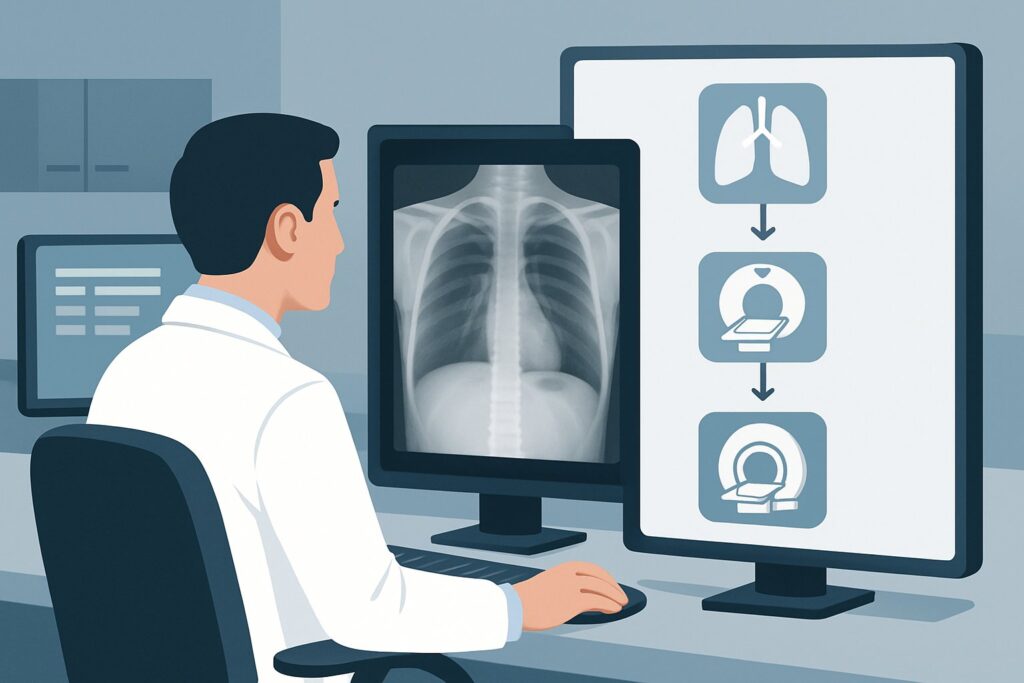
A 45-year-old man, a non-smoker who has worked in a coffee roasting facility for 15 years, presents to your clinic with a persistent dry cough and progressive shortness of breath on exertion. He reports intermittent wheezing. His occupational history is significant for exposure to diacetyl and other volatile organic compounds. You suspect an occupational airway disease, such as constrictive bronchiolitis, but need to rule out other pathologies. This raises the immediate clinical question: what is the most appropriate initial imaging study to order? For this specific scenario of suspected occupational airway disease, the American College of Radiology (ACR) designates `Radiography chest` as a Usually Appropriate initial step.
Who Fits This Clinical Scenario?
This guidance applies to adult patients with a known or suspected history of occupational exposure to inhalants (dusts, gases, fumes, vapors) who present with symptoms suggestive of airway-centric disease. Key symptoms include chronic cough, wheezing, sputum production, and dyspnea. The clinical picture points toward conditions like occupational asthma, industrial bronchitis, or bronchiolitis, rather than a primary interstitial process.
This workflow is distinct from several related clinical situations:
- Asymptomatic Screening: This guidance is for symptomatic patients. For an asymptomatic worker with known exposure who requires routine monitoring, the workup falls under the Occupational exposure, screening, and surveillance scenario.
- Suspected Interstitial Lung Disease (ILD): If the patient’s exam reveals fine inspiratory crackles (“Velcro rales”) or pulmonary function tests (PFTs) show a restrictive pattern, the primary concern shifts to ILD (e.g., asbestosis, silicosis). That presentation follows the suspected interstitial lung disease pathway.
- Known Disease with Suspected Cancer: If a patient has a pre-existing, confirmed occupational lung disease and develops new symptoms like hemoptysis or weight loss concerning for a neoplasm, a different imaging strategy is required.
The focus here is strictly on the initial imaging for a new presentation where the primary suspicion is disease of the bronchi and bronchioles due to workplace exposure.
What Diagnoses Are You Working Up in This Scenario?
The initial imaging choice is driven by a differential diagnosis centered on airway pathology, while also considering common mimics. The goal is to find evidence of airway disease and, just as importantly, to exclude other causes for the patient’s symptoms.
Occupational Asthma: This is one of the most common forms of occupational lung disease, caused by sensitization to an agent in the workplace. It leads to airway inflammation, hyperresponsiveness, and variable airflow obstruction. Chest radiographs are frequently normal but are essential to exclude other diagnoses that can present with cough and wheezing, such as infection or heart failure.
Industrial Bronchitis (or Occupational COPD): Chronic exposure to irritant dusts, fumes, or gases can cause chronic inflammation of the larger airways, clinically indistinguishable from smoking-related chronic bronchitis. Radiography may show signs of hyperinflation, flattened diaphragms, or bronchial wall thickening, similar to findings in COPD.
Constrictive Bronchiolitis (Bronchiolitis Obliterans): A less common but severe and often irreversible fibrotic process affecting the small airways. It is associated with specific exposures, such as diacetyl in food flavorings (“popcorn lung”), sulfur dioxide, or ammonia. The chest radiograph can be deceptively normal, especially in early stages, but may show subtle hyperinflation or peripheral attenuation of vascular markings. Its primary role is to rule out mimics before proceeding to more advanced imaging.
Hypersensitivity Pneumonitis (HP): While often classified as an interstitial lung disease, the subacute form of HP can have prominent small airway involvement, presenting with cough and dyspnea. Initial radiography may show subtle ground-glass opacities or centrilobular nodules, but can also be normal.
Why Is Chest Radiography the Recommended Initial Study?
In a patient with suspected occupational airway disease, the ACR panel rates `Radiography chest` as Usually Appropriate. This recommendation is based on an optimal balance of diagnostic utility, accessibility, and safety for an initial evaluation.
The primary strength of a chest radiograph in this context is its role as a screening and exclusion tool. It provides a broad overview of the thorax, capable of identifying significant alternative causes for the patient’s symptoms, such as pneumonia, cardiogenic pulmonary edema, a large central mass, or significant pleural effusion. For the primary differential, it can reveal supportive, albeit often non-specific, signs like bronchial wall thickening, hyperinflation, or mucus plugging. Given its extremely low radiation dose (☢ <0.1 mSv), it is the ideal first-line test.
While `CT chest without IV contrast` is also rated Usually Appropriate, it is not the preferred initial study. A non-contrast CT, particularly with a high-resolution computed tomography (HRCT) protocol, is far more sensitive for subtle airway changes like bronchial wall thickening, bronchiectasis, and air trapping (when expiratory images are obtained). However, it delivers a significantly higher radiation dose (☢☢☢ 1-10 mSv) and is best reserved as a second-line test if the initial radiograph is negative or equivocal but clinical suspicion remains high.
Other imaging modalities are rated lower for this initial workup:
- CT chest with IV contrast is rated Usually Not Appropriate. The addition of intravenous contrast provides no significant benefit for evaluating the airways or lung parenchyma for this indication. It needlessly exposes the patient to the risks of contrast media (e.g., allergic reaction, contrast-induced nephropathy) and does not improve diagnostic yield for occupational airway disease.
- MRI chest is also Usually Not Appropriate. While it avoids ionizing radiation, MRI has lower spatial resolution for the lung parenchyma and airways compared to CT and is highly susceptible to motion artifact from breathing and cardiac motion, making it unsuitable for this primary evaluation.
What’s Next After Chest Radiography? Downstream Workflow
The results of the initial chest radiograph guide the subsequent diagnostic pathway. The workflow is not linear and must be integrated with clinical findings and pulmonary function testing (PFTs).
If the Radiograph is Negative: A normal chest X-ray is a very common finding, especially in early or mild occupational airway disease like asthma or constrictive bronchiolitis. It does not rule out pathology. If symptoms persist and clinical suspicion is high, the next steps should include comprehensive PFTs with bronchodilator response. If PFTs show an obstructive or mixed pattern, or if constrictive bronchiolitis is strongly suspected, the next logical imaging step is a `CT chest without IV contrast`, specifically an HRCT protocol that includes both inspiratory and expiratory images to assess for air trapping.
If the Radiograph is Positive for Airway Disease: Findings like hyperinflation or bronchial wall thickening support the clinical diagnosis. These findings should be correlated with PFTs to confirm and quantify airflow obstruction. An HRCT may still be valuable to better characterize the extent and nature of the disease (e.g., to differentiate emphysema from small airway disease) and establish a baseline for future comparison.
If the Radiograph Shows an Unexpected Finding: An incidental finding, such as a solitary pulmonary nodule, focal opacity, or evidence of interstitial lung disease, changes the direction of the workup. A nodule may prompt a workup for malignancy, which would align with the ACR scenario for a suspected thoracic neoplasm. Findings of reticulation or honeycombing would shift the focus to a workup for ILD, potentially requiring a follow-up HRCT as outlined in the suspected interstitial lung disease based on radiography variant.
Pitfalls to Avoid (and When to Get Help)
Navigating the workup for suspected occupational airway disease requires careful integration of history, physical exam, and diagnostic tests. Here are a few common pitfalls to avoid:
- Dismissing a Normal Radiograph: The most significant pitfall is stopping the workup after a normal chest X-ray. Many serious occupational airway diseases, particularly constrictive bronchiolitis, have normal radiographs early in their course.
- Omitting Expiratory Scans on Follow-up CT: When ordering a follow-up HRCT for suspected small airway disease, failing to specifically request expiratory phase imaging is a missed opportunity. Air trapping is a key diagnostic sign that is only visible on expiratory scans.
- Defaulting to Contrast-Enhanced CT: Ordering a “routine” chest CT with IV contrast is unnecessary for this indication and adds avoidable risk and cost. The workhorse study is a non-contrast HRCT.
If a patient presents with rapid clinical decline, new-onset hypoxemia, or systemic symptoms, immediate consultation with a pulmonologist is warranted.
Related ACR Topics and Tools
This article covers a single, specific clinical scenario. For a comprehensive overview of imaging for all related presentations, from screening to suspected ILD and malignancy, please refer to our parent guide. The following GigHz tools can also assist in your clinical workflow.
- For breadth across all scenarios in Occupational Lung Diseases, see our parent guide: Occupational Lung Diseases: ACR Appropriateness Decoded.
- ACR Appropriateness Criteria Lookup — for adjacent scenarios
- Imaging Protocol Library — for technique on the recommended study
- Radiation Dose Calculator — for cumulative dose conversations
Frequently Asked Questions
Why is a chest radiograph recommended over a CT scan initially, even though CT is more sensitive?
A chest radiograph is the recommended initial study because it provides an excellent balance of diagnostic information, low radiation dose (less than 0.1 mSv), and wide availability. It is effective at ruling out major alternative diagnoses like pneumonia or heart failure. While a non-contrast CT is more sensitive for subtle airway changes, it carries a higher radiation dose (1-10 mSv) and is best used as a second-line test when the radiograph is unrevealing but clinical suspicion remains high.
If my patient’s chest X-ray is normal, does that rule out occupational airway disease?
No, a normal chest radiograph absolutely does not rule out occupational airway disease. Conditions like occupational asthma and early-stage constrictive bronchiolitis frequently present with normal initial radiographs. If clinical suspicion persists based on symptoms and exposure history, the next steps should include pulmonary function tests (PFTs) and potentially a high-resolution CT (HRCT) with expiratory views.
When should I order a chest CT with intravenous contrast in this setting?
For the initial evaluation of suspected occupational airway disease, a CT with IV contrast is rated ‘Usually Not Appropriate’ by the ACR. Contrast is not needed to visualize the airways or lung parenchyma. It should only be considered if there is a specific co-existing concern, such as suspected pulmonary embolism, aortic dissection, or evaluation of a mediastinal mass, which are separate clinical questions.
How does the workup differ if I suspect interstitial lung disease (ILD) instead of airway disease?
If the clinical presentation (e.g., fine crackles on exam, restrictive pattern on PFTs) points toward ILD like asbestosis or silicosis, the imaging pathway is different. While a chest radiograph is still the appropriate first step, the threshold to proceed to a non-contrast HRCT is much lower, as HRCT is the gold standard for characterizing interstitial patterns. This falls under a different ACR Appropriateness Criteria scenario.
What specific information should I include when ordering a follow-up CT scan?
When ordering a follow-up CT for suspected occupational airway disease, specify ‘High-Resolution Chest CT (HRCT) without IV contrast.’ Crucially, you should also request ‘inspiratory and expiratory phase imaging’ to allow the radiologist to assess for air trapping, a key indicator of small airway disease.
Reviewed by Pouyan Golshani, MD, Interventional Radiologist — May 29, 2026