What Is the Right Initial Imaging for a Palpable, Euthyroid Thyroid Nodule?
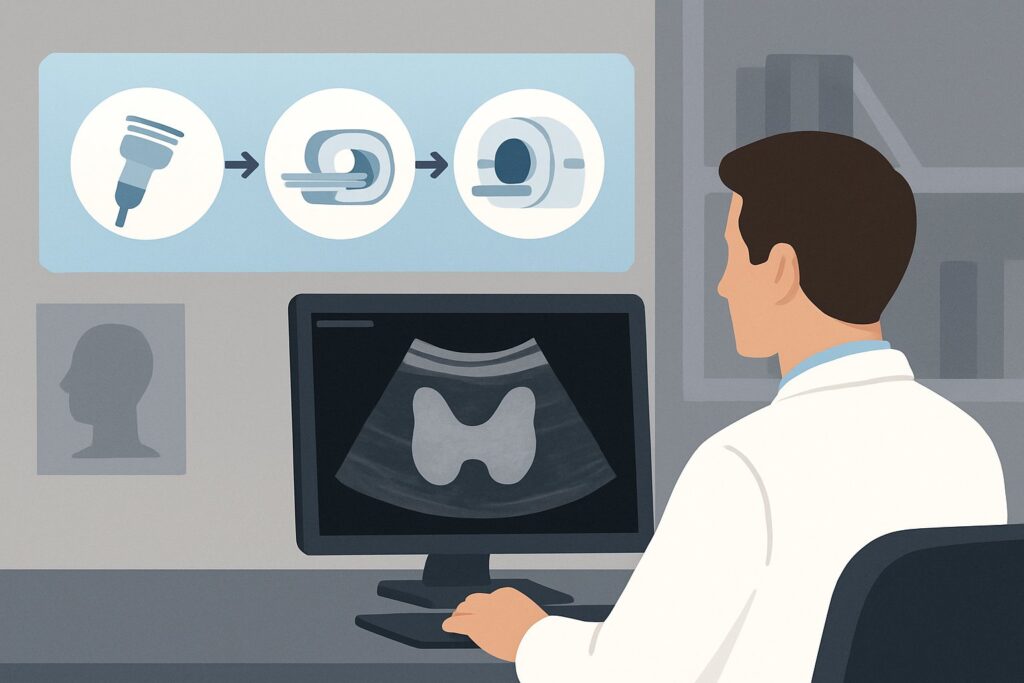
A 45-year-old woman presents to your clinic after discovering a small, firm lump in the front of her neck during a self-exam. She is asymptomatic otherwise. On physical examination, you confirm a palpable, non-tender, mobile 1.5 cm nodule in the right lobe of her thyroid. The rest of the gland feels normal, and there is no cervical lymphadenopathy. Her thyroid-stimulating hormone (TSH) level, ordered last week, is within the normal range. You now face the critical decision of selecting the appropriate initial imaging study to characterize this nodule and guide further management. This article provides a focused, evidence-based workflow for this specific clinical scenario. For the initial imaging of a palpable, euthyroid thyroid nodule, the American College of Radiology (ACR) rates US thyroid as Usually Appropriate.
Who Fits This Clinical Scenario for a Palpable Thyroid Nodule?
This guidance is specifically tailored for patients presenting with a palpable thyroid nodule as the primary finding. The key inclusion criteria are:
- A Palpable Nodule: The nodule was detected by the patient or a clinician on physical examination. This workflow does not apply to incidental nodules found on other imaging studies (incidentalomas).
- Euthyroid Status: The patient has a normal TSH level, indicating normal thyroid gland function.
- No Goiter: The thyroid gland is not diffusely enlarged. The finding is a discrete nodule, not a generalized swelling of the entire gland.
- Initial Imaging: This is the first imaging study being ordered for this specific clinical problem.
It is crucial to distinguish this presentation from similar but distinct clinical situations that require different diagnostic pathways. This guidance should not be applied if:
- The patient has abnormal TSH levels: A low TSH suggests thyrotoxicosis, while a high TSH indicates hypothyroidism. These scenarios have their own dedicated ACR Appropriateness Criteria variants.
- The patient has a diffusely enlarged gland: A palpable goiter, with or without discrete nodules, represents a different clinical question.
- The patient has a known history of thyroid cancer: This would be considered a workup for suspected recurrence or surveillance, not an initial evaluation.
What Diagnoses Are You Working Up with a Palpable Thyroid Nodule?
The primary goal of imaging in this scenario is to stratify the risk of malignancy and determine the need for tissue sampling. While the vast majority of thyroid nodules are benign, a small but significant portion are cancerous, making accurate characterization essential.
The differential diagnosis includes:
Benign Colloid Nodule or Follicular Adenoma: This is by far the most common cause of a palpable thyroid nodule. These represent benign growths of thyroid tissue and colloid. While they can grow large enough to be felt, they pose no risk of metastasis. Ultrasound is highly effective at identifying features strongly suggestive of benignity.
Thyroid Cyst: These fluid-filled sacs within the thyroid are also very common. Simple cysts are almost always benign. Complex cysts, which contain both solid and fluid components, carry a very low risk of malignancy and can be accurately assessed with ultrasound.
Thyroid Carcinoma: This is the most consequential diagnosis to exclude. Papillary thyroid carcinoma is the most common type, followed by follicular carcinoma. Ultrasound is the cornerstone for identifying suspicious features such as microcalcifications, irregular margins, a “taller-than-wide” shape, and internal vascularity, which increase the likelihood of cancer and warrant fine-needle aspiration (FNA).
Thyroiditis (e.g., Hashimoto’s Thyroiditis): While often associated with hypothyroidism and goiter, focal or nodular thyroiditis can present as a discrete nodule in a euthyroid patient. Ultrasound can show characteristic background changes in the thyroid parenchyma that suggest this diagnosis.
Why Is Thyroid Ultrasound the Recommended Initial Study for This Nodule?
The ACR designates US thyroid as Usually Appropriate for this presentation because it is the most effective, safest, and most cost-effective tool for the initial characterization of a thyroid nodule. It directly addresses the key clinical question: which nodules require a biopsy?
The rationale for its top rating is multifaceted:
- Superior Nodule Characterization: Ultrasound provides unparalleled soft-tissue resolution of the thyroid gland. It can precisely define a nodule’s size, location, and composition (solid, cystic, or mixed). Most importantly, it can identify specific sonographic features that are highly predictive of malignancy. These features form the basis of the ACR Thyroid Imaging, Reporting and Data System (TI-RADS), a standardized method for risk stratification that guides recommendations for FNA.
- Safety and Accessibility: Thyroid ultrasound involves no ionizing radiation (adult and pediatric relative radiation level: O 0 mSv). It does not require intravenous contrast, avoiding any risk of allergic reaction or contrast-induced nephropathy. The procedure is widely available, non-invasive, and well-tolerated by patients.
- Guidance for Intervention: If a nodule is deemed suspicious based on its ultrasound appearance, the same modality is used to provide real-time guidance for FNA, ensuring an accurate and safe biopsy.
Alternative imaging modalities are rated lower for this specific initial workup:
- CT Neck (with or without IV contrast): Rated May be appropriate. While CT can identify a thyroid nodule and assess for local invasion or extensive lymphadenopathy, it exposes the patient to ionizing radiation (RRL: ☢☢☢ 1-10 mSv) and has significantly lower resolution for intra-nodular characteristics compared to ultrasound. It cannot reliably distinguish benign from suspicious features and is therefore not the appropriate first-line tool for characterization.
- Nuclear Medicine Scans (e.g., I-123 uptake scan): Rated Usually not appropriate in a euthyroid patient. These scans assess nodule function (“hot” vs. “cold”). While this is the primary imaging modality for a patient with a nodule and a low TSH (thyrotoxicosis), it provides little value in a euthyroid patient, as the vast majority of nodules will be “cold” or “indeterminate,” a finding that includes both benign and malignant lesions.
Once you’ve decided on the top-rated procedure, our protocol guide covers the technique, reporting standards, and clinical pearls for interpretation. US Thyroid.
What’s Next After US thyroid? Downstream Workflow
The results of the thyroid ultrasound will dictate the next steps in management, typically by applying the ACR TI-RADS classification.
- If the Nodule is Benign-Appearing (TI-RADS 1 or 2): For nodules that are purely cystic (TR1) or spongiform (TR2), the risk of malignancy is essentially zero. No FNA is recommended, and follow-up is often not required unless the nodule is large or symptomatic. The patient can be reassured.
- If the Nodule is Low to Moderately Suspicious (TI-RADS 3 or 4): For nodules with low or moderate suspicion, the decision to biopsy depends on size. For example, a TR3 nodule (e.g., an isoechoic solid nodule) is typically biopsied only if it is ≥2.5 cm, while a TR4 nodule (e.g., a solid hypoechoic nodule) is biopsied if it is ≥1.5 cm. Nodules below these size thresholds are usually followed with serial ultrasounds.
- If the Nodule is Highly Suspicious (TI-RADS 5): Nodules with one or more highly suspicious features (e.g., irregular margins, microcalcifications, taller-than-wide shape) carry a significant risk of malignancy. FNA is recommended for these nodules if they are ≥1.0 cm.
- If the Ultrasound is Negative: If ultrasound confirms the palpable finding is not a discrete thyroid nodule but rather normal asymmetric thyroid tissue or a non-thyroidal structure (like a lymph node), the workup may proceed down a different pathway depending on the alternative finding.
The ultimate goal is to selectively perform FNA on nodules with a meaningful risk of cancer, avoiding unnecessary procedures on the large number of benign nodules.
Pitfalls to Avoid (and When to Get Help)
Navigating the workup of a palpable thyroid nodule requires careful attention to detail. Common pitfalls include:
- Ordering the Wrong Initial Test: Ordering a CT or nuclear medicine scan as the first imaging step for a euthyroid patient is inefficient, exposes the patient to unnecessary radiation, and will ultimately still require an ultrasound for definitive characterization.
- Ignoring the TSH Level: Failing to confirm euthyroid status before imaging can lead to a misdirected workup. A low TSH fundamentally changes the algorithm, making a radionuclide scan the appropriate next step.
- Biopsying Based on Size Alone: Modern guidelines strongly recommend against biopsying nodules based solely on size. The decision should be driven by sonographic features and risk stratification (TI-RADS).
- Misinterpreting a Palpable Finding: Not all neck lumps are thyroid nodules. Ultrasound is critical for confirming the thyroidal origin of a palpable mass and distinguishing it from lymphadenopathy, parathyroid adenomas, or other cervical structures.
If the ultrasound reveals extensive disease, evidence of extra-thyroidal extension, or bulky suspicious lymph nodes, it is appropriate to escalate care promptly to an endocrinologist or surgeon for expedited evaluation.
Related ACR Topics and Tools
This article focuses on one specific clinical scenario. For a comprehensive overview of imaging across all common thyroid-related presentations, from goiter to thyrotoxicosis, please refer to our parent guide.
- For breadth across all scenarios in Thyroid Disease, see our parent guide: Thyroid Disease: ACR Appropriateness Decoded.
To explore adjacent scenarios, compare imaging techniques, or discuss radiation dose with your patients, these GigHz resources can help:
Frequently Asked Questions
What if the palpable nodule was found in a patient with a low TSH (hyperthyroidism)?
That is a different clinical scenario. If the TSH is low, the primary concern is a hyperfunctioning (‘hot’) nodule. The ACR-recommended next step is a nuclear medicine thyroid uptake and scan (typically with I-123), not an ultrasound. This determines if the nodule is the source of the excess thyroid hormone.
Does the recommendation for thyroid ultrasound change if the patient is pregnant?
No, the recommendation remains the same. Thyroid ultrasound is the ideal imaging modality during pregnancy because it uses no ionizing radiation and is completely safe for both the mother and the fetus. The workup of a thyroid nodule discovered during pregnancy generally follows the same principles.
Should I order a CT scan of the neck to look for lymph node metastasis at the same time as the ultrasound?
No, a CT scan is not recommended for the initial evaluation. Ultrasound is excellent for evaluating the cervical lymph node chains for suspicious features. A CT scan is typically reserved for preoperative staging in cases of biopsy-proven, locally advanced thyroid cancer, but it is not the first-line imaging test.
The patient is very anxious about cancer. Can I just order a PET/CT scan to be sure?
FDG-PET/CT is rated ‘Usually not appropriate’ for this scenario. It has a high rate of false positives for thyroid nodules (many benign nodules are metabolically active) and exposes the patient to significant radiation (RRL: ☢☢☢☢ 10-30 mSv). Its use is reserved for specific situations in advanced or recurrent thyroid cancer, not for initial diagnosis.
What is ACR TI-RADS and do I need to specify it on my order?
ACR TI-RADS (Thyroid Imaging, Reporting and Data System) is a standardized system radiologists use to classify thyroid nodules on ultrasound based on suspicious features. You do not need to specify it on the order, but you should expect the radiology report to include a TI-RADS score (from TR1 for benign to TR5 for highly suspicious), which will provide a clear recommendation for whether to perform a fine-needle aspiration (FNA) or follow-up imaging.
Reviewed by Pouyan Golshani, MD, Interventional Radiologist — May 29, 2026