Which Imaging Is Best for Anomalous Pulmonary Veins After an Inconclusive Echocardiogram?
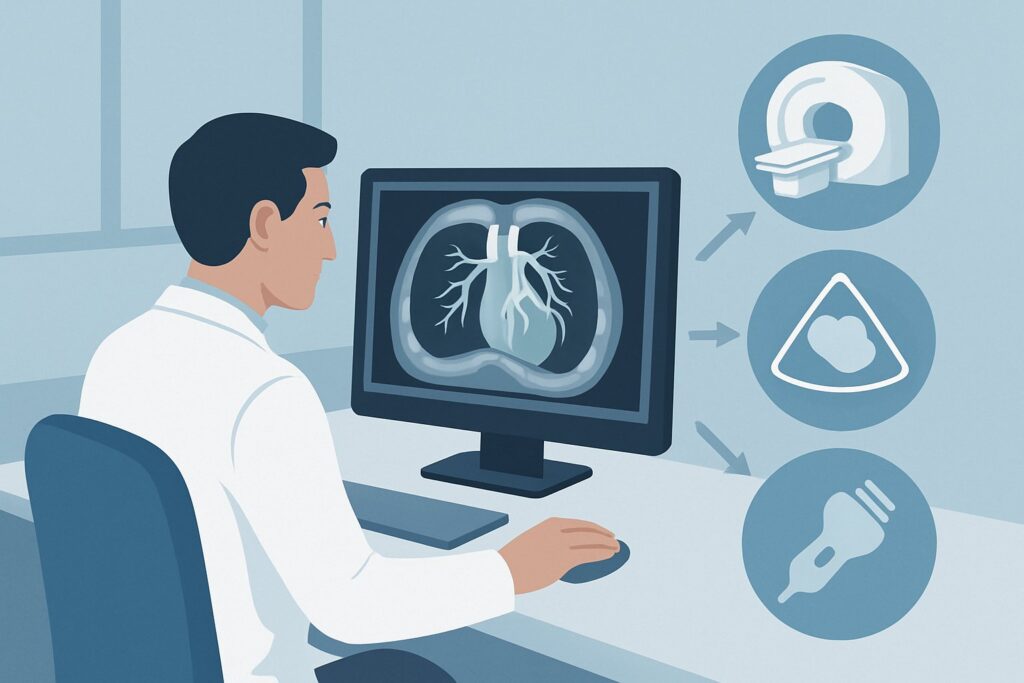
A cardiologist reviews the transthoracic echocardiogram (TTE) of a 42-year-old patient referred for unexplained dyspnea and right ventricular enlargement. The acoustic windows are suboptimal, a common challenge in adult patients. While an atrial septal defect is suspected, the full course of all four pulmonary veins cannot be confidently traced back to the left atrium. The clinical suspicion for partial anomalous pulmonary venous return (PAPVR) is now high, but the TTE is inadequate for a definitive diagnosis or surgical planning. What is the most appropriate next imaging study to order?
This article provides a detailed clinical workflow for this specific scenario, based on the American College of Radiology (ACR) Appropriateness Criteria. For a patient with known or suspected anomalous pulmonary venous return and an inadequate TTE, the ACR rates MRA chest without and with IV contrast as Usually Appropriate.
Who Fits This Clinical Scenario for Anomalous Pulmonary Venous Return?
This guidance applies to a specific patient population, both children and adults, where the central clinical question is the anatomy of the pulmonary venous drainage.
Inclusion Criteria:
- Clinical Suspicion: The patient has signs or symptoms suggestive of anomalous pulmonary venous return, such as unexplained right heart enlargement, atrial septal defect (especially sinus venosus type), or cyanosis.
- Inadequate Echocardiogram: A prior transthoracic echocardiogram (TTE) was performed but failed to definitively visualize the drainage of all four pulmonary veins into the left atrium. This inadequacy may be due to poor acoustic windows, complex anatomy, or other technical limitations.
- Known but Incompletely Characterized Anomaly: The patient has a known diagnosis of anomalous pulmonary venous return, but detailed anatomical information required for management or procedural planning is missing.
Exclusion Criteria (These patients follow different ACR guidelines):
- Repaired Tetralogy of Fallot: If the primary clinical concern is pulmonary valve dysfunction or right ventricular outflow tract obstruction after a Tetralogy of Fallot repair, that specific scenario has its own distinct imaging pathway.
- Post-Switch Transposition of the Great Arteries: Patients who have undergone an atrial or arterial switch procedure for transposition of the great arteries require evaluation focused on baffle leaks, pathway obstruction, or coronary artery issues, which are addressed in separate guidelines.
- Single Ventricle Physiology: Preoperative planning for stage 2 or 3 single ventricle palliation (e.g., Glenn or Fontan procedures) involves a unique set of imaging requirements that are not covered by this workflow.
What Diagnoses Are You Working Up in This Scenario?
When a TTE is inconclusive, advanced imaging is used to confirm or exclude several key diagnoses related to pulmonary venous anatomy. The goal is to create a complete three-dimensional map of the patient’s cardiopulmonary circulation.
Partial Anomalous Pulmonary Venous Return (PAPVR)
This is the most common form of anomalous pulmonary venous return, particularly when first diagnosed in adulthood. In PAPVR, one or more (but not all) of the pulmonary veins drain into the systemic venous circulation—such as the superior vena cava, brachiocephalic vein, or right atrium—instead of the left atrium. This creates a left-to-right shunt. PAPVR is frequently associated with a sinus venosus atrial septal defect, which must also be characterized for complete surgical planning.
Total Anomalous Pulmonary Venous Return (TAPVR)
In this more severe condition, none of the pulmonary veins connect to the left atrium. Instead, they form a confluence that drains into the systemic venous system. TAPVR is a cyanotic congenital heart defect that typically presents and is repaired in infancy. However, rare, unobstructed forms can present later in childhood or even adulthood with symptoms of heart failure or pulmonary hypertension.
Scimitar Syndrome
This is a rare and specific variant of PAPVR. It involves the anomalous drainage of the right pulmonary veins into the inferior vena cava. The syndrome is often accompanied by other abnormalities, including hypoplasia of the right lung and dextroposition of the heart. The anomalous vein can sometimes appear on a chest radiograph as a curved shadow resembling a Turkish sword, or scimitar, giving the syndrome its name.
Pulmonary Vein Stenosis
While not an anomaly of connection, pulmonary vein stenosis is a critical related pathology. It involves the narrowing of one or more pulmonary veins, which can be congenital or acquired (e.g., post-radiofrequency ablation for atrial fibrillation). This condition can mimic the hemodynamic consequences of anomalous drainage and may be difficult to assess fully with echocardiography alone.
Why Is MRA of the Chest the Recommended Study for Anomalous Pulmonary Veins?
The ACR designates several imaging modalities as Usually Appropriate for this scenario, but Magnetic Resonance Angiography (MRA) of the chest offers a superior combination of diagnostic accuracy and safety, particularly in younger patients.
The top-rated study, MRA chest without and with IV contrast, is considered Usually Appropriate. Its key advantage is the complete lack of ionizing radiation (0 mSv). This is a critical consideration for children and young adults who may require follow-up imaging over their lifetime. MRA provides excellent soft-tissue contrast, allowing for precise, three-dimensional delineation of the entire course of each pulmonary vein. It can clearly show their connection points—whether to the left atrium or an anomalous systemic site—and accurately characterize associated cardiac defects like atrial septal defects. The addition of intravenous contrast enables time-resolved angiography, which visualizes blood flow and can help quantify the degree of shunting.
Comparing Alternatives:
- CTA chest with IV contrast is also rated Usually Appropriate. It offers exceptional spatial resolution and is significantly faster than MRA, making it a valuable alternative for patients who are unstable or cannot tolerate a long scan. However, its primary drawback is the use of ionizing radiation (ACR Relative Radiation Level ☢☢☢ for adults and ☢☢☢☢ for children). Given that a non-radiation alternative provides equivalent or superior diagnostic information in most stable patients, MRA is generally the preferred first choice.
- Transesophageal echocardiography (TEE) is rated Usually Not Appropriate as the next step. While TEE provides better views of posterior cardiac structures than TTE, it can still have blind spots for extracardiac venous connections (e.g., to the superior vena cava). Furthermore, it is an invasive procedure requiring sedation or anesthesia. Cross-sectional imaging with MRA or CTA provides a more comprehensive and non-invasive map of the entire thoracic vasculature.
When ordering the MRA, it is crucial to communicate the specific clinical question to the radiology team. Specifying “evaluate for anomalous pulmonary venous return” ensures the protocol is tailored to acquire the necessary sequences, including both anatomic and flow-based imaging.
What’s Next After MRA? Downstream Workflow
The results of the MRA will guide the subsequent clinical pathway, which typically involves a multidisciplinary discussion between cardiology, cardiac surgery, and radiology.
- If the MRA is positive for significant anomalous pulmonary venous return: The next step is typically a consultation with a congenital heart surgeon or interventional cardiologist. The detailed anatomical map provided by the MRA is used to determine the feasibility and approach for repair. For PAPVR with a significant left-to-right shunt (Qp:Qs > 1.5:1), surgical correction to reroute the anomalous veins to the left atrium and close any associated ASD is often recommended to prevent long-term right heart failure and pulmonary hypertension.
- If the MRA is negative and all four pulmonary veins are confirmed to drain normally: The workup should be redirected to investigate other causes of the patient’s symptoms or initial echocardiographic findings (e.g., right ventricular enlargement). This may involve further cardiac evaluation for primary pulmonary hypertension, arrhythmogenic right ventricular cardiomyopathy, or other conditions. The clinical scenario may shift to a different ACR variant for further workup.
- If the MRA is indeterminate or reveals unexpected complexity: In rare cases, the findings may be ambiguous, or a highly complex combination of anomalies may be present. The next step could be a cardiac catheterization with angiography. This invasive procedure, rated Usually Not Appropriate as a primary imaging tool, becomes valuable in these complex situations. It can provide direct pressure measurements within the heart chambers and pulmonary arteries, precisely measure shunt fractions, and offer definitive visualization of vascular connections when non-invasive imaging is inconclusive.
Pitfalls to Avoid (and When to Get Help)
Navigating the workup for anomalous pulmonary veins requires careful attention to detail to avoid common diagnostic and management errors.
- Pitfall 1: Assuming a “normal” TTE is definitive. In adults with poor acoustic windows, a TTE can easily miss PAPVR. Maintain a high index of suspicion in patients with unexplained right ventricular dilation or a suspected sinus venosus ASD.
- Pitfall 2: Not considering radiation dose. In children and young adults, defaulting to CTA without first considering MRA exposes the patient to unnecessary ionizing radiation. Always weigh the clinical urgency and patient stability against the long-term risks of radiation.
- Pitfall 3: Incomplete evaluation. The workup is not complete after identifying an anomalous vein. It is essential to search for and characterize associated lesions, most commonly an atrial septal defect, which is present in the vast majority of sinus venosus PAPVR cases.
- Pitfall 4: Misinterpreting a confluence. The pulmonary veins often join to form a confluence before entering the left atrium. This normal anatomy can be mistaken for the confluence seen in TAPVR if its final connection to the left atrium is not clearly visualized.
If the anatomy is complex or the hemodynamic significance is unclear, escalate the case for discussion with a congenital heart disease specialist and a cardiac radiologist.
Related ACR Topics and Tools
For a comprehensive understanding of imaging in congenital and acquired heart disease, and to ensure proper study selection and interpretation, the following resources are valuable:
- For breadth across all scenarios in Congenital or Acquired Heart Disease, see our parent guide: Congenital or Acquired Heart Disease: ACR Appropriateness Decoded.
- To explore adjacent clinical scenarios and their corresponding ACR recommendations, use the ACR Appropriateness Criteria Lookup.
- For detailed technical specifications on how to perform the recommended MRA or CTA studies, consult the Imaging Protocol Library.
- To discuss cumulative radiation exposure with patients, especially when considering CTA, the Radiation Dose Calculator can be a helpful tool.
Frequently Asked Questions
Why is MRA preferred over CTA if both are rated ‘Usually Appropriate’?
MRA is generally preferred, especially in children and young adults, because it does not use ionizing radiation (0 mSv). It provides excellent anatomical and functional information without the long-term risks associated with radiation exposure. CTA is a strong alternative when MRA is contraindicated (e.g., incompatible implants), unavailable, or when the patient cannot tolerate a longer scan time.
Is an MRA without contrast sufficient for this diagnosis?
An MRA without contrast is also rated ‘Usually Appropriate’ and can often diagnose anomalous pulmonary venous return using non-contrast sequences like steady-state free precession (SSFP). However, the addition of intravenous contrast for a time-resolved MRA provides superior visualization of vascular pathways and allows for quantitative flow analysis, which can help determine the hemodynamic significance of a shunt. Therefore, a study ‘without and with’ contrast is generally more comprehensive.
What if my patient has renal insufficiency and cannot receive gadolinium-based contrast?
In patients with severe renal insufficiency where gadolinium-based contrast agents are a concern, a non-contrast MRA is an excellent option and is rated ‘Usually Appropriate’. Alternatively, a CTA with a carefully managed dose of iodinated contrast may be considered, weighing the risks of contrast-induced nephropathy against the diagnostic need. A discussion with the radiology team is essential to select the safest and most effective study.
Does this guidance apply to evaluating pulmonary veins after an atrial fibrillation ablation?
This specific ACR scenario is for congenital or acquired anomalous connections, not for the post-procedural complication of pulmonary vein stenosis after radiofrequency ablation. While the imaging modalities used are the same (MRA or CTA), the clinical question is different. Post-ablation stenosis evaluation is a distinct clinical scenario, though the technical strengths of MRA and CTA for visualizing pulmonary vein anatomy remain relevant.
My patient is claustrophobic. Is CTA a better choice?
Yes, for patients with severe claustrophobia who cannot tolerate an MRI scan even with sedation, CTA is an excellent and appropriate alternative. It is much faster, typically taking only a few minutes, which significantly improves patient tolerance. The trade-off is the exposure to ionizing radiation, which should be discussed with the patient.
Reviewed by Pouyan Golshani, MD, Interventional Radiologist — May 30, 2026