Which Imaging Study Is Best for Initial Osteoporosis Screening? An ACR-Guided Workflow
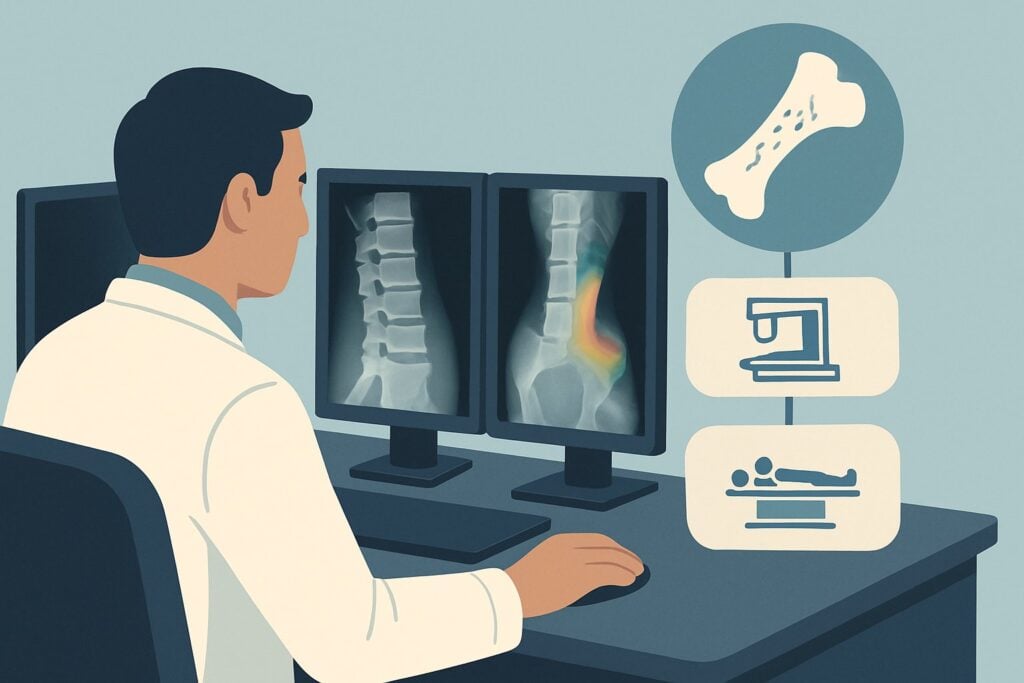
A 67-year-old postmenopausal woman is in your clinic for her annual wellness visit. She has never had a bone density scan and has a family history of hip fractures. You recognize she meets the criteria for osteoporosis screening and must decide on the most appropriate initial imaging test. This clinical decision is common, yet choosing the right study is critical for accurate diagnosis and risk stratification. This article provides a detailed workflow for this specific scenario: osteoporosis screening or initial imaging of clinically suspected low bone mineral density. According to the American College of Radiology (ACR) Appropriateness Criteria, a Dual-energy X-ray Absorptiometry (DXA) scan of the lumbar spine and hip(s) is rated Usually appropriate as the first-line imaging study.
Who Fits This Clinical Scenario?
This guidance applies specifically to patients undergoing initial evaluation for low bone mineral density (BMD). The most common candidates are individuals who meet established screening guidelines, which typically include:
- All women aged 65 years and older.
- All men aged 70 years and older.
- Postmenopausal women younger than 65 or men aged 50-69 with clinical risk factors for fracture (e.g., low body weight, prior fragility fracture, high-risk medication use, or a disease associated with bone loss).
- Adults with a fragility fracture.
It is crucial to distinguish this initial screening scenario from others. This workflow does not apply to:
- Patients requiring follow-up imaging: Individuals with a known diagnosis of osteoporosis or osteopenia who are being monitored for treatment response or disease progression fall under a different ACR variant for surveillance.
- Patients with advanced spinal degenerative changes: If a patient has severe osteoarthritis or other structural changes in the lumbar spine, a standard DXA may be misleading. This situation represents a distinct clinical scenario with different imaging considerations.
- Premenopausal females or males under 50: While imaging is sometimes necessary for this group, it is reserved for those with specific, significant risk factors (like long-term glucocorticoid use) and follows a separate diagnostic pathway.
What Diagnoses Are You Working Up in This Scenario?
The primary goal of ordering imaging in this context is to identify or rule out conditions characterized by low bone mass. The differential diagnosis is focused and hierarchical.
Osteoporosis: This is the principal diagnosis of concern. It is a systemic skeletal disease characterized by low bone mass and microarchitectural deterioration of bone tissue, leading to enhanced bone fragility and a consequent increase in fracture risk. The imaging study directly quantifies bone mineral density to make this diagnosis based on established World Health Organization (WHO) criteria (a T-score of -2.5 or below).
Osteopenia (Low Bone Mass): This is the most common finding and represents a precursor to osteoporosis. It is defined as bone density that is lower than normal peak density but not low enough to be classified as osteoporosis (a T-score between -1.0 and -2.5). While not a disease itself, identifying osteopenia is clinically vital because it prompts a formal fracture risk assessment (e.g., using the FRAX tool) to guide preventive therapy.
Secondary Causes of Low Bone Mineral Density: While the imaging study itself does not diagnose the underlying cause, an abnormal result is a critical trigger to investigate for secondary conditions. These can include endocrine disorders (hyperparathyroidism, hyperthyroidism), vitamin D deficiency, malabsorption syndromes, chronic kidney disease, or effects from medications like glucocorticoids or certain anticonvulsants. A new diagnosis of low BMD should prompt a clinical and laboratory evaluation for these contributors.
Why Is DXA of the Lumbar Spine and Hip(s) the Recommended Study for This Presentation?
The ACR designates Dual-energy X-ray Absorptiometry (DXA) of the lumbar spine and hip(s) as Usually appropriate because it is the established gold standard for diagnosing osteoporosis and assessing fracture risk. The rationale is multifaceted, balancing diagnostic accuracy, safety, and clinical utility.
DXA provides a precise, quantitative measurement of bone mineral density (BMD). The results are reported as T-scores (comparison to a young, healthy adult reference population) and Z-scores (comparison to an age-matched population). For the screening population, the T-score is the key diagnostic value. The lumbar spine and proximal femur (total hip and femoral neck) are the preferred measurement sites because they are common locations for osteoporotic fractures and their BMD values are strongly predictive of future fracture risk.
From a safety perspective, DXA is highly favorable, delivering a very low radiation dose (ACR Relative Radiation Level ☢ <0.1 mSv), which is comparable to daily background radiation. This makes it exceptionally safe for routine screening in asymptomatic individuals.
Alternative studies are rated lower for specific reasons in this initial screening scenario:
- Quantitative Computed Tomography (QCT) of the lumbar spine and hip: While QCT can also measure BMD, it is rated May be appropriate. Its primary drawback is a substantially higher radiation dose (☢☢☢ 1-10 mSv). Although it can provide a true volumetric density measurement and separate trabecular from cortical bone, its higher cost, greater radiation exposure, and less standardized diagnostic criteria make it a secondary choice for routine screening.
- Quantitative Ultrasound (QUS) of the calcaneus: This modality is rated Usually not appropriate for diagnosis. QUS uses sound waves and involves no radiation (O 0 mSv), making it a useful tool for community-based risk assessment. However, its results are not equivalent to DXA-derived BMD, and the WHO diagnostic criteria cannot be applied. An abnormal QUS result requires confirmation with a central DXA scan.
What’s Next After DXA Lumbar Spine and Hip(s)? Downstream Workflow
The DXA report provides a T-score, which dictates the next steps in the clinical workflow. The decision tree is based on the WHO diagnostic categories.
If the T-score is -1.0 or higher (Normal Bone Density):
The patient should be reassured. The next step is counseling on lifestyle modifications to maintain bone health, including adequate calcium and vitamin D intake, weight-bearing exercise, and smoking cessation. Repeat screening is typically not needed for several years, with the interval depending on the initial T-score and the patient’s overall risk profile. For T-scores in the high-normal range, re-screening might be deferred for 10-15 years.
If the T-score is between -1.0 and -2.5 (Osteopenia/Low Bone Mass):
This result requires further risk stratification. The next step is to calculate the patient’s 10-year probability of a major osteoporotic fracture using a validated tool like the Fracture Risk Assessment Tool (FRAX®). This calculation incorporates the femoral neck BMD along with clinical risk factors. If the 10-year risk exceeds established country-specific thresholds (e.g., ≥20% for major osteoporotic fracture or ≥3% for hip fracture in the U.S.), pharmacologic therapy is recommended.
If the T-score is -2.5 or lower (Osteoporosis):
This result confirms a diagnosis of osteoporosis and is a direct indication for initiating treatment. The workflow includes prescribing an anti-resorptive or anabolic agent, ensuring adequate calcium and vitamin D supplementation, and implementing fall prevention strategies. A laboratory workup to rule out secondary causes of osteoporosis is also warranted. This patient will now move into a different clinical pathway for surveillance, which is covered in a separate ACR scenario for follow-up imaging.
Pitfalls to Avoid (and When to Get Help)
Several common pitfalls can occur when ordering and interpreting initial bone density scans. Awareness of these issues can prevent misdiagnosis and ensure appropriate management.
- Screening the wrong population: Ordering DXA scans in low-risk, young, or premenopausal individuals without significant risk factors is generally not indicated and can lead to unnecessary follow-up and patient anxiety.
- Misinterpreting Z-scores: In postmenopausal women and men over 50, diagnosis is based on the T-score. The Z-score (age-matched comparison) is more relevant for younger individuals and can be a clue for secondary causes of osteoporosis if very low (e.g., below -2.0).
- Ignoring spinal artifacts: Severe degenerative joint disease, vertebral compression fractures, or aortic calcification can falsely elevate the lumbar spine BMD measurement. If significant artifacts are present, the interpreting radiologist may note this, and clinical decisions should rely more heavily on the hip BMD values.
- Failing to calculate fracture risk: An osteopenia diagnosis should not be a stopping point. The most significant pitfall is failing to proceed with a FRAX calculation, as many patients with osteopenia have a high enough fracture risk to warrant treatment.
If a DXA report is complex, notes significant artifacts, or the results are discordant with the clinical picture, a consultation with an endocrinologist or a specialist in metabolic bone disease is the appropriate next step.
Related ACR Topics and Tools
For a comprehensive overview of all clinical variants related to bone density imaging, please consult our parent guide. For tools to help you navigate other scenarios, select appropriate protocols, or discuss radiation dose with patients, see the resources below.
- For breadth across all scenarios in Osteoporosis and Bone Mineral Density, see our parent guide: Osteoporosis and Bone Mineral Density: ACR Appropriateness Decoded.
- To explore adjacent clinical scenarios and their recommended imaging studies, use the ACR Appropriateness Criteria Lookup.
- To find detailed technical guidance for this and other studies, browse the Imaging Protocol Library.
- For clear conversations about imaging safety, use the Radiation Dose Calculator to estimate cumulative exposure.
Frequently Asked Questions
Why can’t I just use a standard X-ray to screen for osteoporosis?
Standard radiographs are insensitive for detecting low bone mineral density. A significant amount of bone loss, typically 30-50%, must occur before it becomes apparent on a plain X-ray. DXA is far more sensitive and can detect small changes in bone density, allowing for diagnosis and intervention long before bone loss is visible on a radiograph.
What is the difference between a T-score and a Z-score on a DXA report?
A T-score compares the patient’s bone mineral density (BMD) to that of a healthy 30-year-old adult of the same sex. It is used to diagnose osteoporosis in postmenopausal women and men over 50. A Z-score compares the patient’s BMD to that of an average person of the same age and sex. It is used for premenopausal women and men under 50. A very low Z-score (e.g., below -2.0) may suggest a secondary cause for bone loss.
How often should a patient with a normal initial DXA be re-screened?
The optimal interval for re-screening is not firmly established, but evidence suggests that for patients with normal or mildly low bone mass at baseline, re-screening can be deferred for many years. For T-scores well within the normal range (e.g., > -1.50), re-screening in 10-15 years may be reasonable. For those closer to the osteopenia threshold, a shorter interval of 3-5 years may be more appropriate, depending on other risk factors.
Can I order a DXA of a different body part if the hip or spine isn’t available?
The distal forearm (or one-third radius) is an alternative site that is rated ‘May be appropriate’ by the ACR. It should be measured in specific situations, such as when the hip or spine cannot be accurately measured (e.g., due to bilateral hip replacements or severe spinal deformity) or in patients with hyperparathyroidism, which preferentially affects cortical bone at this site.
What is a FRAX score and when do I need to calculate it?
The FRAX (Fracture Risk Assessment Tool) score calculates a patient’s 10-year probability of having a major osteoporotic fracture (hip, spine, forearm, or humerus) and a hip fracture specifically. It should be calculated for patients whose DXA results show osteopenia (T-score between -1.0 and -2.5) to help determine if their fracture risk is high enough to warrant starting pharmacologic therapy.
Reviewed by Pouyan Golshani, MD, Interventional Radiologist — May 30, 2026