Which Imaging Study Should Follow an Incidental Finding Suggestive of a PAVM?
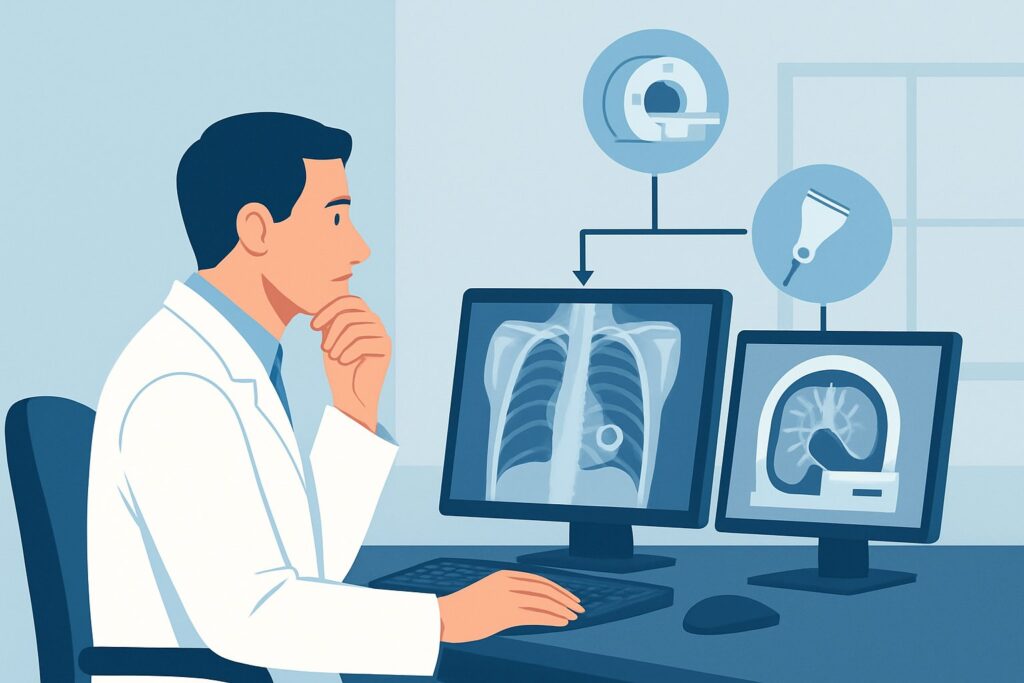
A 58-year-old patient undergoes a chest CT for a pre-operative evaluation for an unrelated surgery. The radiology report notes a 1.5 cm nodular opacity in the right lower lobe with a prominent feeding vessel from the pulmonary artery and a draining pulmonary vein, suspicious for a pulmonary arteriovenous malformation (PAVM). The patient is entirely asymptomatic, with no shortness of breath, history of stroke, or nosebleeds. As the ordering clinician, you must now decide on the most appropriate next step to confirm the diagnosis and assess its hemodynamic significance. This article details the ACR-guided workflow for this specific scenario: an asymptomatic adult with an incidental imaging finding suggestive of a PAVM. For this presentation, the American College of Radiology rates US echocardiography transthoracic with IV contrast as Usually Appropriate.
Who Fits This Clinical Scenario?
This guidance applies specifically to an asymptomatic adult patient who has had a chest radiograph or, more commonly, a computed tomography (CT) scan for an unrelated reason, and the imaging reveals a finding suggestive of a pulmonary arteriovenous malformation. The key inclusion criteria are:
- The patient is an adult.
- The patient has no symptoms attributable to a PAVM (e.g., dyspnea, hypoxemia, hemoptysis, or neurologic symptoms like transient ischemic attack or brain abscess).
- The finding was incidental on imaging performed for another purpose.
It is crucial to distinguish this situation from other related, but distinct, clinical scenarios that require a different diagnostic approach. This workflow does not apply if:
- The patient is symptomatic. An adult presenting with a transient ischemic attack, seizures, or a brain abscess has a higher pre-test probability of a clinically significant right-to-left shunt, and the workup may be expedited differently.
- The patient is being screened for Hereditary Hemorrhagic Telangiectasia (HHT). An asymptomatic patient with a known family history of HHT undergoing initial screening for PAVMs follows a separate pathway, as the goal is proactive detection.
- The patient has a known, previously treated PAVM. Surveillance imaging after embolization has its own set of recommendations and intervals.
Applying this workflow to the wrong patient presentation can lead to diagnostic delays or inappropriate testing.
What Diagnoses Are You Working Up in This Scenario?
When an incidental imaging finding suggests a PAVM, the primary goal is to confirm its presence and functional significance. The differential diagnosis includes several possibilities that can mimic this appearance on a non-definitive study like a non-contrast chest CT or radiograph.
Pulmonary Arteriovenous Malformation (PAVM) is the leading concern. This is an abnormal, low-resistance connection between a pulmonary artery and a pulmonary vein, which bypasses the pulmonary capillary bed. This creates a right-to-left shunt, allowing deoxygenated blood and potential emboli to enter the systemic circulation. While many are congenital and associated with HHT, they can be solitary and sporadic.
A solitary pulmonary nodule of another etiology is also on the differential. The initial imaging may not have been sufficient to definitively characterize the lesion. It could represent a benign entity like a granuloma or hamartoma, or a primary or metastatic malignancy. The presence of clear feeding and draining vessels strongly points toward a vascular lesion, but confirmation is needed.
A pulmonary varix, which is a focal dilation of a pulmonary vein, can sometimes be mistaken for a PAVM. Unlike a PAVM, it does not involve a direct arteriovenous connection and therefore does not cause a right-to-left shunt. It is a less common finding but remains a diagnostic consideration.
Finally, other rare vascular anomalies or neoplasms could be considered. These are much less common but underscore the need for a definitive functional and anatomic evaluation before proceeding with any potential intervention.
Why Is Transthoracic Echocardiography with IV Contrast the Recommended Study?
For an asymptomatic patient with an incidental finding, the first critical question is not just “Is there a PAVM?” but “Is there a physiologically significant right-to-left shunt?” The ACR designates US echocardiography transthoracic with IV contrast as Usually Appropriate because it directly and non-invasively answers this functional question.
This study, often called a “bubble study,” involves injecting agitated saline into a peripheral vein. In a normal circulatory system, these microbubbles are filtered out by the pulmonary capillaries. If a right-to-left shunt exists, as in a PAVM, the bubbles will bypass the capillary bed and appear in the left side of the heart. The timing is key: bubbles appearing in the left atrium 3-5 cardiac cycles or more after appearing in the right atrium are indicative of an intrapulmonary shunt. This test is highly sensitive for detecting shunts and serves as an excellent initial screening tool.
The primary advantages of this approach are:
- No Ionizing Radiation: The procedure has a radiation level of O (0 mSv), making it preferable to CT-based options for an initial assessment.
- Functional Assessment: It directly confirms the presence of a shunt, which is the pathophysiologic consequence of a PAVM that leads to clinical risk.
- High Sensitivity: It is a very effective method for detecting even small intrapulmonary shunts.
Other imaging studies are rated differently for this specific scenario:
- CTA pulmonary arteries with IV contrast is also rated Usually Appropriate. It provides excellent anatomic detail of the PAVM’s feeding artery, nidus, and draining vein. However, it involves ionizing radiation (☢☢☢ 1-10 mSv) and iodinated contrast. It is often the best test for pre-procedural planning, but the bubble study is a better and safer first step to simply confirm the shunt’s existence.
- US echocardiography transthoracic resting (without contrast) is rated Usually Not Appropriate. Without the agitated saline contrast, the study cannot detect an intrapulmonary shunt and therefore fails to answer the primary clinical question. When ordering, it is critical to specify “with IV contrast” or “bubble study for shunt evaluation.”
What’s Next After Transthoracic Echocardiography? Downstream Workflow
The results of the contrast echocardiogram will guide the subsequent management steps in a clear, logical sequence.
If the study is positive for a delayed right-to-left shunt (bubbles appear in the left atrium >3 cardiac cycles after the right), this confirms the presence of a hemodynamically significant intrapulmonary shunt. This finding validates the initial suspicion of a PAVM. The next step is to define the anatomy for potential treatment. A CTA of the pulmonary arteries with IV contrast is typically ordered to precisely map the feeding artery size, location, and complexity of the PAVM. This information is essential for interventional radiology to plan for transcatheter embolization, which is the standard treatment for PAVMs with feeding arteries of 3 mm or greater.
If the study is negative, a significant intrapulmonary right-to-left shunt is effectively ruled out. This makes a clinically relevant PAVM highly unlikely. The focus should then return to the initial incidental finding on CT or chest radiography. Depending on the morphology and size of the lesion, the appropriate next step may be short-term imaging follow-up (e.g., a dedicated chest CT) to ensure stability and rule out a neoplastic process, consistent with guidelines for managing indeterminate pulmonary nodules.
If the study is indeterminate due to poor acoustic windows or other technical limitations, an alternative non-invasive study should be considered. In this case, proceeding to a CTA pulmonary arteries with IV contrast or an MRA of the pulmonary arteries without and with IV contrast would be a reasonable next step, as both are also rated Usually Appropriate for this scenario.
Pitfalls to Avoid (and When to Get Help)
In managing this specific clinical scenario, several common pitfalls can lead to diagnostic errors or unnecessary procedures. Be mindful of the following:
- Ordering the Wrong Echocardiogram: Simply ordering a “transthoracic echo” without specifying “with IV contrast” or “bubble study for shunt evaluation” will result in a non-diagnostic test.
- Misinterpreting Bubble Timing: An immediate appearance of bubbles in the left heart (within 1-2 cycles) suggests an intracardiac shunt (e.g., PFO, ASD), not a PAVM. The delay is the key diagnostic feature for an intrapulmonary shunt.
- Prematurely Dismissing the Finding: Do not assume an incidental vascular-appearing nodule is benign without a functional assessment. The risk of paradoxical embolism and stroke from an untreated PAVM is significant.
- Forgetting the HHT Connection: If a PAVM is confirmed, it is critical to screen the patient for other signs of Hereditary Hemorrhagic Telangiectasia, as they may have other AVMs (e.g., cerebral, hepatic) and require genetic counseling.
If the diagnosis remains uncertain after non-invasive imaging, or if a complex PAVM is identified, consultation with a pulmonologist or an interventional radiologist is the appropriate next step.
Related ACR Topics and Tools
The American College of Radiology provides extensive guidance on imaging for vascular conditions. For a broader overview of all clinical variants related to this topic, please see our comprehensive guide. Additionally, several GigHz tools can help streamline your clinical workflow and decision-making process.
- For breadth across all scenarios in Pulmonary Arteriovenous Malformation (PAVM), see our parent guide: Pulmonary Arteriovenous Malformation (PAVM): ACR Appropriateness Decoded.
- To explore other clinical scenarios or search the complete guidelines, use the ACR Appropriateness Criteria Lookup.
- For detailed procedural techniques on recommended studies, consult the Imaging Protocol Library.
- To discuss radiation exposure with your patients, the Radiation Dose Calculator can help quantify and contextualize cumulative dose.
Frequently Asked Questions
Why not go directly to a CTA of the pulmonary arteries instead of starting with an echocardiogram?
A transthoracic echocardiogram with IV contrast (bubble study) is a non-invasive, radiation-free test that directly answers the most important initial question: is there a physiologically significant right-to-left shunt? A CTA provides excellent anatomical detail but involves radiation and iodinated contrast. The bubble study is a better initial screening tool to confirm the shunt’s presence before proceeding to a CTA for pre-procedural planning.
What if the patient has an allergy to IV contrast?
The ‘contrast’ used for a bubble study is agitated saline with microbubbles, not the iodinated or gadolinium-based contrast agents used in CT and MRI. It is extremely safe and allergic reactions are not a concern. If a downstream CTA is needed for a patient with an iodinated contrast allergy, options include pre-medication with steroids or using MRA of the pulmonary arteries as an alternative.
Does a negative bubble study completely rule out a PAVM?
A technically adequate negative bubble study makes a hemodynamically significant PAVM highly unlikely. It is very sensitive for detecting shunts large enough to be clinically relevant. It is theoretically possible for very small, microscopic PAVMs to exist that do not produce a detectable shunt, but these are generally not the target of screening or treatment.
What specific findings on a chest CT or radiograph are ‘suggestive’ of a PAVM?
The classic finding is a well-defined, round or oval, non-calcified nodule or mass, most commonly found in the lower lobes. The key feature that distinguishes it from other nodules is the clear identification of a feeding pulmonary artery and a draining pulmonary vein connecting to the lesion, which can often be seen on contrast-enhanced CT.
Is this imaging workflow different if the patient had symptoms like a TIA or shortness of breath?
Yes, absolutely. This article’s workflow is strictly for asymptomatic patients with an incidental finding. A patient presenting with neurologic symptoms (like a TIA or brain abscess) or significant pulmonary symptoms has a much higher pre-test probability of a clinically significant PAVM, and the workup may be more urgent or proceed directly to definitive anatomic imaging like CTA. That represents a different ACR clinical scenario.
Reviewed by Pouyan Golshani, MD, Interventional Radiologist — May 30, 2026