Which Imaging Study Should You Order First for a Symptomatic Hip Prosthesis?
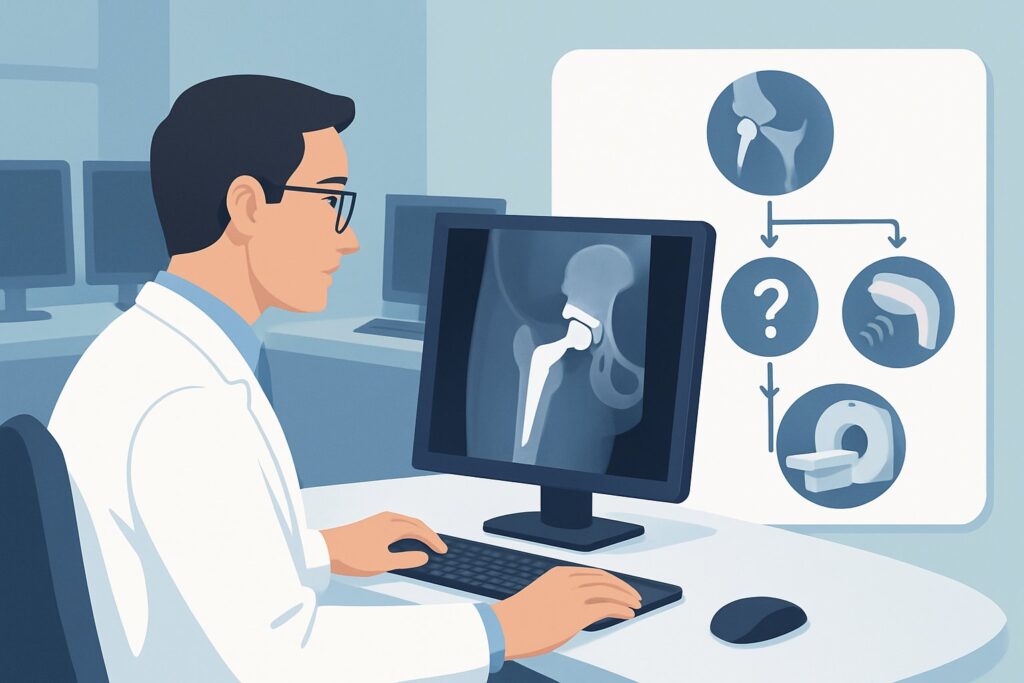
A 68-year-old patient with a total hip arthroplasty (THA) from three years ago presents to your clinic with new, progressive groin pain and a sensation of instability when walking. They deny any recent trauma. The immediate clinical question is how to begin the diagnostic workup. While advanced imaging modalities like CT and MRI are available, the initial evaluation of a symptomatic hip prosthesis requires a foundational study to assess the hardware and surrounding bone. This article provides a focused, step-by-step workflow for this specific scenario, clarifying why the American College of Radiology (ACR) designates one particular study as the essential starting point. For this presentation—a symptomatic patient with a hip prosthesis requiring initial imaging—the ACR rates Radiography hip as Usually appropriate.
Who Fits This Clinical Scenario?
This guidance applies to patients who have a previously placed total hip arthroplasty and are now presenting with new or worsening symptoms. These symptoms can include pain (groin, thigh, or buttock), a feeling of instability or “giving way,” clicking, popping, or a noticeable change in limb length or gait. The key element is the presence of symptoms without a clear history of acute, high-energy trauma, which would trigger a different diagnostic pathway.
This workflow is specifically for the initial imaging step. It is crucial to distinguish this scenario from others that may appear similar but require a different approach:
- Routine Asymptomatic Follow-up: This guidance does not apply to patients who are pain-free and undergoing routine surveillance imaging after their THA.
- Acute, High-Energy Injury: A patient presenting with severe pain immediately following a significant fall or accident may require a different protocol, as the pre-test probability for a periprosthetic fracture is much higher.
- Specific Metal-on-Metal Concerns: Patients with known metal-on-metal prostheses presenting with symptoms suggestive of adverse local tissue reaction (ALTR) or pseudotumor may proceed more quickly to advanced imaging like MARS MRI after initial radiographs.
The focus here is on the undifferentiated symptomatic patient, where radiographs serve as the critical first branch in the decision tree.
What Diagnoses Are You Working Up in This Scenario?
When a patient with a THA becomes symptomatic, the differential diagnosis is broad, centering on the failure of the implant, its fixation, or the surrounding biological structures. The initial imaging aims to identify or exclude the most common and consequential causes of painful arthroplasty.
Aseptic Loosening: This is the most common long-term failure mechanism for total hip arthroplasty. It occurs when the bond between the implant and the bone (or the cement mantle and the bone) degrades over time, leading to micromotion and pain. Radiographs are the primary tool for detecting signs of loosening, such as progressive radiolucent lines at the bone-implant interface.
Periprosthetic Fracture: While often associated with trauma, these fractures can also occur with minimal or no injury, particularly around a loose or poorly fixed implant (an occult fracture). Radiographs are highly effective at identifying displaced fractures and can often reveal stress risers or bone changes that predispose to fracture.
Implant Dislocation or Malposition: This is a more common early complication but can occur at any time. Radiographs can definitively assess the position of the femoral head within the acetabular cup and evaluate for signs of subluxation or frank dislocation. They also allow for measurement of component angles, such as inclination and anteversion, which can contribute to instability.
Infection (Osteolysis): Periprosthetic joint infection (PJI) is a devastating complication. While radiographs cannot diagnose infection directly, they can show secondary signs like focal, aggressive bone loss (osteolysis), periosteal reaction, or rapid component loosening, which are highly suspicious and warrant an aggressive subsequent workup.
Hardware Failure: Though less common with modern implants, catastrophic failure such as fracture of the femoral stem or dissociation of a modular component can occur. These events are typically obvious on standard radiographs.
Why Is Radiography the Recommended Initial Study for This Presentation?
The ACR designates hip radiography as Usually appropriate because it is a high-yield, low-cost, and widely available examination that directly assesses the most common causes of a painful THA. It provides an excellent overview of component positioning, bone-implant interfaces, and the integrity of the surrounding bone.
A standard radiographic series, including an anteroposterior (AP) view of the pelvis and both AP and lateral views of the symptomatic hip, is the cornerstone of the evaluation. Comparison with previous radiographs is invaluable for detecting subtle interval changes, such as component migration, subsidence, or the development of radiolucent lines.
In contrast, other imaging modalities are rated lower for this initial step for specific reasons:
- CT hip (without or with contrast): Rated Usually not appropriate as a first-line test. While CT with metal artifact reduction sequence (MARS) protocols is excellent for problem-solving when radiographs are inconclusive, it involves a higher radiation dose (☢☢☢ 1-10 mSv) and is not necessary for the initial assessment. It is a second-line study.
- MRI hip (without or with contrast): Also rated Usually not appropriate. Severe metallic susceptibility artifact from the prosthesis significantly degrades image quality, limiting the evaluation of the bone-implant interface. While MARS MRI is useful for evaluating soft tissues for complications like pseudotumor or abductor tendon tears, it is not the correct initial test for assessing for loosening or fracture. It carries a radiation level of O 0 mSv, but its diagnostic limitation in this context makes it unsuitable for first-line use.
- Bone Scan with SPECT/CT: Rated Usually not appropriate for initial imaging. This nuclear medicine study is sensitive for detecting increased metabolic activity, which can be seen in loosening, infection, or fracture. However, it is not specific, and its role is in the secondary workup of a patient with persistent symptoms and non-diagnostic radiographs. It also involves a significant radiation dose (☢☢☢ 1-10 mSv).
The radiographic examination provides the essential framework for the entire diagnostic algorithm. It is the most efficient way to confirm or exclude major mechanical problems before proceeding to more complex and costly investigations.
What’s Next After Radiography? Downstream Workflow
The results of the initial hip radiographs will dictate the subsequent clinical pathway. The goal is to triage the patient toward the correct diagnosis and treatment, which may involve further imaging, laboratory tests, or surgical consultation.
If radiographs are clearly positive: When radiographs reveal definitive evidence of a major complication—such as gross loosening with component migration, a displaced periprosthetic fracture, or dislocation—the next step is typically an urgent or semi-urgent orthopedic surgery consultation. Further imaging may be required for pre-operative planning (e.g., a CT scan to better define bone stock for revision surgery), but the primary diagnosis is established.
If radiographs are negative or equivocal: This is a common and challenging situation. A patient with persistent, significant symptoms despite normal-appearing radiographs requires further investigation. The downstream workflow now branches based on the leading clinical suspicion:
- If infection is suspected: The workup shifts to the ACR scenario for a symptomatic patient where infection is not excluded. This involves obtaining inflammatory markers (ESR and CRP). If these are elevated, the next step is often an image-guided hip aspiration for culture and cell count.
- If mechanical loosening or occult fracture is suspected: The workup proceeds to the ACR scenario for a symptomatic patient where infection is excluded. The next logical imaging study is often a CT scan with metal artifact reduction (MARS) to better delineate subtle radiolucent lines or non-displaced fracture lines that were obscured on radiographs. A nuclear medicine bone scan with SPECT/CT may also be considered.
In all cases of negative initial imaging in a symptomatic patient, a thorough review of the clinical history and physical exam is warranted to ensure no other diagnosis (e.g., spinal stenosis, vascular claudication) is being missed.
Pitfalls to Avoid (and When to Get Help)
Navigating the workup of a symptomatic hip arthroplasty requires careful attention to detail. Several common pitfalls can delay diagnosis or lead to unnecessary testing.
- Failing to Obtain Comparison Films: The single most valuable tool for interpreting radiographs of a THA is a prior study. Always request and review previous images to assess for subtle changes in component position or the development of radiolucencies.
- Inadequate Radiographic Views: A single AP view is insufficient. A complete initial series should include an AP of the pelvis (to assess for leg length and offset) and both AP and a true lateral of the affected hip.
- Over-reliance on a “Normal” Report: Radiographic signs of loosening can be subtle. If clinical suspicion is high despite a negative or non-specific radiographic report, do not stop the workup. The patient’s symptoms should guide the decision to proceed to second-line investigations.
- Ignoring Metal Artifact: Be aware that portions of the bone-implant interface may be obscured by the prosthesis itself. If the area of maximal tenderness corresponds to a region that is poorly visualized, this is an indication for cross-sectional imaging like CT.
If the diagnosis remains elusive after initial radiographs and basic labs, or if there are signs suggestive of complex failure modes, consultation with an orthopedic surgeon specializing in adult reconstruction is the appropriate next step.
Related ACR Topics and Tools
The evaluation of a symptomatic hip arthroplasty is a common clinical challenge. For a comprehensive overview of all related scenarios and to refine your imaging decisions, the following resources are available.
- For breadth across all scenarios in Imaging after Total Hip Arthroplasty, see our parent guide: Imaging after Total Hip Arthroplasty: ACR Appropriateness Decoded.
- To explore other clinical presentations, use the ACR Appropriateness Criteria Lookup.
- For details on imaging techniques, consult the Imaging Protocol Library.
- To discuss radiation exposure with patients, refer to the Radiation Dose Calculator.
Frequently Asked Questions
Why not just start with a CT scan to get more detail?
While a CT scan, especially with metal artifact reduction (MARS), provides excellent detail, it is considered a second-line test by the ACR for this initial workup. Radiographs are highly effective at diagnosing the most common causes of failure (e.g., obvious loosening, fracture, dislocation), are faster, cheaper, and involve less radiation. Starting with radiographs is a more efficient and resource-conscious approach, reserving CT for cases where radiographs are negative or inconclusive.
What specific radiographic views are essential for this initial evaluation?
A standard, complete series is critical. This should include: 1) An Anteroposterior (AP) view of the entire pelvis, which allows for comparison with the contralateral hip and assessment of leg length and offset. 2) An AP view centered on the symptomatic hip. 3) A true lateral view of the symptomatic hip (e.g., a crosstable lateral or frog-leg lateral) to evaluate the components in an orthogonal plane.
How does the workup change if the patient has bilateral symptomatic hip replacements?
The fundamental principle remains the same. The initial imaging for both hips would be radiography. A single AP pelvis view provides a good initial look at all four components (both acetabular and femoral). This would be supplemented by dedicated AP and lateral views of each hip individually to ensure a complete evaluation.
Is there any role for ultrasound in this scenario?
For evaluating the prosthesis itself, ultrasound is rated ‘Usually not appropriate.’ The sound waves cannot penetrate the metal implant to assess the bone-implant interface. However, ultrasound has a niche role if the clinical suspicion is for a superficial soft tissue issue, such as a hematoma, abscess, or trochanteric bursitis, but it is not part of the primary workup for implant failure.
What if the radiograph report mentions ‘stable-appearing prosthesis’ but my patient is still in significant pain?
This is a critical juncture. A ‘stable’ radiographic appearance does not rule out a clinical problem. The patient’s symptoms are the primary guide. This finding should prompt you to move to the next step of the workflow, which involves considering infection (checking ESR/CRP) or occult mechanical failure (considering a CT with MARS or nuclear medicine study) based on the overall clinical picture.
Reviewed by Pouyan Golshani, MD, Interventional Radiologist — May 30, 2026