Which Imaging Study Should You Order for Dyspnea from a Suspected Arrhythmia?
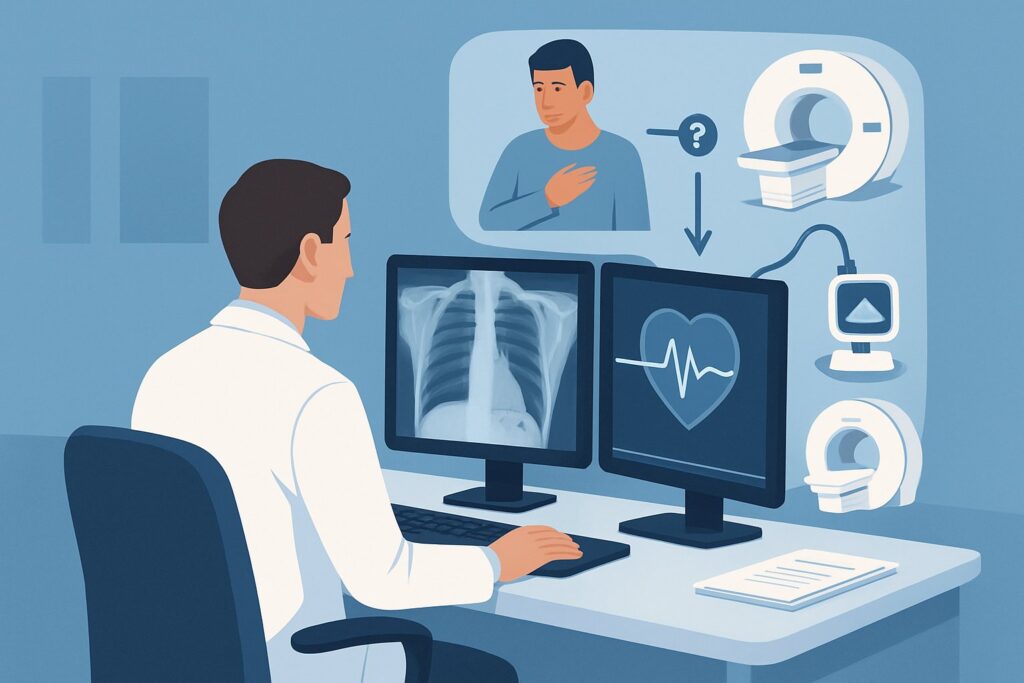
A 68-year-old male presents to your clinic with intermittent shortness of breath, most noticeable when climbing stairs. He also reports episodes of “fluttering” in his chest. An extensive ischemic workup, including a recent negative stress test, has already been completed. His electrocardiogram (ECG) in the office shows a normal sinus rhythm. You suspect an underlying cardiac arrhythmia is causing his dyspnea, but the trigger and substrate are unclear. What is the appropriate initial imaging study to evaluate the heart’s structure and function in this context? This article provides a step-by-step clinical workflow for this specific scenario, grounded in the American College of Radiology (ACR) Appropriateness Criteria. For this patient, a resting transthoracic echocardiogram is rated Usually Appropriate as the initial imaging test.
Who Fits This Clinical Scenario?
This guidance applies to patients presenting with dyspnea where a cardiac arrhythmia is the leading suspected cause. The key inclusion criteria are:
- Primary Symptom: Dyspnea (shortness of breath).
- Suspected Cause: A cardiac arrhythmia, often suggested by concurrent symptoms like palpitations, pre-syncope, or syncope.
- Ischemia Excluded: A crucial prerequisite is that coronary artery disease or active ischemia has been reasonably ruled out through prior testing (e.g., negative stress test, recent coronary angiography).
This workflow is distinct from other similar presentations. This article does not apply if:
- Valvular Disease is the Primary Suspicion: If a physical exam reveals a significant new or changed heart murmur, the workup follows the dyspnea due to suspected valvular disease pathway.
- Pericardial Disease is Suspected: If the patient presents with pleuritic, positional chest pain, a pericardial friction rub, or ECG changes suggestive of pericarditis, the workup shifts to the dyspnea due to suspected pericardial disease pathway.
- Ischemia is Not Excluded: If the patient has active chest pain, risk factors for coronary artery disease, and no recent ischemic evaluation, the workup for acute or chronic ischemia takes precedence.
What Diagnoses Are You Working Up in This Scenario?
When ordering imaging for dyspnea suspected to be from an arrhythmia, you are primarily searching for a structural substrate—an underlying abnormality in the heart muscle or chambers that could generate or perpetuate an abnormal rhythm. The differential diagnosis includes several key conditions.
Structural and Myocardial Disease: This is the broadest and most common category. It includes cardiomyopathies such as hypertrophic cardiomyopathy (HCM), which is a well-known cause of atrial and ventricular arrhythmias, and dilated cardiomyopathy (DCM), where the stretched cardiac muscle is prone to electrical instability. Restrictive or infiltrative cardiomyopathies, like cardiac amyloidosis or sarcoidosis, can also disrupt the heart’s conduction system and are important, though less common, considerations.
Atrial Fibrillation Substrate: The most common sustained arrhythmia, atrial fibrillation (AFib), is often associated with structural changes, most notably left atrial enlargement. Identifying an enlarged left atrium on imaging increases the post-test probability of paroxysmal AFib being the culprit for the patient’s symptoms, even if it’s not captured on a spot ECG.
Arrhythmogenic Right Ventricular Cardiomyopathy (ARVC): A less common but critical diagnosis to consider, particularly in younger patients, is ARVC. This genetic condition involves fibrofatty replacement of the right ventricular myocardium, creating a substrate for life-threatening ventricular arrhythmias.
Significant Valvular Dysfunction: While not the primary suspicion in this scenario, moderate-to-severe valvular disease can lead to chamber enlargement and pressure overload, which in turn can trigger arrhythmias. The initial imaging study serves to screen for this possibility as well.
Why Is a Resting Transthoracic Echocardiogram the Recommended Initial Study?
The ACR designates US echocardiography transthoracic resting (TTE) as Usually Appropriate for the initial imaging of a patient with dyspnea and suspected arrhythmia. This recommendation is based on the modality’s excellent ability to assess the key differential diagnoses safely and efficiently.
A TTE provides a wealth of information directly relevant to this clinical question. It offers a real-time assessment of left and right ventricular size and systolic function, wall thickness (to screen for hypertrophy), and chamber dimensions, including left atrial volume. It can readily identify significant valvular stenosis or regurgitation and estimate pulmonary artery pressures. For the conditions on the differential, TTE is highly effective at identifying the macroscopic changes associated with dilated or hypertrophic cardiomyopathies and can often detect regional wall motion abnormalities suggestive of ARVC or sarcoidosis.
Crucially, TTE achieves this with no ionizing radiation (0 mSv) and is widely available, relatively inexpensive, and non-invasive. This makes it the ideal first-line test to screen for a structural cause of a suspected arrhythmia.
How do alternative studies compare for this specific scenario?
- MRI heart function and morphology without and with IV contrast is also rated Usually Appropriate. It offers superior tissue characterization and is the gold standard for assessing infiltrative diseases (amyloid, sarcoidosis) and ARVC. However, it is more costly, less accessible, and has a longer acquisition time, making it better suited as a second-line, problem-solving tool after an initial TTE is performed.
- CT heart function and morphology with IV contrast is rated May be appropriate. While it provides excellent anatomic detail, it exposes the patient to significant ionizing radiation (☢☢☢☢ 10-30 mSv) and offers less functional information than TTE or MRI. Its use is typically reserved for specific indications like evaluating cardiac masses or complex congenital anatomy, not for the initial workup of a suspected arrhythmia.
- US echocardiography transthoracic stress is rated Usually not appropriate. Because ischemia has already been excluded by the scenario’s definition, a stress test is redundant and does not answer the primary question about underlying structural abnormalities that could be arrhythmogenic at rest.
What’s Next After a Resting Transthoracic Echocardiogram? Downstream Workflow
The results of the initial TTE will guide your next steps in a branching decision tree. The goal is to integrate the structural findings from imaging with the electrical data from an ECG or ambulatory monitor.
If the TTE is definitively positive:
If the echocardiogram reveals a clear structural abnormality—such as hypertrophic cardiomyopathy, a severely dilated left ventricle with poor function, or significant left atrial enlargement—the diagnosis is clarified. The next step is typically a referral to a cardiologist or electrophysiologist. Further risk stratification may involve cardiac MRI for tissue characterization (e.g., assessing for fibrosis in HCM) or an electrophysiology (EP) study to directly assess arrhythmia risk and guide therapy, which could include medication, ablation, or an implantable cardioverter-defibrillator (ICD).
If the TTE is negative or non-diagnostic:
A normal TTE is a common and reassuring finding, but it does not rule out an arrhythmia. It simply suggests the absence of a major underlying structural cause. In this case, the focus of the workup shifts entirely to capturing the electrical event. The next logical step is prolonged ambulatory cardiac monitoring with a Holter monitor (24-48 hours), an event monitor, or a mobile cardiac telemetry unit (up to 30 days) to correlate the patient’s symptoms of dyspnea with a specific rhythm disturbance.
If the TTE is technically limited or indeterminate:
In patients with poor acoustic windows due to body habitus or lung disease, the TTE may be inconclusive. If a high clinical suspicion for structural disease remains, two options are available. A US echocardiography transesophageal (TEE), rated May be appropriate, can provide much clearer images, particularly of posterior structures like the left atrium. Alternatively, a MRI heart function and morphology, rated Usually Appropriate, can be used to overcome the limitations of ultrasound entirely and provide comprehensive structural and functional assessment.
Pitfalls to Avoid (and When to Get Help)
Navigating the workup for dyspnea and suspected arrhythmia requires careful integration of clinical context with imaging results. Here are a few common pitfalls to avoid:
- Stopping the workup after a normal echo: Remember that a TTE evaluates structure, not primary electrical conduction. A normal echo in a symptomatic patient should prompt further electrical investigation (e.g., ambulatory monitoring), not a premature conclusion that the heart is not the problem.
- Ordering a stress test: This scenario explicitly assumes ischemia has been excluded. Ordering a stress echo or nuclear stress test is redundant, adds cost, and is rated Usually not appropriate by the ACR for this indication.
- Ignoring the ECG: Clues on the 12-lead ECG, such as pre-excitation (Wolff-Parkinson-White syndrome), Brugada pattern, or prolonged QT interval, may point to a primary electrical disorder even if the heart structure is normal.
- Dismissing mild findings: Mild left atrial enlargement or borderline left ventricular hypertrophy may still be significant in the context of a patient with frequent palpitations and dyspnea.
If the initial non-invasive workup (TTE and ambulatory monitoring) is negative but the patient’s symptoms are severe or worsening, escalation to a cardiology or electrophysiology specialist is warranted for consideration of more advanced testing.
Related ACR Topics and Tools
This article covers one specific clinical variant. For a comprehensive overview of all scenarios related to dyspnea of suspected cardiac origin after ischemia has been excluded, please consult the parent topic hub article. Additionally, several GigHz tools can assist in applying these criteria in your daily practice.
- Parent Topic Hub: For breadth across all scenarios in Dyspnea-Suspected Cardiac Origin (Ischemia Already Excluded), see our parent guide: Dyspnea-Suspected Cardiac Origin (Ischemia Already Excluded): ACR Appropriateness Decoded.
- ACR Criteria Lookup: To explore other clinical scenarios or different patient presentations, use the Imaging Appropriateness Selector.
- Imaging Protocols: For detailed technical guidance on performing the recommended studies, see the Imaging Protocol Library.
- Dose Calculation: To discuss radiation exposure from various imaging tests with your patients, the Radiation Dose Calculator can be a helpful resource.
Frequently Asked Questions
Why is a stress echocardiogram rated ‘Usually Not Appropriate’ for this specific scenario?
A stress echocardiogram is designed to provoke and detect myocardial ischemia under stress. This clinical scenario is explicitly defined as one where ischemia has already been excluded. Therefore, performing a stress test would be redundant and would not address the primary clinical question, which is to identify a non-ischemic structural cause for a suspected arrhythmia.
When should I consider ordering a cardiac MRI instead of an echocardiogram as the first test?
This is rare. A resting transthoracic echocardiogram (TTE) is the appropriate initial test in nearly all cases due to its availability, cost-effectiveness, and lack of radiation. You might consider a cardiac MRI first only in specific situations where there is a very high pre-test probability for a condition known to be better characterized by MRI, such as arrhythmogenic right ventricular cardiomyopathy (ARVC) or suspected cardiac sarcoidosis, and local expertise is high.
What should I do if the patient has poor acoustic windows and the TTE is inconclusive?
If the TTE is technically limited, you have two excellent follow-up options. A transesophageal echocardiogram (TEE), rated ‘May be appropriate,’ uses a probe in the esophagus to get much clearer images, especially of the atria. Alternatively, a cardiac MRI, rated ‘Usually Appropriate,’ can bypass the issue of acoustic windows entirely and provide a comprehensive, high-resolution assessment of cardiac structure and function.
Does a normal echocardiogram rule out a cardiac cause of dyspnea?
No. A normal TTE is very helpful for ruling out many significant structural causes, such as hypertrophic cardiomyopathy, severe valvular disease, or a large pericardial effusion. However, it does not rule out a primary electrical problem (like atrial fibrillation or ventricular tachycardia with a structurally normal heart), coronary artery disease (which was excluded by definition in this scenario), or significant diastolic dysfunction, which can sometimes be subtle on a standard echo.
Why is a chest radiograph rated ‘May be appropriate (Disagreement)’?
The panel had disagreement on the utility of a chest radiograph. Proponents argue it is a low-cost, very low-radiation test that can quickly assess for gross cardiomegaly or overt pulmonary edema, which can be useful context. Opponents argue that it has low sensitivity and specificity for the specific cardiac abnormalities that cause arrhythmias and adds little diagnostic value beyond a good physical exam and a focused TTE, which is the definitive first imaging step.
Reviewed by Pouyan Golshani, MD, Interventional Radiologist — May 26, 2026