After a Normal Radiograph, What Is the Best Imaging for a Suspected Puncture Wound Infection?
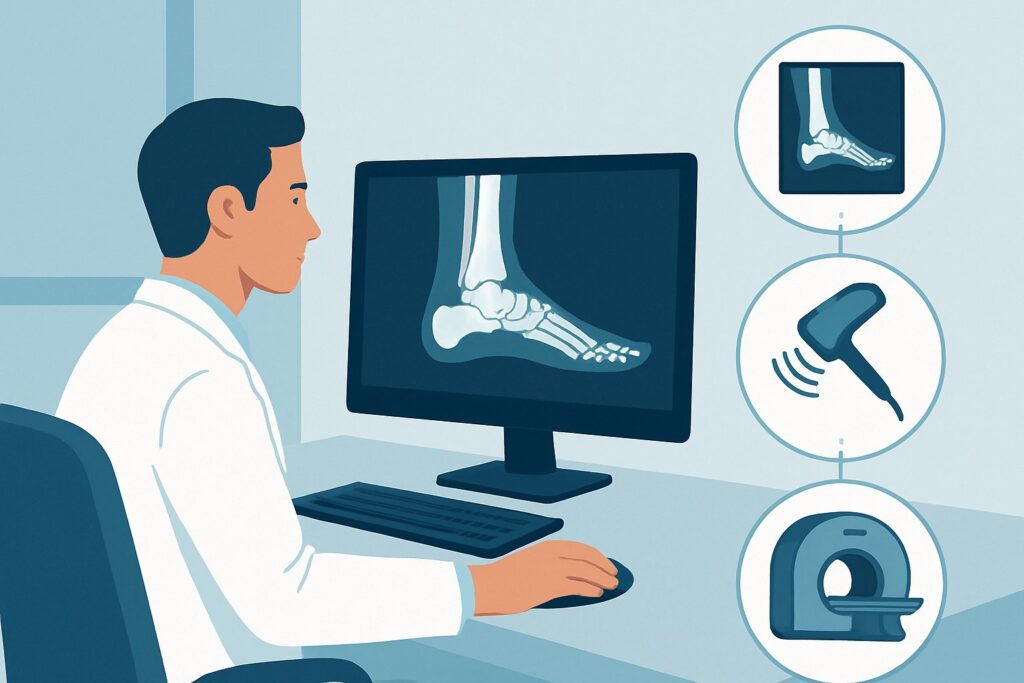
It’s a busy shift in the urgent care center. A 34-year-old construction worker presents with a painful, swollen, and erythematous right foot, three days after stepping on a nail. He pulled the nail out himself, but the site has become progressively worse. You’re concerned about a soft tissue infection, a possible abscess, and the potential for a retained foreign body fragment. The initial radiographs of the foot are normal, showing no radiopaque foreign material or signs of osteomyelitis. Now you face a critical decision: what is the next, most appropriate imaging study to order? This article provides a detailed clinical workflow for this specific scenario, guiding you through the differential, imaging rationale, and downstream management. Based on the American College of Radiology (ACR) Appropriateness Criteria, an ultrasound of the area of interest is Usually appropriate and is the recommended next step.
Who Fits This Clinical Scenario?
This guidance is specifically for patients presenting with a suspected soft tissue infection following a puncture wound, where initial radiographs are normal. The key inclusion criteria are:
- A clear history of a puncture wound (e.g., from a nail, wood splinter, glass shard).
- Clinical signs of localized soft tissue infection, such as erythema, edema, warmth, and tenderness.
- A concern for a retained foreign body that may not be visible on x-ray (e.g., wood, plastic, small glass fragments).
- Initial radiographs of the affected area have been performed and are negative for a foreign body, fracture, or osseous changes of osteomyelitis.
It is crucial to distinguish this presentation from similar but distinct clinical situations that require a different diagnostic approach. This workflow does not apply if:
- Osteomyelitis is the primary concern. If the patient has deep, focal bone tenderness, chronic symptoms, or risk factors that elevate the suspicion for bone infection over soft tissue infection, the workup follows a different path.
- Septic arthritis is suspected. If the signs of infection are centered on a joint, with pain on range of motion and a possible effusion, the imaging strategy shifts to evaluate the intra-articular space.
- Surgical hardware is present. The presence of implanted metal, such as plates or screws, creates imaging artifacts and necessitates specialized protocols, often involving MRI with metal artifact reduction sequences.
What Diagnoses Are You Working Up in This Scenario?
When a patient presents after a puncture wound with negative radiographs, your imaging choice is driven by a focused differential diagnosis. The goal is to distinguish simple cellulitis from more complex conditions that require procedural intervention.
Cellulitis vs. Abscess
This is the most common diagnostic crossroads. Cellulitis is a diffuse inflammation of the dermis and subcutaneous tissues that typically responds to antibiotics alone. An abscess, however, is a walled-off collection of purulent material that requires drainage for source control. Imaging must reliably differentiate between a phlegmon (a region of severe inflammation that may precede an abscess) and a drainable fluid collection, as this distinction fundamentally changes management.
Retained Foreign Body
Puncture wounds carry a high risk of implanting foreign material into the soft tissues. While radiographs are excellent for detecting metal or large pieces of glass, they routinely miss radiolucent materials like wood, plastic, thorns, or small glass fragments. A retained foreign body can act as a nidus for persistent or recurrent infection, and its removal is often necessary for complete resolution.
Necrotizing Fasciitis
Though less common, necrotizing fasciitis is a life-threatening emergency that must be considered in a rapidly progressing soft tissue infection, especially with pain out of proportion to physical findings. Early imaging can reveal suggestive signs like fascial thickening, fluid collections along fascial planes, or soft tissue gas, prompting immediate surgical consultation. While MRI is the most sensitive imaging modality for this diagnosis, ultrasound can often provide the first clues.
Pyomyositis
This refers to a bacterial infection within skeletal muscle, which can also lead to abscess formation. It can be a complication of a deep puncture wound that seeds bacteria directly into the muscle tissue. Imaging is essential to confirm the intramuscular location of the infection and guide potential drainage.
Why Is Ultrasound of the Area of Interest the Recommended Next Study?
For a patient with a suspected soft tissue infection and possible retained foreign body after a normal radiograph, the ACR designates US area of interest as Usually appropriate. It is often the best initial cross-sectional imaging test due to its unique combination of safety, accessibility, and diagnostic capability for this specific clinical question.
The primary strength of ultrasound is its superb soft tissue resolution without using ionizing radiation (adult and pediatric radiation relative level: O, 0 mSv). It can readily distinguish simple cellulitis (seen as diffuse thickening and echogenicity of the subcutaneous tissues, often with a “cobblestone” appearance) from a well-defined, drainable abscess (typically appearing as a complex, hypoechoic or anechoic fluid collection with posterior acoustic enhancement). Furthermore, ultrasound is highly effective at identifying many radiolucent foreign bodies. Wood, for instance, often appears as a hyperechoic structure with posterior acoustic shadowing. The sonographer can also perform a dynamic assessment, using the transducer to apply pressure and confirm the compressibility of a fluid collection or to localize a foreign body in real-time for marking or percutaneous removal.
While other advanced imaging modalities are also rated as Usually appropriate, they often serve as second-line or problem-solving tools in this context.
- MRI area of interest without and with IV contrast: MRI offers the most detailed anatomical evaluation of soft tissues, fascia, muscle, and bone marrow. It is superior to ultrasound for defining the full extent of deep infections and is the most sensitive test for necrotizing fasciitis and early osteomyelitis. However, it is more expensive, less widely available, and more time-consuming than ultrasound, making it a better choice when ultrasound is negative or equivocal and clinical suspicion remains high.
- CT area of interest with or without IV contrast: CT is excellent for detecting gas associated with necrotizing infections and can identify certain foreign bodies (like glass) better than radiographs. However, it involves ionizing radiation (RRL: Varies) and has lower soft tissue contrast resolution than both ultrasound and MRI for differentiating phlegmon from a drainable abscess.
Given its safety, low cost, high accessibility, and direct ability to answer the primary clinical questions—is there an abscess and is there a foreign body?—ultrasound is the logical and recommended first imaging study after a negative radiograph.
What’s Next After Ultrasound? Downstream Clinical Workflow
The results of the ultrasound will guide your immediate next steps and downstream management plan. The clinical pathway typically branches into one of three directions.
If the ultrasound is positive:
A definitive finding of a drainable abscess or a retained foreign body dictates procedural intervention. If an abscess is identified, the next step is typically incision and drainage (I&D). If a foreign body is clearly visualized, its location can be marked on the skin to guide removal. In some cases, ultrasound can be used in real-time to guide the procedure. Antibiotic therapy is tailored based on the procedural findings and local resistance patterns.
If the ultrasound is negative:
A negative ultrasound that shows only changes consistent with cellulitis, with no abscess or foreign body, supports a course of medical management with antibiotics and close clinical follow-up. However, if the clinical suspicion for a deep abscess, necrotizing fasciitis, or osteomyelitis remains high despite the negative ultrasound, you should escalate to a more sensitive imaging modality. In this situation, an MRI area of interest without and with IV contrast becomes the next logical step to fully evaluate the deep soft tissues, fascial planes, and adjacent bone.
If the ultrasound is indeterminate:
Sometimes, the findings are ambiguous. The sonographer may identify a complex, poorly organized fluid collection that could represent either a phlegmon (severe inflammation) or a nascent, non-drainable abscess. In these cases, management depends on the clinical picture. For a stable patient, a trial of antibiotics with close observation and a repeat ultrasound in 24-48 hours is a reasonable strategy to assess for maturation into a drainable collection. For a patient who appears toxic or is not improving, proceeding directly to MRI may be warranted to better characterize the process.
Common Pitfalls to Avoid in Puncture Wound Infections
Navigating the workup of a puncture wound infection requires vigilance to avoid common diagnostic and management errors. Be mindful of these specific pitfalls:
- Over-reliance on negative radiographs: A normal x-ray does not rule out a retained foreign body. Remember that organic materials like wood and thorns, as well as plastic and most glass, are radiolucent. The history of a puncture wound is the key driver for further imaging.
- Failing to communicate with the radiologist: When ordering the ultrasound, provide a clear and specific history. Stating “Rule out abscess and retained foreign body from wood splinter” is far more helpful than “Foot pain.” This context allows the sonographer to use appropriate techniques and focus the search.
- Delaying imaging in severe cases: If a patient presents with signs of systemic toxicity, crepitus, or pain that is disproportionate to the visible skin changes, do not delay advanced imaging or surgical consultation while awaiting an ultrasound. Necrotizing fasciitis is a surgical emergency.
- Misinterpreting ultrasound findings: A retained wood splinter can be intensely hyperechoic and may be mistaken for soft tissue gas by an inexperienced operator. Ensure the study is interpreted by a qualified radiologist who is aware of the clinical history.
If the patient is clinically deteriorating, has signs of deep space infection, or if imaging findings are complex, escalate care by obtaining an urgent surgical or infectious disease consultation.
Related ACR Topics and Tools
This article focuses on one specific clinical scenario. For a comprehensive overview of imaging for musculoskeletal infections and for tools to help you in your practice, please refer to the following resources.
- For breadth across all scenarios in Suspected Osteomyelitis, Septic Arthritis, or Soft Tissue Infection (Excluding Spine and Diabetic Foot), see our parent guide: Suspected Osteomyelitis, Septic Arthritis, or Soft Tissue Infection (Excluding Spine and Diabetic Foot): ACR Appropriateness Decoded.
- To look up other clinical variants and see the full, evidence-based ratings, use the ACR Appropriateness Criteria Lookup.
- For detailed technical guidance on performing the recommended study, consult the Imaging Protocol Library.
- To help discuss radiation exposure from CT with patients, the Radiation Dose Calculator can be a useful aid.
Frequently Asked Questions
Why not just order an MRI first, since it’s also rated ‘Usually Appropriate’?
While MRI is an excellent test, ultrasound is often preferred as the *initial* study in this scenario due to its lower cost, wider availability, faster acquisition time, and lack of ionizing radiation. It directly answers the two most pressing questions: is there a drainable abscess and is there a retained foreign body? MRI is best reserved for cases where the ultrasound is negative or inconclusive but high clinical suspicion for a deep or complex infection remains.
What types of foreign bodies can ultrasound detect that radiographs miss?
Ultrasound is particularly valuable for detecting radiolucent foreign bodies, which are invisible on x-rays. This includes common materials from puncture wounds like wood splinters, thorns, plastic fragments, and small shards of glass. These objects typically appear as bright (hyperechoic) structures on ultrasound, often with a characteristic acoustic shadow behind them.
If the ultrasound is negative, can I confidently rule out a retained foreign body?
Ultrasound is highly sensitive for detecting retained foreign bodies in the soft tissues, but it is operator-dependent and can be limited by patient body habitus, wound location, or the acoustic properties of the material. A negative, high-quality ultrasound in the hands of an experienced sonographer significantly lowers the likelihood of a retained object. However, if a strong clinical suspicion persists (e.g., a non-healing wound), MRI may be considered as it can sometimes identify foreign bodies missed by ultrasound, particularly those that incite a significant inflammatory reaction (granuloma).
Does the patient need IV contrast for this ultrasound?
No, intravenous contrast is not used for standard musculoskeletal ultrasound. The diagnostic information is obtained from the grayscale images and, importantly, from color Doppler imaging. Doppler can be used to assess for increased blood flow (hyperemia) in the inflamed tissues surrounding an abscess and to confirm the absence of flow within the fluid collection itself, helping to distinguish it from a solid mass.
How does the workup change if there are clinical signs of bone involvement?
If there is high clinical suspicion for osteomyelitis (e.g., deep pain, focal bony tenderness, or if the puncture wound was deep enough to hit bone), the diagnostic algorithm changes. While ultrasound can show fluid collections adjacent to the bone, it cannot directly visualize bone marrow infection. In this case, the ACR guidelines for suspected osteomyelitis would apply, and MRI without and with IV contrast becomes the imaging modality of choice after initial radiographs.
Reviewed by Pouyan Golshani, MD, Interventional Radiologist — May 30, 2026