Pulsatile Tinnitus Workup: Why MRA Is the ACR-Recommended First Step
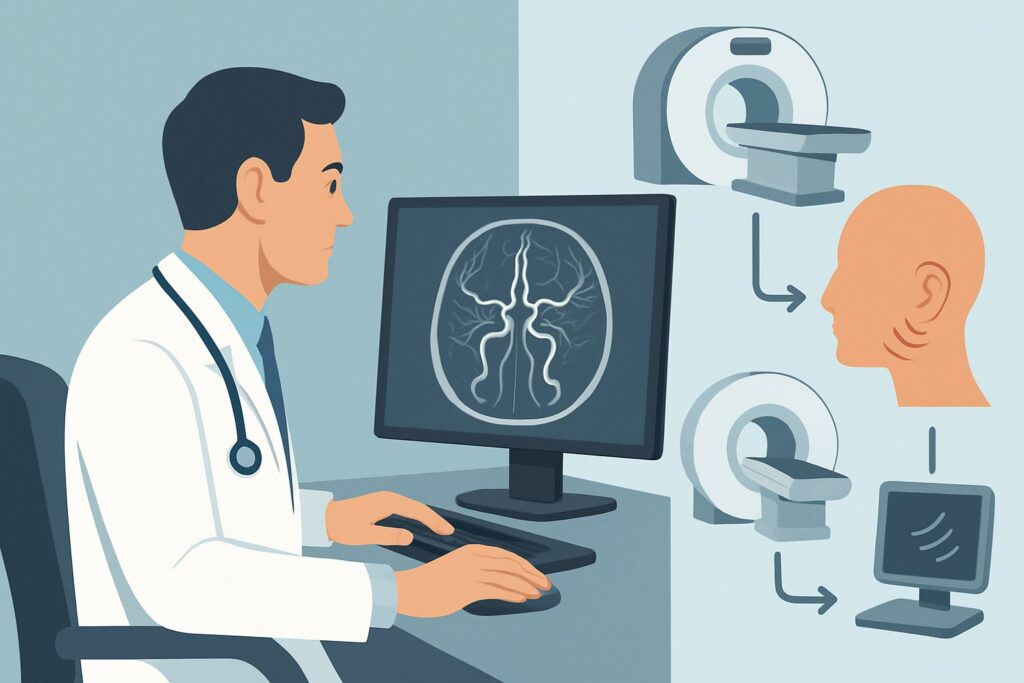
A 45-year-old woman presents to your clinic describing a “whooshing” sound in her right ear, perfectly in sync with her heartbeat. It has been a persistent nuisance for months, affecting her concentration and sleep. Your otoscopic exam is unremarkable—the tympanic membrane is clear, with no signs of a mass, discoloration, or effusion behind it. You correctly suspect a vascular etiology for her pulsatile tinnitus. The next step is imaging, but which study provides the most diagnostic yield without unnecessary radiation or risk? This article details the American College of Radiology (ACR) recommended workflow for this exact scenario: pulsatile tinnitus with a normal otoscopic exam. For this presentation, the ACR rates MRA head with IV contrast as Usually Appropriate.
Who Fits This Clinical Scenario?
This imaging workflow is designed for a specific patient presentation: an adult with pulsatile tinnitus, which can be unilateral or bilateral, who has a critical negative finding on physical exam—no visible retrotympanic lesion on otoscopy. The pulsatile nature, often described by the patient as hearing their own heartbeat, is the key feature that points toward a vascular or structural cause rather than a sensorineural one.
This guidance does not apply to patients with different presentations, which require distinct workups:
- Suspected Retrotympanic Lesion: If otoscopy reveals a reddish or bluish mass behind the tympanic membrane, the pre-test probability for a vascular tumor like a glomus tympanicum or jugulare paraganglioma is substantially higher. That scenario has its own dedicated imaging pathway, often starting with a high-resolution temporal bone CT.
- Nonpulsatile Tinnitus: Patients describing a constant ringing, buzzing, or hissing sound that is not synchronous with their pulse fall under the nonpulsatile tinnitus category. The workup for nonpulsatile tinnitus is different and often focuses on sensorineural hearing loss and retrocochlear pathology.
Confirming a normal otoscopic exam is the crucial first step to ensure you are on the correct diagnostic path outlined here.
What Diagnoses Are You Working Up in This Scenario?
With a normal otoscopic exam, the differential diagnosis for pulsatile tinnitus shifts away from middle ear masses toward vascular anomalies of the head and neck. The goal of imaging is to identify these potentially treatable and sometimes dangerous conditions.
Dural Arteriovenous Fistula (dAVF): This is one of the most critical diagnoses to exclude. A dAVF is an abnormal connection between arteries and veins in the dura mater. The resulting high-flow, high-pressure venous drainage can cause the audible bruit of pulsatile tinnitus. Left untreated, certain types of dAVFs can lead to intracranial hemorrhage or neurologic deficits.
Arterial Stenosis, Dissection, or Aneurysm: Turbulent blood flow caused by atherosclerotic disease, fibromuscular dysplasia (FMD), or a dissection of the carotid or vertebral arteries can manifest as pulsatile tinnitus. While less common, intracranial aneurysms can also be a source.
Aberrant Vasculature and Osseous Anomalies: Anatomic variants can place high-flow vessels adjacent to the cochlea. Common examples include a dehiscent or high-riding jugular bulb, an aberrant internal carotid artery coursing through the middle ear space (which may not always be visible on otoscopy), or a persistent stapedial artery.
Venous Sinus Abnormalities: Conditions like venous sinus stenosis (including idiopathic intracranial hypertension) or a sigmoid sinus diverticulum or dehiscence can create turbulent flow and a venous “hum” perceived as tinnitus.
Vascular Tumors: While a classic glomus tumor is often visible on otoscopy, smaller paragangliomas or those located outside the middle ear (e.g., carotid body tumors) can also cause pulsatile tinnitus and would not be seen on a standard ear exam.
Why Is MRA Head with IV Contrast the Recommended Study?
The ACR designates four studies as Usually Appropriate for this scenario, but Magnetic Resonance Angiography (MRA) of the head with IV contrast often serves as the best initial test, balancing diagnostic power with safety. It directly addresses the most concerning items in the differential diagnosis without using ionizing radiation (0 mSv).
The rationale for its high rating is its excellent ability to visualize arterial structures and flow dynamics. Time-resolved MRA techniques, enhanced with gadolinium-based contrast, are particularly sensitive for identifying the early venous filling characteristic of a dural arteriovenous fistula. It can also clearly define the vessel lumen to detect stenosis, dissections, and aneurysms associated with conditions like FMD or atherosclerosis.
How do alternative studies compare for this specific presentation?
- CTA head and neck with IV contrast: This is also rated Usually Appropriate and is an excellent alternative, especially if MRI is contraindicated. It provides superior spatial resolution for osseous structures and is very fast. However, its primary drawback is the use of ionizing radiation (ACR RRL ☢☢☢, 1-10 mSv), a significant consideration, particularly in younger patients who may require follow-up imaging.
- MRA head without IV contrast: This study is rated May be appropriate. While non-contrast Time-of-Flight (TOF) sequences are good for visualizing major arteries, they can be less sensitive for detecting low-flow dAVFs and may not fully characterize vessel wall abnormalities or inflammatory changes that would be visible with contrast.
When ordering, specifying the indication as “pulsatile tinnitus” is critical for the radiologist to tailor the protocol correctly, potentially including dynamic, time-resolved sequences. While the ACR recommends a contrast-enhanced study for this scenario, understanding the foundational non-contrast sequences is also crucial. Once you’ve decided on MRA, our protocol guide covers the technique for sequences like 3D Time-of-Flight: MRA Brain Without Contrast (3D TOF).
What’s Next After MRA? Downstream Workflow
The results of the initial MRA will guide your next steps, creating a clear decision tree for patient management.
- Positive for a High-Risk Lesion: If the MRA identifies a dural arteriovenous fistula, a large aneurysm, or a significant arterial dissection, the next step is an urgent referral to a Neurointerventional Radiologist or Neurosurgeon. This will typically lead to a digital subtraction angiogram (DSA), which remains the gold standard for confirming the diagnosis and planning endovascular treatment.
- Positive for Other Findings: If the study reveals atherosclerotic stenosis or findings suggestive of fibromuscular dysplasia, management will involve a neurologist or vascular specialist for medical optimization and further risk stratification.
- Negative or Inconclusive Study: If the MRA is negative but clinical suspicion for pulsatile tinnitus remains high, the workup is not necessarily over. The differential still includes venous or osseous causes that may be better characterized by other modalities. In this case, a dedicated MRV head with IV contrast (May be appropriate) can be ordered to look for venous sinus stenosis or a sigmoid diverticulum. Alternatively, if an osseous cause like a dehiscent jugular bulb is suspected, a CT temporal bone without IV contrast (May be appropriate (Disagreement)) may be warranted. Consulting with the reporting neuroradiologist can help determine the most logical next test.
Pitfalls to Avoid (and When to Get Help)
Navigating the workup for pulsatile tinnitus requires avoiding a few common diagnostic traps.
- Ordering a Non-Vascular Study: A frequent mistake is ordering a routine non-contrast CT or MRI of the brain. These studies are rated Usually not appropriate for this indication as they lack the vascular detail to identify the underlying cause and can lead to false reassurance from a “normal” report.
- Incomplete Field of View: The source of tinnitus may be in the cervical carotid or vertebral arteries. While MRA of the head is a primary recommendation, remember that CTA of the head and neck is also Usually Appropriate and ensures the full course of the great vessels is evaluated. If ordering MRA, ensure the protocol adequately covers the skull base and uppermost neck.
- Forgetting the Veins: A normal arterial study (MRA/CTA) does not rule out a venous cause. If a patient’s symptoms persist after a negative arterial-focused scan, actively consider venous pathologies and proceed to MRV or CTV as a logical next step.
If the initial imaging is negative and the patient’s symptoms are severe or progressive, it is appropriate to escalate care with a referral to an otolaryngologist or neurologist with expertise in this area.
Related ACR Topics and Tools
For a comprehensive overview of all clinical variants related to tinnitus, from pulsatile to nonpulsatile, please see our parent guide. For other tools to help refine your imaging orders, the resources below are available.
- For breadth across all scenarios in Tinnitus, see our parent guide: Tinnitus: ACR Appropriateness Decoded.
- To look up other clinical scenarios, visit the ACR Appropriateness Criteria Lookup.
- To review technical details of various studies, explore the Imaging Protocol Library.
- To discuss radiation exposure with your patients, use the Radiation Dose Calculator.
Frequently Asked Questions
Why choose MRA over CTA if both are rated ‘Usually Appropriate’ for pulsatile tinnitus?
The primary reason to prefer MRA with IV contrast is the avoidance of ionizing radiation (0 mSv for MRA vs. 1-10 mSv for CTA). This is especially important for younger patients. MRA also offers superior soft tissue contrast and can provide dynamic flow information that is highly sensitive for dural arteriovenous fistulas. CTA is an excellent alternative if the patient has contraindications to MRI or if a faster scan is needed.
What should I order if my patient has a contraindication to MRI or gadolinium contrast?
If a patient cannot undergo an MRI or receive gadolinium, CTA head and neck with IV contrast is the best alternative. It is also rated ‘Usually Appropriate’ by the ACR for this scenario and provides excellent visualization of vascular and osseous anatomy. Be sure to check renal function before administering iodinated contrast.
Does ‘no retrotympanic lesion on otoscopy’ mean I can skip the physical exam?
Absolutely not. The otoscopic exam is a critical decision point. This entire workflow is predicated on the finding of a normal exam. Identifying a retrotympanic mass completely changes the differential diagnosis, placing glomus tumors much higher on the list and shifting the recommended initial imaging study, often toward a CT of the temporal bones.
Is a venous study like MRV or CTV ever the first choice?
Generally, no. While venous pathologies are an important cause of pulsatile tinnitus, arterial causes like dural fistulas and dissections are often more urgent to diagnose. Therefore, an arterial-focused study (MRA or CTA) is the recommended first step. If that study is negative and symptoms persist, a dedicated venous study like MRV head with IV contrast is a logical next step and is rated ‘May be appropriate’ by the ACR.
My patient’s MRA was negative. What are the chances we missed something?
A high-quality, contrast-enhanced MRA of the head is very sensitive for the most significant arterial causes of pulsatile tinnitus. However, a negative study does not completely rule out a cause. Potential reasons for a negative MRA include a very low-flow dural fistula, a venous sinus abnormality not well-visualized without dedicated venogram sequences, or an osseous anomaly like a small sigmoid sinus dehiscence. If clinical suspicion remains high, the next steps are to consider MRV or a high-resolution temporal bone CT.
Reviewed by Pouyan Golshani, MD, Interventional Radiologist — June 27, 2026