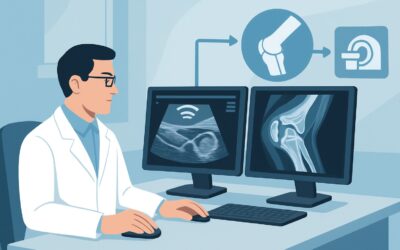
Should You Order MRI for Chronic Knee Pain with Signs of Prior Osseous Injury?

A 28-year-old patient presents with several months of chronic knee pain and a sensation of instability, which they trace back to a “bad twist” playing soccer a year ago. They never sought formal evaluation at the time. You order initial knee radiographs, and the report notes a small, corticated osseous fragment adjacent to the lateral tibial plateau, consistent with a chronic Segond fracture. The joint space appears preserved. The patient’s symptoms are now limiting their activity, and your physical exam is suspicious for ligamentous laxity. The next step is clear: you need advanced imaging to evaluate the internal structures of the knee. But which study provides the most definitive information? This article details the American College of Radiology (ACR) workflow for this specific scenario, where initial radiographs suggest a significant prior injury. For this presentation, an MRI of the knee without IV contrast is rated Usually appropriate.
Who Fits This Clinical Scenario?
This guidance applies to a specific subset of patients: adults or children aged 5 years or older presenting with chronic knee pain where the initial knee radiograph reveals evidence of a previous, significant osseous injury. These radiographic findings are often subtle but carry high clinical significance. Key examples include:
- Segond fracture: An avulsion fracture of the lateral tibial plateau, highly associated with an Anterior Cruciate Ligament (ACL) tear.
- Tibial spine (or intercondylar eminence) avulsion fracture: A fracture at the insertion of the ACL, also indicating significant ligamentous injury.
- Pellegrini-Stieda lesion: Calcification of the medial collateral ligament (MCL) at its femoral insertion, indicating a prior significant sprain or tear.
- Arcuate sign: An avulsion fracture of the fibular styloid, associated with posterolateral corner injury.
This workflow is distinct from other common knee pain scenarios. This guidance does not apply if the initial radiograph is entirely negative or if it demonstrates only degenerative changes like osteoarthritis or findings of osteochondritis dissecans. Those situations follow different diagnostic pathways. The critical feature of this scenario is a radiographic finding that acts as a “footprint” of a major past traumatic event, pointing toward underlying soft tissue damage as the likely cause of the patient’s chronic symptoms.
What Diagnoses Are You Working Up in This Scenario?
When a radiograph shows a sign of prior major trauma like a Segond fracture, the differential diagnosis shifts away from degenerative causes and focuses sharply on chronic internal derangement and instability. The imaging workup is designed to confirm and characterize the extent of these soft tissue injuries.
Anterior Cruciate Ligament (ACL) Tear
This is the primary diagnosis to confirm or exclude. A Segond fracture, in particular, is considered almost pathognomonic for an associated ACL tear. The chronic pain and instability are classic symptoms of a deficient ACL, which leads to abnormal knee kinematics and subsequent articular cartilage wear over time.
Meniscal Tear
Meniscal tears frequently accompany ACL injuries due to the same traumatic rotational forces. A “bucket-handle” tear or other complex tear can cause mechanical symptoms like locking and catching, contributing significantly to the patient’s chronic pain and dysfunction. The status of the medial and lateral menisci is a critical factor in surgical planning.
Associated Ligamentous and Soft Tissue Injury
The initial trauma may have damaged more than just the ACL. Depending on the radiographic sign, injuries to the Posterior Cruciate Ligament (PCL), Medial Collateral Ligament (MCL), or structures of the posterolateral corner may also be present. Identifying the full constellation of injuries is essential for a comprehensive diagnosis and treatment plan.
Chondral Injury and Early Osteoarthritis
Chronic instability from an untreated ligamentous injury leads to abnormal loading of the articular cartilage. This can cause chondral defects (damage to the cartilage surface) or accelerate the development of post-traumatic osteoarthritis. Advanced imaging can map the extent of cartilage damage, which has important prognostic implications.
Why Is MRI of the Knee Without IV Contrast the Recommended Study?
The ACR designates an MRI of the knee without IV contrast as Usually appropriate for this clinical scenario because it provides superior evaluation of the soft tissue structures—ligaments, menisci, and cartilage—that are the primary source of pathology.
The radiographic finding of a prior osseous injury like a Segond fracture is a strong predictor of internal derangement. The clinical question is no longer “if” there is an injury, but rather “what is the exact nature and extent of the soft tissue damage?” MRI directly visualizes these structures with unmatched detail. It can definitively diagnose a full-thickness ACL tear, characterize the morphology of a meniscal tear, and identify associated bone marrow edema, chondral defects, and other ligamentous injuries. This level of detail is crucial for guiding decisions between conservative management and surgical intervention, such as ACL reconstruction.
Let’s consider the alternatives and why they are rated lower:
- CT knee without IV contrast and CT arthrography knee are both rated May be appropriate. While CT is excellent for bone, it provides significantly less detail of the ligaments and menisci than MRI. Even with intra-articular contrast (arthrography), its ability to characterize the substance of the cruciate ligaments and menisci is inferior. Furthermore, CT involves ionizing radiation (adult RRL=☢ <0.1 mSv), whereas MRI does not (RRL=O 0 mSv).
- MR arthrography knee is rated Usually not appropriate. This invasive procedure, which involves injecting gadolinium contrast directly into the joint, is not necessary in this context. A standard non-contrast MRI provides sufficient diagnostic information to evaluate for the suspected ACL and meniscal tears. The added complexity, cost, and small risk of the injection are not justified.
- MRI knee without and with IV contrast is also Usually not appropriate. Intravenous contrast is not needed to visualize the ligaments or menisci for traumatic derangement and does not add diagnostic value for the primary differential diagnoses in this scenario.
In summary, a non-contrast MRI of the knee offers the highest diagnostic yield with no ionizing radiation, making it the most effective and safest choice for characterizing the expected internal derangement. Once you’ve decided on this study, our protocol guide covers the essential technical details. For a deeper dive into the technique, contrast considerations, and reading principles, see our complete guide: MRI Knee Without Contrast.
What’s Next After an MRI of the Knee? Downstream Workflow
The results of the MRI will directly guide the subsequent management plan, which typically involves a consultation with orthopedic surgery.
If the MRI is positive for a significant injury (e.g., ACL tear, repairable meniscal tear):
The next step is a referral to an orthopedic surgeon. The MRI findings, combined with the patient’s symptoms, activity level, and goals, will determine the treatment. For an active individual with an ACL tear and instability, the most likely recommendation will be surgical reconstruction. The MRI provides the surgeon with a detailed anatomical roadmap for pre-operative planning.
If the MRI is negative for a discrete tear:
This is an unlikely outcome given the presence of a radiographic finding like a Segond fracture. However, if the MRI shows only chronic changes, such as a healed or scarred ligament without a full-thickness tear, and no meniscal pathology, the focus shifts to non-operative management. This would primarily involve a structured physical therapy program to strengthen the surrounding musculature and improve dynamic stability. If pain persists, the diagnosis of functional instability or other pain generators would be reconsidered.
If the MRI shows complex or indeterminate findings:
In cases with extensive chondral damage, multiple ligament injuries, or findings that do not perfectly correlate with the clinical exam, an orthopedic consultation is still the critical next step. The surgeon will integrate the physical exam findings with the detailed imaging to arrive at the most accurate diagnosis and formulate a comprehensive, often multi-stage, treatment plan.
Pitfalls to Avoid (and When to Get Help)
In this scenario, the initial radiograph has already provided a major clue. The primary pitfalls involve under-appreciating its significance or choosing a suboptimal next imaging step.
- Dismissing the radiographic finding: Do not mistake a chronic Segond fracture or tibial spine avulsion for an insignificant finding. These are markers of major ligamentous injury and warrant a full workup.
- Ordering the wrong MRI: Requesting an MRI “with and without IV contrast” is unnecessary, adds cost, and exposes the patient to gadolinium without benefit for this indication. A non-contrast study is sufficient.
- Choosing CT over MRI: Unless the patient has a contraindication to MRI (e.g., incompatible hardware), MRI is the superior test for this indication due to its excellent soft tissue contrast and lack of ionizing radiation.
- Delaying advanced imaging: Allowing a patient with chronic instability to continue high-level activities without a definitive diagnosis risks further damage to the menisci and articular cartilage.
If the clinical picture and MRI findings are discordant, or if the patient has complex multi-ligamentous injuries, referral to an orthopedic surgeon specializing in sports medicine is the appropriate escalation.
Related ACR Topics and Tools
This article covers one specific variant of chronic knee pain. For a comprehensive overview of all related scenarios, from negative radiographs to degenerative joint disease, please see our parent guide. It provides a breadth of information that complements this deep-dive workflow.
- For breadth across all scenarios in Chronic Knee Pain, see our parent guide: Chronic Knee Pain: ACR Appropriateness Decoded.
- To explore other clinical scenarios, use the ACR Appropriateness Criteria Lookup.
- To review standard techniques for hundreds of studies, visit the Imaging Protocol Library.
- For discussions about radiation exposure with patients, consult the Radiation Dose Calculator.
Frequently Asked Questions
What exactly is a Segond fracture and why is it so important?
A Segond fracture is a small avulsion fracture (a piece of bone pulled off by a ligament) from the lateral edge of the tibial plateau. It is caused by internal rotation and varus stress to the knee. Its clinical importance is its extremely high association—in over 75-100% of cases—with a tear of the Anterior Cruciate Ligament (ACL). Seeing it on a radiograph essentially serves as a proxy for a major ligamentous knee injury.
Is an MRI necessary if the patient is already going to see an orthopedist?
Yes, in most cases. While an orthopedic surgeon can often diagnose an ACL tear on physical exam, the MRI is critical for pre-operative planning. It confirms the diagnosis, evaluates the menisci for tears, assesses the condition of the articular cartilage, and identifies any other associated ligamentous injuries. This complete picture is essential for the surgeon to plan the appropriate surgical procedure.
Why is MR arthrography rated ‘Usually not appropriate’ for this scenario?
MR arthrography, which involves injecting contrast directly into the joint, is typically reserved for specific indications like evaluating for a re-tear of a repaired meniscus or assessing for a labral tear in the hip or shoulder. For diagnosing a primary ACL or meniscal tear in the context of a prior injury, a standard non-contrast MRI provides excellent diagnostic accuracy. The added invasiveness, cost, and time of an arthrogram are not justified as it does not significantly improve diagnostic yield for this particular question.
Does this imaging recommendation change for a child versus an adult?
No, the recommendation for a non-contrast MRI remains the same for children 5 years and older. However, the interpretation and management may differ. In skeletally immature patients, a tibial spine avulsion fracture is more common than a mid-substance ACL tear. The MRI is crucial for determining the degree of fracture displacement and assessing for any entrapped soft tissue (like the meniscus), which guides whether the child needs surgery or can be managed in a cast.
What if the radiograph shows an old tibial spine avulsion instead of a Segond fracture?
The workflow is identical. A tibial spine (or intercondylar eminence) avulsion fracture occurs at the ACL’s insertion site on the tibia and is also a sign of a significant ACL injury. An MRI without IV contrast is still the ‘Usually appropriate’ next step to confirm the integrity of the ligament itself, assess for associated meniscal or chondral injury, and determine the degree of fracture displacement to guide treatment.
Reviewed by Pouyan Golshani, MD, Interventional Radiologist — June 27, 2026