What Imaging Should You Order for Suspected Ankle Impingement with Normal Radiographs?
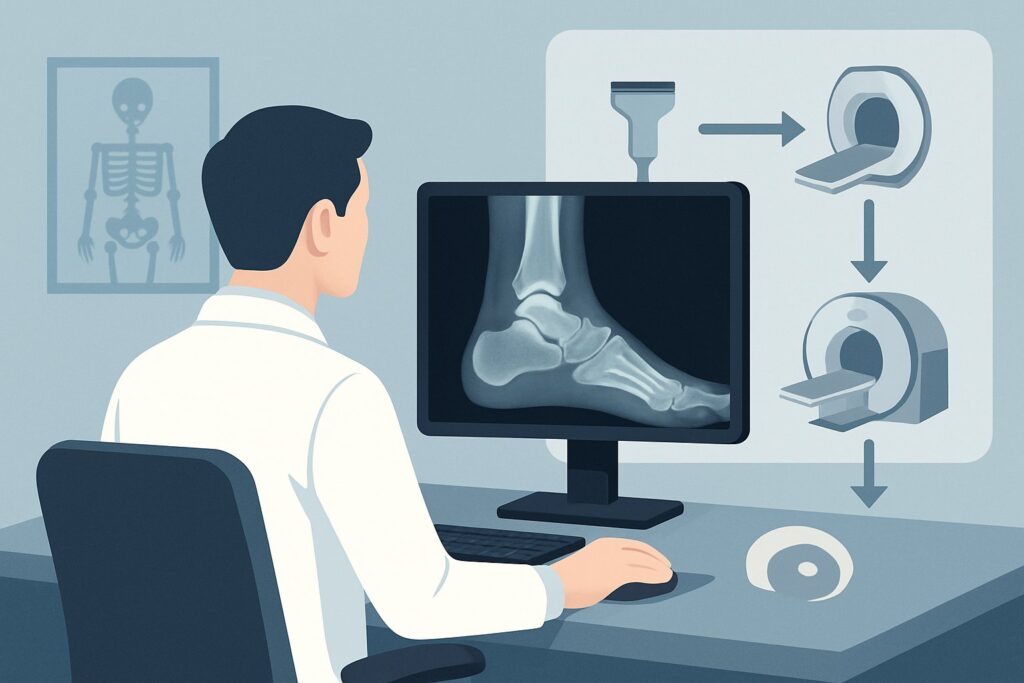
A 34-year-old former collegiate soccer player presents to your clinic with a six-month history of persistent anterior ankle pain. The pain is sharp, localized, and worsens with dorsiflexion, especially when climbing stairs or squatting. Physical examination reveals tenderness over the anterolateral joint line and reproduces the pain with forced dorsiflexion and eversion. You’ve already obtained standard ankle radiographs, which came back as normal. Your leading clinical diagnosis is ankle impingement syndrome, but you need to confirm the diagnosis and rule out other pathologies before considering arthroscopy. Which imaging study should you order next?
This article provides a detailed clinical workflow for this specific scenario, grounded in the American College of Radiology (ACR) Appropriateness Criteria. For a patient with chronic ankle pain and normal radiographs where impingement is suspected, the ACR rates MRI ankle without IV contrast as Usually Appropriate. We will explore the rationale for this recommendation, the differential diagnosis you are working up, and the downstream clinical pathway based on the imaging results.
Who Fits This Clinical Scenario for Suspected Ankle Impingement?
This guidance is tailored for a specific patient population. Correctly identifying if your patient fits this scenario is the crucial first step to ensure you order the most appropriate and value-based imaging study.
Inclusion Criteria (This article applies if your patient has):
- Chronic Ankle Pain: Symptoms have persisted for weeks or months, not days.
- Normal or Nonspecific Radiographs: Initial X-rays show no acute fracture, significant degenerative joint disease, or other clear cause for the pain. Minor, nonspecific findings like small osteophytes may be present but do not fully explain the clinical picture.
- Clinical Suspicion of Impingement: The history and physical exam point towards impingement syndrome. This typically involves pain with end-range of motion (dorsiflexion for anterior impingement, plantarflexion for posterior impingement) and localized tenderness.
Exclusion Criteria (This article does NOT apply if your patient’s primary presentation is):
- Acute Trauma: This workflow is for chronic pain. Acute injuries follow a different diagnostic pathway, often starting with the Ottawa Ankle Rules.
- Suspected Ankle Instability: If the dominant symptom is a sensation of the ankle “giving way” or recurrent sprains, the workup is different. This falls under the ACR variant for suspected ankle instability, where stress radiographs or specific MRI sequences for ligaments are prioritized.
- Suspected Tendon Abnormality: If pain and swelling are precisely localized to a specific tendon (e.g., Achilles, peroneal, or posterior tibial) and exacerbated by resisted motion, the workup is focused on tendinopathy or tear.
- Known Osteochondral Lesion: If radiographs have already identified a clear osteochondral lesion of the talus, the next step is often for characterization and surgical planning, which follows a distinct ACR variant.
What Diagnoses Are You Working Up with Suspected Ankle Impingement?
When you order an imaging study for suspected ankle impingement, you are primarily investigating a set of mechanical and soft-tissue pathologies that cause pain by getting “pinched” within the joint. The differential diagnosis guides what the radiologist will be looking for.
Anterolateral Impingement Syndrome is the most common cause in this scenario, especially in patients with a history of inversion ankle sprains. It results from the entrapment of hypertrophic synovium or fibrotic scar tissue within the anterolateral gutter of the ankle. MRI is excellent at visualizing this abnormal soft tissue, which is invisible on radiographs.
Anterior Impingement Syndrome, often called “footballer’s ankle,” is typically associated with bony spurs (osteophytes) on the anterior aspect of the distal tibia and the talar neck. While large spurs may be visible on radiographs, MRI can detect smaller spurs and, more importantly, the associated bone marrow edema and synovitis that confirm their clinical significance as the source of pain.
Posterior Impingement Syndrome is common in athletes who perform repetitive, forceful plantarflexion, such as ballet dancers or soccer players. The pain is caused by compression of soft tissues or bony structures between the posterior tibia and the calcaneus. This can involve an accessory ossicle (os trigonum), a prominent posterior talar process (Stieda process), or soft-tissue thickening, all of which are clearly delineated on MRI.
Sinus Tarsi Syndrome is a less common but important consideration. It presents as poorly localized pain in the lateral hindfoot, often with a subjective feeling of instability. The sinus tarsi is a space between the talus and calcaneus containing ligaments, vessels, and fat. MRI can reveal synovitis, scar tissue, or ligamentous injury within this space, confirming the diagnosis.
Finally, the imaging study must also serve to rule out other causes of pain that can mimic impingement, such as an occult osteochondral lesion of the talus (OLT). These cartilage and underlying bone injuries can be subtle or radiographically occult but are readily detected by MRI.
Why Is MRI Ankle without IV Contrast Usually Appropriate for This Presentation?
The American College of Radiology designates MRI ankle without IV contrast as Usually Appropriate for this clinical scenario because it provides the most comprehensive diagnostic information with no ionizing radiation. Its superior soft-tissue contrast is perfectly suited to evaluate the primary pathologies in the differential diagnosis.
MRI can directly visualize the key findings of impingement, including synovial thickening, intra-articular scar tissue (such as an abnormal Bassett’s ligament in anterolateral impingement), and fluid within the joint recesses. For bony impingement, it not only shows the osteophytes but also the associated bone marrow edema, which confirms that the bony abnormality is the active pain generator. Furthermore, MRI is the gold standard for detecting occult osteochondral lesions, stress fractures, and subtle ligamentous injuries that are invisible on plain films.
The recommendation specifically calls for an MRI without intravenous contrast. For the vast majority of impingement cases, the intrinsic contrast between synovium, fluid, cartilage, and scar tissue on standard non-contrast sequences is sufficient for diagnosis. Adding gadolinium-based contrast agents (Usually Not Appropriate) does not typically improve diagnostic yield for this indication and introduces unnecessary cost and potential risks (e.g., nephrogenic systemic fibrosis in patients with renal impairment, gadolinium deposition).
How do alternative studies compare for this specific scenario?
- Ultrasound (US) ankle: Rated as May be appropriate, ultrasound can be a useful, dynamic tool in experienced hands. It can visualize synovial thickening and perform dynamic assessment to see tissue being pinched. However, it is highly operator-dependent, has a limited field of view, and cannot assess for intraosseous pathology like bone marrow edema or occult osteochondral lesions.
- CT ankle without IV contrast: Also rated as May be appropriate, CT excels at delineating bony anatomy, making it useful for assessing the size and location of osteophytes in anterior or posterior bony impingement. However, it provides very limited information about the soft-tissue components (synovitis, scar tissue) that are central to the diagnosis of most impingement syndromes. It also involves a small amount of ionizing radiation (adult RRL ☢ <0.1 mSv).
Therefore, a non-contrast MRI of the ankle remains the single best next step, offering a complete evaluation of both the soft-tissue and osseous structures relevant to suspected impingement syndrome after normal radiographs.
What’s Next After MRI Ankle without IV Contrast? Downstream Workflow
The MRI report is not the end of the diagnostic journey; it’s the map for the next phase of management. Your downstream workflow will diverge based on the findings.
If the MRI is positive for impingement syndrome:
A definitive finding of synovial thickening, scar tissue, or bony impingement with associated edema confirms the clinical diagnosis. The next step is typically a trial of conservative management, including physical therapy, activity modification, and possibly a corticosteroid injection. If these measures fail, the MRI provides a precise anatomical roadmap for surgical intervention, such as arthroscopic debridement.
If the MRI is negative or shows only nonspecific findings:
A truly negative MRI is a valuable result, as it effectively rules out most structural causes of the patient’s pain. The workup may then shift towards non-structural causes or reconsider the initial diagnosis. If clinical suspicion for impingement remains very high despite a negative MRI, an image-guided anesthetic injection (May be appropriate (Disagreement)) can serve as a diagnostic and potentially therapeutic tool. A positive response (significant pain relief) can confirm a diagnosis of impingement even with subtle imaging findings, potentially justifying arthroscopy.
If the MRI reveals an alternative diagnosis:
The study may uncover an unexpected cause for the pain, such as an osteochondral lesion, a stress fracture, or significant tendinopathy. Each of these findings initiates a different treatment pathway. For instance, an osteochondral lesion would pivot the workup to the ACR variant for that specific condition, potentially requiring further imaging like CT arthrography or referral to an orthopedic surgeon specializing in cartilage restoration.
Pitfalls to Avoid (and When to Get Help)
Navigating the workup for suspected ankle impingement requires avoiding a few common pitfalls to ensure an accurate and efficient diagnosis.
- Ordering a contrast-enhanced MRI unnecessarily: For standard impingement evaluation, IV contrast is rated Usually Not Appropriate. It adds cost and potential risk without improving diagnostic accuracy for this indication. Stick to the non-contrast protocol unless the radiologist recommends contrast for a specific unexpected finding.
- Accepting a low-quality MRI: Ankle MRI requires high-resolution imaging with specific sequences. If a study is degraded by motion artifact or performed on a low-field-strength magnet, subtle findings like synovial thickening can be missed. Do not hesitate to ask for a repeat study if the quality is suboptimal.
- Over-reliance on the imaging report: Always correlate the MRI findings with your clinical examination. A small osteophyte seen on MRI may be an incidental finding, not the cause of pain. The presence of associated bone marrow edema or synovitis is key to confirming its clinical relevance.
If the diagnosis remains elusive after a high-quality MRI, or if the findings are complex, this is the time to escalate. A consultation with a musculoskeletal radiologist to review the images or a referral to an orthopedic foot and ankle specialist is the appropriate next step.
Related ACR Topics and Tools
This article focuses on a single clinical scenario. For a comprehensive overview of all variants related to chronic ankle pain, or to explore the technical details of the recommended imaging studies, the following resources are invaluable.
- For breadth across all scenarios in Chronic Ankle Pain, see our parent guide: Chronic Ankle Pain: ACR Appropriateness Decoded.
- To explore other clinical situations, use the Imaging Appropriateness Selector.
- For technical specifications on imaging protocols, consult the Imaging Protocol Library.
- To discuss radiation exposure with patients for CT or other modalities, the Radiation Dose Calculator can help quantify and explain the dose.
Frequently Asked Questions
Why not start with an ultrasound for suspected ankle impingement?
Ultrasound is rated ‘May be appropriate’ and can be a good first choice in some settings, especially for dynamic assessment of soft-tissue impingement. However, its effectiveness is highly dependent on the skill of the operator, and it cannot evaluate for bone marrow edema or occult cartilage lesions. MRI provides a more comprehensive and reproducible evaluation, which is why it is rated ‘Usually Appropriate’ as the definitive next step after radiographs.
Is an MR arthrogram better than a standard MRI for this scenario?
MR arthrography, which involves injecting contrast directly into the joint, is rated ‘May be appropriate’. It is excellent for evaluating intra-articular structures like the cartilage surface and ligaments in detail. However, for the primary question of soft-tissue or bony impingement, a standard non-contrast MRI is typically sufficient and less invasive. MR arthrography is generally reserved for cases where there is a high suspicion of an osteochondral lesion or subtle instability.
My patient’s radiograph showed a small anterior tibial spur. Do I still need an MRI?
Yes. While the radiograph identifies a potential cause of bony impingement, an MRI is still valuable. It will confirm if the spur is clinically significant by showing associated bone marrow edema and synovitis. More importantly, it will evaluate for concurrent soft-tissue impingement and rule out other potential causes of pain, providing a complete picture for treatment planning.
What if the MRI is negative but my clinical suspicion for impingement is very high?
This is a key clinical dilemma. If a high-quality MRI is truly negative, the next step could be a diagnostic, image-guided injection of local anesthetic into the suspected area of impingement. If the patient’s pain is temporarily but significantly relieved, it provides strong evidence for impingement syndrome, even in the absence of clear MRI findings. This can help guide a decision for arthroscopy.
Does this guidance apply to children and adolescents?
Yes, the ACR recommendations for this scenario are the same for pediatric patients, with MRI without contrast also rated as ‘Usually Appropriate’. Given the complete absence of ionizing radiation, MRI is an especially attractive modality in younger patients. The differential diagnosis in adolescents may also include physeal (growth plate) injuries, which are well-visualized on MRI.
Reviewed by Pouyan Golshani, MD, Interventional Radiologist — May 26, 2026