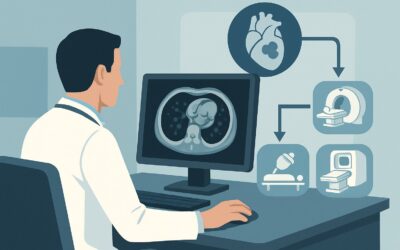
What Imaging Should You Order for Suspected Arrhythmogenic Cardiomyopathy?

A 32-year-old patient presents to your clinic after an episode of syncope during a pickup basketball game. An electrocardiogram (ECG) in the emergency department showed frequent premature ventricular contractions (PVCs) and a brief run of non-sustained ventricular tachycardia. A basic workup has already excluded coronary artery disease and other common causes of syncope. You now face the critical question of how to investigate for an underlying structural heart problem, with arrhythmogenic cardiomyopathy high on your differential. This article provides a step-by-step clinical workflow for this specific scenario, guiding your initial imaging choice based on the American College of Radiology (ACR) Appropriateness Criteria. For this presentation, the ACR rates `US echocardiography transthoracic resting` as Usually Appropriate.
Who Fits This Clinical Scenario?
This guidance applies to patients presenting with clinical manifestations suggestive of an arrhythmogenic cardiomyopathy (AC), where ischemic heart disease has already been reasonably excluded. The typical patient is a young or middle-aged adult with symptoms of ventricular arrhythmia, such as palpitations, presyncope, or syncope. The presenting arrhythmia may range from frequent PVCs to sustained ventricular tachycardia. A significant family history of premature sudden cardiac death is a major red flag that places a patient squarely in this scenario.
This workflow is distinct from other nonischemic cardiomyopathy workups. It is NOT for patients whose primary presentation is:
- Suggestive of hypertrophic cardiomyopathy: These patients often have a harsh systolic murmur, significant left ventricular hypertrophy on ECG, and a different set of diagnostic criteria.
- Suggestive of restrictive or infiltrative disease: This presentation typically involves signs and symptoms of diastolic heart failure (e.g., peripheral edema, elevated jugular venous pressure) often out of proportion to systolic dysfunction.
- Suggestive of inflammatory cardiomyopathy (myocarditis): This scenario is often preceded by a viral illness and may be accompanied by chest pain, fever, and elevated inflammatory markers like troponin and C-reactive protein.
Correctly identifying your patient’s primary clinical syndrome is crucial for selecting the most appropriate initial imaging test.
What Diagnoses Are You Working Up in This Scenario?
When you suspect arrhythmogenic cardiomyopathy, you are investigating a group of genetic heart muscle diseases that predispose patients to life-threatening ventricular arrhythmias and sudden cardiac death. The differential is focused but includes important mimics.
Arrhythmogenic Right Ventricular Cardiomyopathy (ARVC) is the classic and most common diagnosis in this category. It is characterized by the progressive replacement of the right ventricular (RV) myocardium with fibrofatty tissue. This structural change creates the substrate for re-entrant ventricular arrhythmias and can lead to RV dilation and dysfunction over time.
Arrhythmogenic Left Ventricular Cardiomyopathy (ALVC) is a less common variant where the fibrofatty replacement predominantly affects the left ventricle. Patients may present similarly with ventricular arrhythmias but without the classic RV abnormalities on imaging, making it a diagnostic challenge.
Cardiac Sarcoidosis is a key mimic. This inflammatory disease involves the formation of granulomas in the myocardium, which can disrupt the heart’s electrical system and cause ventricular arrhythmias. It can affect any chamber and may present with imaging findings that overlap significantly with ARVC, particularly late gadolinium enhancement on MRI.
Idiopathic Ventricular Tachycardia is a diagnosis of exclusion. This refers to VT originating from a specific location (e.g., the RV outflow tract) in a structurally normal heart. While initial imaging is essential to rule out underlying cardiomyopathy, the heart may appear entirely normal, shifting the focus to electrophysiologic testing and catheter ablation.
Why Is US Echocardiography Transthoracic Resting the Recommended Initial Study?
For a patient with suspected arrhythmogenic cardiomyopathy, the ACR designates `US echocardiography transthoracic resting` as a Usually Appropriate initial imaging study. This recommendation is based on its accessibility, lack of ionizing radiation (0 mSv), and ability to provide crucial initial information about cardiac structure and function.
The primary goal of the initial echo is to assess for major structural criteria of ARVC. The sonographer and interpreting physician will specifically look for evidence of right ventricular dilation, reduced RV systolic function (e.g., fractional area change), and regional RV wall motion abnormalities like akinesis (lack of motion), dyskinesis (abnormal outward motion), or aneurysm formation. While echo is less sensitive than cardiac MRI for detecting subtle or early disease, a clearly abnormal study can rapidly advance the diagnostic process. Its widespread availability and low cost make it the logical first step in the imaging cascade.
It is important to note that `MRI heart function and morphology without and with IV contrast` is also rated as Usually Appropriate. Cardiac MRI is the gold standard non-invasive imaging modality for AC, offering superior tissue characterization to detect fibrofatty infiltration and myocardial fibrosis (via late gadolinium enhancement). However, echo is often performed first due to its practicality.
Other imaging modalities are rated lower for this specific initial workup:
- `US echocardiography transesophageal` is Usually Not Appropriate. While excellent for visualizing posterior structures like the left atrium, it provides suboptimal views of the RV free wall and apex, which are critical areas of interest in ARVC.
- `CTA coronary arteries with IV contrast` is Usually Not Appropriate in this context. Ischemic disease has already been excluded, and while cardiac CT can assess morphology and function, it involves significant radiation (☢☢☢ 1-10 mSv) and lacks the detailed tissue characterization provided by MRI.
What’s Next After US Echocardiography Transthoracic Resting? Downstream Workflow
The results of the initial transthoracic echocardiogram will guide your next steps, but it is rarely the final step in the workup for arrhythmogenic cardiomyopathy.
If the echo is clearly positive and demonstrates major criteria for ARVC (e.g., severe RV dilation and dysfunction with regional wall motion abnormalities), the diagnosis is strongly supported. The next step is typically a comprehensive risk stratification, which includes cardiac MRI to quantify the extent of disease and assess for left ventricular involvement, ambulatory ECG monitoring to quantify arrhythmia burden, and an electrophysiology (EP) consultation to discuss further testing and potential implantation of a cardioverter-defibrillator (ICD).
If the echo is negative or shows only minor, non-specific abnormalities, but your clinical suspicion remains high (due to arrhythmia type, family history, or ECG findings), you should proceed directly to cardiac MRI. Echocardiography has limited sensitivity for early-stage ARVC, and a normal echo does not rule out the disease. Cardiac MRI with contrast is essential to look for more subtle structural changes and tissue-level pathology like fibrofatty infiltration or fibrosis.
If the echo suggests an alternative diagnosis, the workflow pivots. For instance, if the study reveals severe, global left ventricular dysfunction without RV abnormalities, the workup would shift to the pathway for suspected nonischemic dilated cardiomyopathy. If it shows significant, unexplained left ventricular hypertrophy, the focus moves to the workup for hypertrophic cardiomyopathy.
Pitfalls to Avoid (and When to Get Help)
Navigating the workup for suspected arrhythmogenic cardiomyopathy requires careful interpretation and a low threshold for further investigation. Here are common pitfalls to avoid:
- Stopping the workup after a normal echo: This is the most critical pitfall. Given the low sensitivity of echo for early disease, a normal study in a patient with high-risk features (e.g., syncope, ventricular tachycardia) must be followed by a cardiac MRI.
- Misinterpreting athletic heart changes: Intense endurance training can cause physiologic RV dilation and ECG changes that mimic ARVC. A thorough athletic history and consultation with a sports cardiologist may be necessary to differentiate these conditions.
- Forgetting about the left ventricle: While ARVC is the classic form, remember that arrhythmogenic cardiomyopathy can also primarily involve the left ventricle (ALVC) or be biventricular. Always scrutinize LV structure and function.
If a patient presents with sustained ventricular tachycardia, hemodynamic instability, or recurrent syncope, immediate escalation to an electrophysiologist or admission to a specialized center is warranted for urgent evaluation and management.
Related ACR Topics and Tools
This article focuses on a single clinical scenario. For a comprehensive overview of imaging for all forms of nonischemic myocardial disease, please consult the parent topic hub article. For additional tools to aid in your clinical decision-making, see the resources below.
- For breadth across all scenarios in Nonischemic Myocardial Disease with Clinical Manifestations (Ischemic Cardiomyopathy Already Excluded), see our parent guide: Nonischemic Myocardial Disease with Clinical Manifestations (Ischemic Cardiomyopathy Already Excluded): ACR Appropriateness Decoded.
- To explore other clinical presentations, use the Imaging Appropriateness Selector.
- For detailed procedural techniques, visit the Imaging Protocol Library.
- To discuss radiation exposure with patients, use the Radiation Dose Calculator.
Frequently Asked Questions
Why is cardiac MRI also rated ‘Usually Appropriate’ if echocardiography is the recommended first step?
While transthoracic echocardiography is the best initial test due to its accessibility and lack of radiation, cardiac MRI is considered the non-invasive gold standard for diagnosing arrhythmogenic cardiomyopathy. It provides superior visualization of the right ventricle and, crucially, allows for tissue characterization to detect fibrofatty infiltration and fibrosis (scar), which are hallmarks of the disease. In many cases, echo is a screening tool, and a subsequent MRI is required for definitive diagnosis, especially if the echo is normal or equivocal but clinical suspicion is high.
What is the role of genetic testing in suspected arrhythmogenic cardiomyopathy?
Genetic testing plays a crucial role. Arrhythmogenic cardiomyopathy is a genetic disease, most commonly associated with mutations in genes encoding desmosomal proteins. Identifying a pathogenic mutation can confirm a diagnosis, facilitate cascade screening of family members, and may have prognostic implications. It is typically recommended for patients who meet or have borderline diagnostic criteria after a full clinical and imaging evaluation.
Does a normal echocardiogram and a normal cardiac MRI rule out arrhythmogenic cardiomyopathy?
While a normal, high-quality cardiac MRI makes a diagnosis of arrhythmogenic cardiomyopathy very unlikely, it may not completely rule it out in all cases. Some individuals may be ‘genotype-positive, phenotype-negative,’ meaning they carry a pathogenic mutation but have not yet developed detectable structural heart disease. In patients with a very high-risk profile (e.g., malignant family history, high-risk arrhythmia), ongoing surveillance and consultation with an electrophysiology specialist are still necessary even with normal imaging.
When should I consider an endomyocardial biopsy?
Endomyocardial biopsy is rarely used for the primary diagnosis of ARVC due to its low diagnostic yield (the disease is often patchy) and procedural risks. Its main role is in cases where an inflammatory or infiltrative process, such as cardiac sarcoidosis or giant cell myocarditis, is a strong competing diagnosis that cannot be excluded by non-invasive imaging. The decision to proceed with a biopsy should be made in consultation with a heart failure or cardiomyopathy specialist.
How does the workup change if the patient has a strong family history of sudden cardiac death?
A strong family history of sudden cardiac death significantly increases the pre-test probability of an inherited cardiomyopathy. In this context, the threshold to proceed with advanced imaging should be very low. Even if the initial echocardiogram is completely normal, a cardiac MRI is almost always warranted to look for subtle signs of disease. Early consultation with a genetic counselor and an electrophysiologist is also highly recommended.
Reviewed by Pouyan Golshani, MD, Interventional Radiologist — May 26, 2026