What Imaging Should You Order for Suspected Post-CPR Rib Fractures?
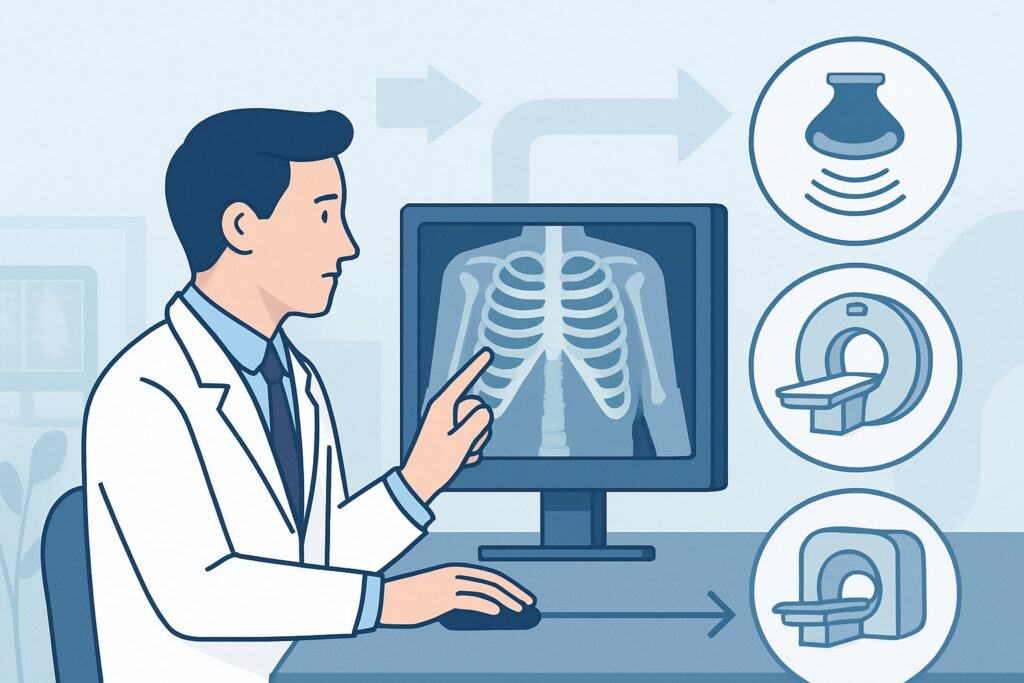
A 72-year-old man is successfully resuscitated following a witnessed cardiac arrest in the emergency department. After return of spontaneous circulation and stabilization, he is intubated but awake enough to localize pain to his anterior chest wall. You feel palpable crepitus over the left sternal border and are concerned about iatrogenic injuries from the prolonged cardiopulmonary resuscitation (CPR). The immediate clinical question is what imaging study to order first to assess for rib fractures and, more importantly, associated life-threatening complications. According to the American College of Radiology (ACR) Appropriateness Criteria, a standard `Radiography chest` is rated Usually Appropriate as the initial imaging step in this specific scenario.
Who Fits This Clinical Scenario for Post-CPR Rib Fractures?
This clinical workflow applies to any patient, adult or pediatric, who has recently undergone CPR with manual chest compressions and now has clinical signs or symptoms suggesting thoracic injury. Key indicators include focal chest wall pain, tenderness, palpable crepitus, chest wall deformity, or splinting with respiration. The patient is presumed to be hemodynamically stable enough to undergo initial diagnostic imaging, as unstable patients would proceed directly to life-saving interventions.
It is critical to distinguish this scenario from similar but distinct clinical presentations that require different imaging pathways:
- Minor Blunt Trauma: If a patient has suspected rib fractures from a minor fall or blow to the chest but did not undergo CPR, that falls under the sibling ACR scenario for minor blunt trauma. The management and imaging considerations differ slightly as the mechanism of injury is different.
- Suspected Pathologic Fracture: If there is a concern for a pathologic fracture (e.g., in a patient with known metastatic cancer or severe osteoporosis where a fracture may occur with minimal or no trauma), the workup is aimed at characterizing the underlying bone lesion, which follows a separate ACR guideline.
- Major Multi-System Trauma: A patient who receives CPR as part of a resuscitation from high-energy, multi-system trauma (e.g., a motor vehicle collision) will typically be evaluated under advanced trauma life support (ATLS) protocols, which often involve whole-body CT scanning and are outside the scope of this specific guideline.
What Diagnoses Are You Working Up After Cardiopulmonary Resuscitation?
The goal of initial imaging after CPR is not merely to count rib fractures but to identify or exclude associated injuries that can cause rapid clinical deterioration. The differential diagnosis is driven by the mechanics of chest compressions and positive-pressure ventilation.
Rib Fractures: This is the most common skeletal injury following CPR. Fractures are most frequently seen in the anterior and lateral ribs. The presence of multiple fractures, especially if displaced, increases the risk of underlying organ injury and respiratory compromise (flail chest).
Sternal Fracture: Also a common consequence of chest compressions, sternal fractures can be difficult to visualize on standard radiographs but are an important source of post-resuscitation pain. A displaced sternal fracture raises concern for underlying mediastinal injury.
Pneumothorax and/or Hemothorax: These are the most critical, life-threatening complications to identify. A fractured rib end can easily puncture the visceral pleura, leading to lung collapse (pneumothorax) or bleeding into the pleural space (hemothorax). These conditions require immediate intervention, such as chest tube placement.
Pulmonary Contusion: Bruising of the lung parenchyma can result from the direct force of compressions. This can lead to hypoxia and mimic pneumonia on imaging, impacting ventilator management and overall respiratory care.
Mediastinal Injury: While less common, severe force can cause injury to the heart, great vessels, or tracheobronchial tree. While a chest radiograph has low sensitivity for these, it can reveal secondary signs like a widened mediastinum or pneumomediastinum that would prompt more advanced imaging.
Why Is a Chest Radiograph the Recommended Initial Study After CPR?
The ACR designates `Radiography chest` as Usually appropriate for the initial evaluation of suspected rib fractures after CPR because it provides the best balance of diagnostic utility, speed, safety, and availability in the acute setting.
The primary role of the initial chest radiograph is not to find every single non-displaced fracture but to rapidly screen for the clinically significant complications discussed above. A portable anteroposterior (AP) chest X-ray can be performed quickly at the bedside without moving a potentially unstable patient. It is highly effective for detecting a moderate-to-large pneumothorax, a significant hemothorax, or extensive pulmonary contusion—diagnoses that directly alter immediate patient management. Furthermore, it involves a very low radiation dose (adult RRL ☢ <0.1 mSv).
Other imaging modalities are rated lower for this specific initial workup for several key reasons:
- Radiography rib views: Rated May be appropriate. While dedicated rib views are more sensitive for detecting subtle or non-displaced fractures, they deliver a substantially higher radiation dose (adult RRL ☢☢☢ 1-10 mSv) and rarely change acute management. The information gained often does not justify the additional radiation and patient movement, especially when the primary concern is ruling out life-threatening complications visible on a standard chest film.
- CT chest without IV contrast: Rated May be appropriate. CT is far more sensitive than radiography for detecting all rib and sternal fractures, as well as small pneumothoraces and pulmonary contusions. However, it is reserved as a second-line or problem-solving tool. Using it as the initial study is often unnecessary, involves more radiation (adult RRL ☢☢☢ 1-10 mSv), and requires transporting the patient to the CT scanner.
- US chest: Rated Usually not appropriate. While bedside ultrasound is excellent for detecting pneumothorax (as part of an e-FAST exam), the ACR does not recommend it as the primary comprehensive imaging tool in this scenario because it provides a limited evaluation of the entire thorax, cannot reliably assess for hemothorax severity, and is highly operator-dependent for fracture detection.
What Is the Downstream Workflow After the Initial Chest Radiograph?
The results of the initial chest radiograph guide the subsequent clinical and diagnostic pathway. The workflow is a decision tree based on the findings.
- If the radiograph is positive for pneumothorax or large hemothorax: The next step is therapeutic, not diagnostic. The patient requires immediate intervention, typically with needle decompression or chest tube thoracostomy. The imaging has successfully identified a life-threatening, correctable condition.
- If the radiograph shows multiple displaced rib fractures or a flail segment: Management focuses on aggressive pain control, pulmonary toilet, and respiratory support. These patients are at high risk for developing pneumonia or respiratory failure. No further imaging is typically needed unless new symptoms arise, such as increasing oxygen requirement or signs of infection.
- If the radiograph is negative but clinical suspicion remains high: If the patient has severe, localized pain, a palpable deformity, or worsening respiratory status despite a normal chest X-ray, it is reasonable to consider a more sensitive study. A `CT chest without IV contrast` (May be appropriate) can be performed to look for occult fractures, a small pneumothorax, or pulmonary contusion not visible on the radiograph.
- If the radiograph is negative and the patient is clinically stable: For many patients, a negative chest radiograph is sufficiently reassuring. Management can proceed with supportive care, including analgesia and incentive spirometry, with a plan for clinical re-evaluation. Imaging has successfully ruled out immediate life-threatening injury.
Pitfalls to Avoid (and When to Get Help)
Navigating the post-CPR evaluation requires avoiding several common pitfalls. First, do not fixate on simply counting rib fractures; the primary goal is to identify and manage the associated complications like pneumothorax. Second, avoid ordering dedicated rib views as the initial study, as they add radiation without significantly altering acute management. Third, remember that a negative chest radiograph does not completely rule out a fracture; maintain a high index of suspicion in patients with persistent, severe, focal pain. Finally, do not delay imaging in a patient with any signs of respiratory distress or hemodynamic instability post-resuscitation. If the patient develops worsening hypoxia, hypotension, or has signs of a widened mediastinum on the initial radiograph, escalate immediately for surgical or critical care consultation and consider urgent advanced imaging like a CT angiogram to rule out major vascular injury.
Related ACR Topics and Tools
For a comprehensive overview of imaging for all rib fracture scenarios, from minor trauma to pathologic causes, please see our parent topic hub article. The following GigHz tools can also support your clinical decision-making for this and other thoracic imaging scenarios.
- For breadth across all scenarios in Rib Fractures, see our parent guide: Rib Fractures: ACR Appropriateness Decoded.
- For adjacent scenarios and different clinical presentations, consult the Imaging Appropriateness Selector.
- For details on imaging techniques, explore the Imaging Protocol Library.
- To discuss cumulative exposure with patients or teams, use the Radiation Dose Calculator.
Frequently Asked Questions
Why not just get a CT scan on every post-CPR patient to be sure?
While a CT scan is more sensitive for fractures, the ACR recommends a chest radiograph as the initial study because it is faster, uses significantly less radiation, can be done portably at the bedside, and is excellent at detecting the immediate, life-threatening complications (like a large pneumothorax) that require urgent intervention. A CT is reserved for cases where the radiograph is inconclusive or when there is high clinical suspicion for an injury not seen on the initial film.
Does the imaging recommendation change if the patient is a child?
No, the ACR recommendation for an initial chest radiograph remains the same for the pediatric population. Radiation stewardship is even more critical in children, making the low-dose chest radiograph (pediatric RRL ☢ <0.03 mSv) the strongly preferred first step over a higher-dose CT scan.
If the chest X-ray is normal, can I confidently rule out a rib fracture?
Not entirely. A standard chest radiograph can miss non-displaced or hairline rib fractures. However, its primary purpose in this acute setting is to rule out major complications. If the X-ray is normal and the patient is stable, management is typically supportive regardless of a potential occult fracture. If pain is severe and localized, a CT scan may be considered as a next step.
What if I suspect a sternal fracture instead of a rib fracture?
A standard AP chest radiograph is not very sensitive for sternal fractures. A lateral chest view can sometimes show a displaced sternal fracture, but CT is the definitive imaging modality. However, the initial management is the same: start with a standard chest radiograph to rule out associated injuries like pneumomediastinum or hemothorax. If the radiograph is unrevealing but suspicion for a significant sternal injury is high, a CT may be warranted.
Is there any role for a bone scan in this scenario?
No, a bone scan is rated as Usually not appropriate in the acute post-CPR setting. A bone scan is a nuclear medicine study that is highly sensitive for bone turnover and is used to detect stress fractures, occult fractures, or metastatic disease, but it takes hours to perform and provides no information about acute complications like pneumothorax or hemorrhage. It has no role in the initial evaluation.
Reviewed by Pouyan Golshani, MD, Interventional Radiologist — May 26, 2026