What Is the Best Initial Imaging for a Patient with Suspected Active Tuberculosis?
A 45-year-old man presents to your clinic with a six-week history of a productive cough, intermittent fevers, night sweats, and an unintentional 15-pound weight loss. He has a history of travel to a region with endemic tuberculosis. You are concerned about active pulmonary TB and know that prompt diagnosis is critical for both the patient’s health and for public health. The immediate clinical question is which imaging study to order first to evaluate his lungs. This article provides a detailed workflow for this specific scenario, based on the American College of Radiology (ACR) Appropriateness Criteria, which rates chest radiography as Usually appropriate for the initial evaluation of suspected active tuberculosis.
Who Fits This Clinical Scenario?
This guidance applies to patients for whom there is a clinical suspicion of active pulmonary tuberculosis. This suspicion is typically based on a constellation of signs and symptoms, which may include a persistent cough (often lasting more than 2-3 weeks), hemoptysis, fever, drenching night sweats, unexplained weight loss, and fatigue. The pre-test probability is often elevated by risk factors such as known exposure to an individual with active TB, birth or extended residence in a high-prevalence country, substance use, or living in a congregate setting like a shelter or correctional facility. Immunocompromised patients, including those with HIV, diabetes, or on immunosuppressive medications, also fit this scenario.
This workflow is distinct from the evaluation of asymptomatic individuals. This guidance does not apply to patients who have a newly positive tuberculin skin test (PPD) or interferon-gamma release assay (IGRA) but no clinical symptoms. That situation represents a workup for latent TB infection, not active disease. Similarly, this article does not cover the scenario of an asymptomatic individual requiring screening for placement in a group home or skilled nursing facility. The presence of clinical symptoms suggesting active disease is the key differentiator for applying this imaging pathway.
What Diagnoses Are You Working Up in This Scenario?
When ordering imaging for a patient with symptoms suggestive of active TB, you are evaluating for several potential diagnoses. The differential is broad, but imaging helps narrow the possibilities and guide subsequent microbiologic testing.
Active Pulmonary Tuberculosis is the primary diagnosis of concern. Imaging is used to identify characteristic findings such as parenchymal consolidation, particularly in the apical and posterior segments of the upper lobes or the superior segments of the lower lobes. The presence of cavitation (a hallmark of post-primary TB), hilar or mediastinal lymphadenopathy, and pleural effusions are key features that increase suspicion.
Bacterial Pneumonia, especially community-acquired pneumonia that is slow to resolve, can mimic the symptoms of TB. While typical lobar consolidation is more common in bacterial pneumonia, atypical presentations can overlap significantly with TB, making imaging a crucial first step before committing to a specific antimicrobial regimen.
Fungal Infections, such as histoplasmosis, coccidioidomycosis, or blastomycosis, can produce clinical and radiographic findings nearly identical to tuberculosis, including cavitary lesions and lymphadenopathy. The patient’s travel and exposure history are critical clues, as these infections are endemic to specific geographic regions.
Malignancy, particularly bronchogenic carcinoma (e.g., squamous cell carcinoma), can present with a cavitary lung mass that mimics TB. Lymphoma may present with mediastinal and hilar adenopathy. In an older patient or a patient with a significant smoking history, malignancy must be considered a key differential diagnosis.
Why Is Chest Radiography the Recommended Initial Study for Suspected Active TB?
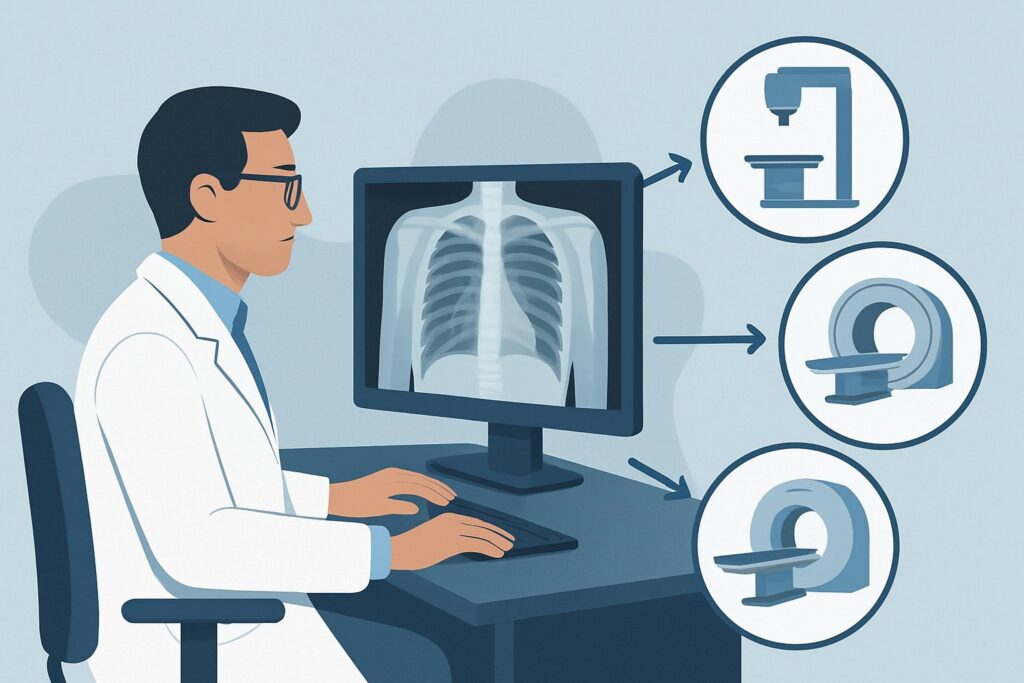
The ACR Appropriateness Criteria rate chest radiography as Usually appropriate and the primary recommended study for the initial imaging of a patient with suspected active tuberculosis. The rationale is based on its high diagnostic utility, wide availability, low cost, and minimal radiation dose.
A standard two-view (posteroanterior and lateral) chest radiograph is highly sensitive for detecting parenchymal abnormalities associated with active TB. It can readily identify the classic findings of upper-lobe infiltrates, cavitation, and adenopathy that strongly suggest the diagnosis and prompt immediate implementation of respiratory isolation and sputum collection for acid-fast bacilli (AFB) testing. Its ability to provide a rapid, global assessment of the thorax is sufficient for the crucial first step in management.
In contrast, other modalities are reserved for specific situations:
- CT chest without IV contrast is also rated Usually appropriate. However, it is not the recommended initial study due to its significantly higher radiation dose and cost. CT is superior for detecting subtle miliary disease, defining the extent of bronchiectasis, and evaluating mediastinal adenopathy. It is best used as a problem-solving tool after an abnormal or equivocal chest radiograph, or if clinical suspicion remains high despite a normal radiograph, particularly in an immunocompromised patient.
- CT chest with IV contrast is rated May be appropriate. The addition of intravenous contrast is generally not necessary for the initial diagnosis of pulmonary TB. Its utility is reserved for evaluating potential complications, such as mediastinal abscesses, vascular involvement, or differentiating complex lymph node masses from adjacent vascular structures.
- MRI chest is rated Usually not appropriate. While it involves no ionizing radiation, MRI has inferior spatial resolution for evaluating the lung parenchyma and is poor at detecting calcifications, a common finding in old, healed TB. Its role is limited to very specific indications, such as evaluating chest wall or spinal involvement.
The radiation dose trade-off is significant. A chest radiograph delivers a very low effective dose (adult_rrl=☢ <0.1 mSv), while a chest CT delivers a substantially higher dose (adult_rrl=☢☢☢ 1-10 mSv). Given that the radiograph provides the necessary information for initial decision-making in most cases, it is the clear first-line choice.
What’s Next After Chest Radiography? Downstream Workflow
The results of the initial chest radiograph will guide your next steps in the diagnostic and management pathway.
If the radiograph is positive or highly suspicious for TB: The immediate priority is to establish respiratory isolation to prevent transmission. The next step is to obtain at least three sputum specimens for AFB smear, mycobacterial culture, and a nucleic acid amplification test (NAAT). A positive AFB smear or NAAT can provide a rapid presumptive diagnosis while awaiting culture confirmation. A CT scan may be considered to better delineate the extent of disease, especially if the findings are complex, but it should not delay the initiation of microbiologic testing and isolation.
If the radiograph is negative: A normal chest radiograph does not definitively exclude active TB, especially in patients who are severely immunocompromised (e.g., advanced HIV) or have early disease. If your clinical suspicion remains high based on symptoms and risk factors, you should still proceed with sputum induction for microbiologic testing. If induced sputum is negative or cannot be obtained, consultation with a pulmonologist for consideration of bronchoscopy with bronchoalveolar lavage may be necessary. A non-contrast chest CT can also be considered in this scenario to look for subtle findings missed on the radiograph.
If the radiograph is indeterminate: The findings may be non-specific, such as a solitary nodule, diffuse infiltrates, or adenopathy without classic features of TB. In this case, a `CT chest without IV contrast` is the logical next step to better characterize the abnormalities and narrow the differential diagnosis. CT features can help distinguish between infectious, inflammatory, and malignant etiologies, guiding further workup which may include bronchoscopy, percutaneous biopsy, or serologic testing for fungal disease.
Pitfalls to Avoid (and When to Get Help)
In the workup of suspected active TB, several common pitfalls can delay diagnosis or lead to misinterpretation. Be mindful of the following:
- Dismissing a “normal” radiograph in a high-risk patient: Immunocompromised patients, particularly those with HIV, can have active pulmonary TB with a normal or near-normal chest radiograph. High clinical suspicion should always prompt microbiologic evaluation regardless of imaging findings.
- Anchoring on “classic” apical disease: While apical cavitation is classic for post-primary (reactivation) TB, primary TB can present with middle or lower lobe consolidation, hilar adenopathy (Ghon complex), and pleural effusion. Atypical presentations are common.
- Delaying isolation based on imaging: Do not wait for a “perfect” radiographic picture of TB before placing a patient with a consistent clinical syndrome in respiratory isolation. The public health risk is too high.
If the patient presents with massive hemoptysis, acute respiratory distress, or hemodynamic instability, this constitutes a medical emergency. Escalate care immediately to an intensive care setting and seek urgent consultation from pulmonology and potentially interventional radiology.
Related ACR Topics and Tools
This article covers a single, focused clinical scenario. For a broader view of all clinical variants related to this topic, please see our comprehensive parent guide. For additional tools to help with ordering decisions and patient communication, see the resources below.
- For breadth across all scenarios in Imaging of Possible Tuberculosis, see our parent guide: Imaging of Possible Tuberculosis: ACR Appropriateness Decoded.
- To explore other clinical situations, visit the Imaging Appropriateness Selector.
- To review technical details for imaging studies, see the Imaging Protocol Library.
- To help discuss radiation exposure with patients, use the Radiation Dose Calculator.
Frequently Asked Questions
Why is a chest radiograph preferred over a CT scan as the first test for suspected active TB?
A chest radiograph is the preferred initial test because it is highly effective for detecting the signs of active TB, widely available, fast, and involves a very low radiation dose (less than 0.1 mSv). A CT scan, while more detailed, delivers a much higher radiation dose and is best reserved as a second-line or problem-solving tool for equivocal cases or when clinical suspicion remains high despite a normal radiograph.
What if the patient is pregnant and I suspect active TB?
For a pregnant patient with suspected active TB, a chest radiograph remains the recommended initial imaging study. The abdomen should be shielded with a lead apron to minimize fetal radiation exposure. The risk of untreated active tuberculosis to both the mother and the fetus is substantial and far outweighs the minimal, near-negligible risk from a shielded chest radiograph.
Does a normal chest radiograph completely rule out active TB?
No. A normal chest radiograph does not definitively rule out active tuberculosis. Patients with early disease or those who are significantly immunocompromised (e.g., with advanced HIV) can have active TB with normal or minimally abnormal imaging. If clinical suspicion is high, you must proceed with microbiologic testing, such as induced sputum collection, regardless of the imaging result.
When should I order a CT scan with IV contrast for a TB workup?
According to the ACR, a CT chest with IV contrast is rated ‘May be appropriate.’ It is not used for the initial diagnosis of uncomplicated pulmonary TB. It should be considered only when there is a concern for specific complications, such as a mediastinal abscess, fistula formation, or involvement of major blood vessels, where contrast can help delineate soft tissue and vascular anatomy.
What are the ‘classic’ chest radiograph findings of active post-primary TB?
The most classic findings of post-primary (reactivation) tuberculosis on a chest radiograph are infiltrates and consolidation in the apical and/or posterior segments of the upper lobes, often with associated cavity formation. Other common findings include hilar or mediastinal lymphadenopathy, pleural effusions, and evidence of old, healed disease such as fibrotic scarring or calcified granulomas (Ghon focus).
Reviewed by Pouyan Golshani, MD, Interventional Radiologist — May 26, 2026