What Is the Best Initial Imaging for Recurrent Hemoptysis? An ACR-Guided Workflow

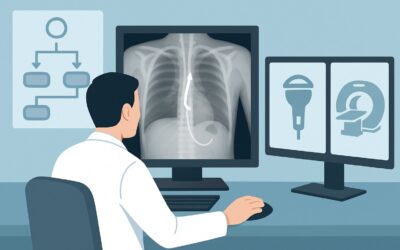
A 62-year-old male with a 40-pack-year smoking history presents to your clinic for follow-up. He reports three separate episodes of coughing up a tablespoon of bright red blood over the past four months. Each episode resolved spontaneously, and he is currently asymptomatic with stable vital signs. He has no other new symptoms. You are now faced with a common clinical question: what is the most appropriate initial imaging study to investigate the cause of his recurrent, non-massive hemoptysis? This article provides a detailed, scenario-specific workflow for this exact presentation, explaining the rationale behind the imaging choices. According to the American College of Radiology (ACR) Appropriateness Criteria, the initial study of choice, Radiography chest, is rated Usually Appropriate.
Who Fits This Clinical Scenario for Recurrent Hemoptysis?
This guidance applies specifically to patients presenting for an initial imaging workup of recurrent, non-massive hemoptysis. The key inclusion criteria are multiple, distinct episodes of coughing up blood over a period of weeks or months, where each episode is not life-threatening in volume. This pattern suggests a chronic or intermittent underlying process that requires investigation.
It is critical to distinguish this scenario from similar but distinct clinical presentations that follow different diagnostic pathways:
- Massive (Life-Threatening) Hemoptysis: This is a medical emergency, often defined as expectorating more than 100-600 mL of blood in 24 hours or any amount that causes hemodynamic instability or airway compromise. These patients require immediate stabilization and often proceed directly to advanced imaging like Computed Tomography Angiography (CTA) or intervention. This workflow does not apply.
- First-Time, Non-Massive Hemoptysis: A patient with a single, isolated episode of hemoptysis may have a different pre-test probability for various conditions. While the workup can be similar, the “recurrent” nature of the scenario discussed here raises the index of suspicion for chronic conditions like bronchiectasis or malignancy, influencing the imaging rationale.
- Pseudohemoptysis: This workflow is for bleeding originating from the lower respiratory tract. It is not intended for patients where the source of bleeding is suspected to be from the nasopharynx (epistaxis) or the gastrointestinal tract (hematemesis).
What Diagnoses Are You Working Up in Recurrent Hemoptysis?
When ordering imaging for recurrent hemoptysis, you are primarily investigating structural lung diseases that can cause bleeding from the bronchial or pulmonary circulation. The differential is broad, but several key diagnoses are at the forefront.
One of the most common causes is bronchiectasis. In this condition, chronic inflammation leads to irreversible dilation of the airways. The associated inflammation results in hypertrophy of the bronchial arteries, which are systemic vessels under high pressure. These fragile, dilated vessels are prone to rupture, leading to recurrent episodes of hemoptysis that can range from minor to severe.
Chronic bronchitis, particularly in patients with a significant smoking history, is another frequent culprit. Persistent airway inflammation causes mucosal edema and engorgement of superficial blood vessels. The mechanical stress of coughing can easily lead to bleeding from this friable mucosa, typically resulting in small-volume, recurrent hemoptysis.
A critical diagnosis to exclude is lung malignancy. An endobronchial tumor can grow into the airway, and its rich neovascular supply can bleed. Alternatively, a larger parenchymal tumor can erode into adjacent blood vessels. In patients with risk factors such as advanced age and a history of smoking, malignancy must remain high on the differential until proven otherwise.
Finally, chronic or prior infections are an important consideration. Active tuberculosis can cause cavitation and parenchymal destruction leading to bleeding. Healed tuberculosis can leave behind bronchiectasis or, less commonly, a Rasmussen aneurysm (a pseudoaneurysm of a pulmonary artery branch adjacent to a cavity). Fungal infections, such as an aspergilloma growing within a pre-existing lung cavity, can also cause significant hemoptysis by irritating the cavity wall or invading local vessels.
Why Is a Chest Radiograph the Recommended Initial Study for Recurrent Hemoptysis?
The ACR Appropriateness Criteria rate Radiography chest as Usually Appropriate for the initial evaluation of recurrent hemoptysis. This recommendation is based on its role as a highly effective, low-risk screening tool that can guide the entire subsequent diagnostic workflow.
A standard two-view chest radiograph is an excellent first step because it is widely available, inexpensive, and delivers a very low radiation dose (☢ <0.1 mSv). Despite its limitations compared to cross-sectional imaging, it can readily identify or suggest many of the key diagnoses in the differential. A radiograph may reveal a discrete lung mass, a cavitary lesion suggestive of infection or malignancy, focal consolidation, or the characteristic "tram tracking" and cystic changes of bronchiectasis. If the radiograph clearly localizes an abnormality, it provides crucial information for planning the next, more definitive study, such as a targeted CT or bronchoscopy. It is equally important to understand why other, more advanced modalities are not the recommended initial step.
- CTA chest with IV contrast is also rated Usually Appropriate, but it is not the ideal first test. It is a much higher radiation (☢☢☢ 1-10 mSv) and resource-intensive study. Its primary role is as the next step after a non-diagnostic or abnormal chest radiograph. CTA provides exquisite detail of the lung parenchyma and, critically, maps the bronchial and pulmonary arterial anatomy, which is essential for identifying the source of bleeding and planning potential embolization. It is the problem-solving tool, not the screening tool.
- CT chest without IV contrast is rated Usually not appropriate. While it provides excellent detail of the lung parenchyma, it fails to evaluate the vascular structures that are the source of bleeding. Omitting intravenous contrast makes it impossible to assess for hypertrophied bronchial arteries, active extravasation, or pulmonary artery pseudoaneurysms. Ordering a non-contrast CT in this setting is a common pitfall that leads to an incomplete evaluation and often requires a second, contrast-enhanced study.
In summary, starting with a chest radiograph is a logical, stepwise approach. It screens for obvious pathology at a low cost and radiation dose, effectively triaging patients who need to proceed to more advanced imaging.
What’s Next After a Chest Radiograph? Downstream Workflow
The results of the initial chest radiograph dictate the subsequent management path. The workflow is a decision tree based on whether the study is positive, negative, or indeterminate.
If the chest radiograph is positive: The findings guide the next step. If a mass concerning for malignancy is identified, the next logical study is a CT of the chest with IV contrast to fully stage the lesion and evaluate for mediastinal and hilar lymphadenopathy. If the radiograph shows findings suggestive of bronchiectasis or a cavitary lesion, a high-resolution CT or CTA chest is warranted to confirm the diagnosis, define the extent of disease, and assess the vasculature. In these cases, the radiograph has successfully localized the problem and justified the use of more advanced imaging.
If the chest radiograph is negative: This is a critical decision point. A normal chest radiograph does not rule out significant pathology as a cause of recurrent hemoptysis. Small endobronchial tumors, mild bronchiectasis, or arteriovenous malformations can all be occult on plain films. In a patient with ongoing recurrent hemoptysis, particularly one with risk factors like a smoking history, a negative radiograph should prompt escalation to the next level of imaging. The most appropriate next step is a CTA chest with IV contrast to perform a more sensitive search for an underlying cause.
If the chest radiograph is indeterminate: Findings may be subtle or non-specific, such as mild parenchymal scarring or questionable airway thickening. In these situations, much like a negative result in a high-risk patient, the appropriate next step is to proceed with a CTA chest to better characterize the findings and evaluate the underlying vasculature.
Pitfalls to Avoid (and When to Get Help)
Navigating the workup for recurrent hemoptysis requires avoiding several common pitfalls that can delay diagnosis or lead to inefficient use of resources.
- Stopping the workup after a negative chest radiograph: This is the most significant pitfall. In the setting of recurrent bleeding, a normal radiograph is not a definitive endpoint. High-risk patients (e.g., smokers over 40) require further evaluation, typically with CTA.
- Ordering a non-contrast CT: As mentioned, this is an incomplete study for hemoptysis. It fails to assess the bronchial and pulmonary arteries, which are the primary sources of bleeding. Always specify IV contrast when ordering a CT for this indication.
- Misinterpreting the source: Remember to exclude pseudohemoptysis from nasopharyngeal or gastrointestinal sources before embarking on an extensive pulmonary workup.
- Ignoring risk factors: A young, non-smoking patient with a single episode of hemoptysis after a viral illness has a very different risk profile than an older smoker with recurrent bleeding. Tail the intensity of your workup to the pre-test probability of serious disease.
If a patient’s hemoptysis becomes massive or is associated with any respiratory distress or hemodynamic instability, this constitutes a medical emergency. Escalate care immediately for airway management and consult both pulmonology and interventional radiology for urgent evaluation.
Related ACR Topics and Tools
For a comprehensive overview of imaging for all clinical variants of hemoptysis, from massive to non-massive, please see our parent topic hub article. For further exploration of appropriateness criteria, imaging techniques, and radiation safety, the following resources are available.
- For breadth across all scenarios in Hemoptysis, see our parent guide: Hemoptysis: ACR Appropriateness Decoded.
- ACR Appropriateness Criteria Lookup — for adjacent scenarios
- Imaging Protocol Library — for technique on the recommended study
- Radiation Dose Calculator — for cumulative dose conversations
Frequently Asked Questions
Why not start with a CTA chest for everyone with recurrent hemoptysis?
While CTA chest is a highly sensitive test, it involves significantly more radiation (☢☢☢ 1-10 mSv) and cost than a chest radiograph (☢ <0.1 mSv). The American College of Radiology recommends a stepwise approach, using the chest radiograph as an initial screening tool. It can often identify the cause or localize the problem, allowing for more targeted follow-up and avoiding unnecessary radiation and resource use in a subset of patients.
If the chest radiograph is negative, is bronchoscopy the next step?
Not usually. If the chest radiograph is negative in a patient with recurrent hemoptysis and risk factors for malignancy, the next recommended step is typically a CTA of the chest. CTA is excellent for detecting subtle parenchymal disease, bronchiectasis, and vascular abnormalities that may be missed on a radiograph. Bronchoscopy is generally reserved for cases where CTA is also negative but suspicion remains high, or when a central airway lesion is suspected.
What is the difference between a ‘CT chest with contrast’ and a ‘CTA chest’ for this scenario?
While both use intravenous contrast, a CTA (Computed Tomography Angiography) protocol is specifically timed to optimize visualization of the blood vessels—in this case, the bronchial and pulmonary arteries. A standard ‘CT with contrast’ may be timed for optimal parenchymal or soft tissue enhancement (e.g., venous phase), which is less ideal for identifying the small, hypertrophied bronchial arteries that are often the source of bleeding. For a hemoptysis workup, a CTA protocol is superior.
Does this guidance apply to pediatric patients?
This article and the cited radiation levels are primarily focused on adults. While the diagnostic algorithm is conceptually similar in children, the differential diagnosis for recurrent hemoptysis is different (e.g., foreign body, congenital anomalies are more common), and radiation dose considerations are even more critical. Pediatric cases should be managed in consultation with a pediatric pulmonologist and radiologist, adhering to ALARA (As Low As Reasonably Achievable) principles for radiation.
What if the patient has renal insufficiency and cannot receive IV contrast?
This presents a clinical challenge. A non-contrast high-resolution CT (HRCT) can be performed to evaluate for parenchymal causes like bronchiectasis, malignancy, or cavitary disease. However, it cannot assess the vasculature. If a bleeding source is not identified, other modalities like bronchoscopy or, in select cases, a nuclear medicine ventilation/perfusion (V/Q) scan might be considered. Management should be discussed in a multidisciplinary setting.
Reviewed by Pouyan Golshani, MD, Interventional Radiologist — May 29, 2026