What Is the Next Imaging Study for TGA After Arterial Switch With an Inadequate Echocardiogram?
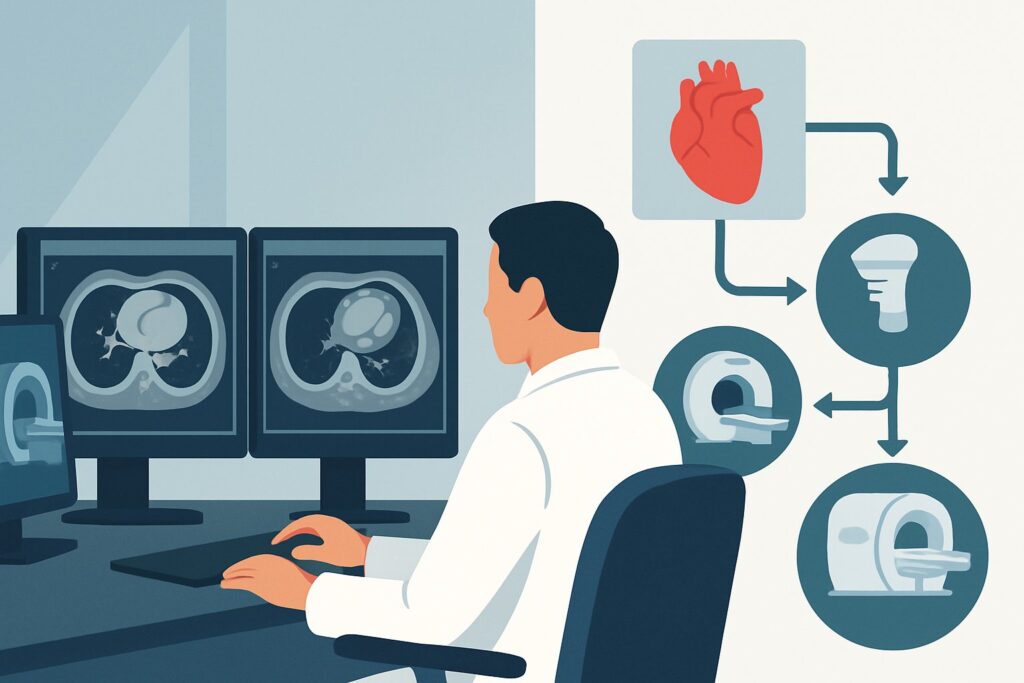
A 28-year-old patient, born with d-transposition of the great arteries (d-TGA) and status-post an arterial switch operation (ASO) in infancy, presents for their annual cardiology follow-up. Their routine transthoracic echocardiogram (TTE) is technically limited, with poor acoustic windows obscuring a clear view of the neopulmonary root and the origins of the reimplanted coronary arteries. The supervising cardiologist needs to decide on the next imaging study to complete the patient’s surveillance for known long-term complications. This article details the American College of Radiology (ACR) guided workflow for this specific clinical question. While advanced modalities like cardiac MRI and CT are central to this evaluation, the ACR rates a baseline Radiography chest as Usually Appropriate as an initial step.
Who Fits This Clinical Scenario?
This guidance applies to a specific cohort: children or adults with a known history of d-transposition of the great arteries who have undergone surgical correction via an arterial switch operation. The critical trigger for this workflow is a preceding transthoracic echocardiogram that was deemed incomplete, inadequate, or technically limited for assessing key cardiovascular structures and function. This often occurs due to poor acoustic windows in adults, body habitus, or complex postsurgical anatomy.
It is crucial to distinguish this scenario from similar but distinct clinical presentations that follow different diagnostic pathways:
- Patients with TGA after an Atrial Switch: This guidance does not apply to patients who underwent a Mustard or Senning procedure (atrial switch). Those patients face a different set of long-term complications, such as baffle leaks, systemic right ventricular failure, and arrhythmias, which are evaluated under a separate ACR Appropriateness Criteria variant.
- Patients with Repaired Tetralogy of Fallot: While also a complex congenital condition requiring lifelong surveillance, the primary concerns in repaired Tetralogy of Fallot revolve around pulmonary valve dysfunction, right ventricular dilation, and the RV outflow tract. This represents a different clinical question and imaging workup.
- Patients with an Adequate Echocardiogram: If the TTE provides a comprehensive and technically adequate assessment of all relevant structures and no new concerns are raised, further advanced imaging may not be immediately necessary, and this specific workflow would not be initiated.
What Diagnoses Are You Working Up in This Scenario?
For patients post-ASO, imaging is not for diagnosing a new disease but for lifelong surveillance of well-documented potential sequelae of the surgical repair. An inadequate TTE leaves critical questions unanswered regarding these potential complications.
The most common and consequential concern is supravalvular pulmonary stenosis (PS). This narrowing often occurs at the anastomotic site of the neopulmonary artery and can lead to progressive right ventricular pressure overload. It is the most frequent reason for reintervention in this patient population.
Another key area of surveillance is the neoaortic root and valve. The native pulmonary valve is repositioned to serve as the systemic aortic valve. Over time, the neoaortic root can dilate, and the valve can become regurgitant, as it was not originally developed to withstand systemic pressures. Progressive neoaortic root dilation or significant aortic regurgitation can ultimately require surgical intervention.
Perhaps the most critical potential complication involves the reimplanted coronary arteries. During the ASO, the coronary arteries are excised from the native aorta and transferred to the neoaorta. This complex maneuver can lead to kinking, stretching, or stenosis of the coronary ostia or proximal vessels. Coronary artery obstruction is a primary cause of late morbidity and mortality, including myocardial ischemia, infarction, and sudden cardiac death.
Finally, assessing biventricular size and systolic function is a cornerstone of follow-up. Any of the above complications can lead to ventricular dysfunction over time, and tracking these parameters is essential for clinical management.
Why Advanced Imaging Is Usually Appropriate After Inadequate Echocardiography
While the ACR lists Radiography chest as Usually Appropriate, it serves as a basic, low-dose initial assessment. In the context of an inadequate echocardiogram for a post-ASO patient, the true problem-solvers are Cardiac Magnetic Resonance (CMR) and Cardiac Computed Tomography (CCT), which are also rated Usually Appropriate. The choice between them depends on the specific clinical question.
A chest radiograph provides a general overview of cardiac size and contour, pulmonary vascularity, and the position of the great arteries. It is a very low-radiation study (☢ <0.1 mSv for adults) but cannot visualize the specific anatomical details needed, such as coronary artery origins or anastomotic sites. It is best considered a baseline study, not the definitive test to answer the questions posed by a limited TTE.
The definitive non-invasive evaluations are:
- MRI heart function and morphology without and with IV contrast (CMR): Rated Usually Appropriate, this is the gold standard for assessing ventricular volumes, mass, and function without ionizing radiation (O 0 mSv). It excels at quantifying valvular regurgitation (e.g., neoaortic regurgitation) and stenosis severity using phase-contrast flow analysis. It provides excellent anatomical detail of the great vessels and is the preferred modality for serial, radiation-free functional follow-up.
- CTA chest with IV contrast (CCT): Also rated Usually Appropriate, CCT offers superior spatial resolution for anatomical assessment. It is the best non-invasive modality for evaluating the coronary arteries, clearly delineating their origin, course, and any potential stenosis. It is also excellent for defining the anatomy of the branch pulmonary arteries and the neopulmonary anastomosis. This comes at the cost of ionizing radiation (☢☢☢ 1-10 mSv for adults, ☢☢☢☢ 3-10 mSv for pediatrics) and requires iodinated contrast.
Why are other studies rated lower?
US echocardiography transesophageal (TEE)is rated Usually not appropriate. While TEE can overcome the limitations of TTE, it is invasive and often provides limited views of the branch pulmonary arteries and the right ventricular outflow tract, which are key areas of concern.Arteriography coronary with ventriculography(invasive cardiac catheterization) is also rated Usually not appropriate for routine surveillance. While it is the gold standard for coronary assessment, it is reserved for cases where non-invasive imaging (like CCT) is inconclusive or when a therapeutic intervention is planned.
What’s Next After Imaging? Downstream Workflow
The results of the advanced imaging study (CMR or CCT) will directly guide the subsequent clinical management and surveillance plan.
- If the study is normal: If both anatomical and functional assessments are within normal limits for the patient’s age and surgical history, they can typically return to their routine surveillance schedule, often with annual or biennial clinical and TTE follow-up.
- If pulmonary stenosis is identified: If significant supravalvular or branch pulmonary artery stenosis is found, the patient will likely be referred for cardiac catheterization to measure gradients directly and potentially perform a balloon angioplasty or stent implantation.
- If neoaortic root dilation is found: The rate of dilation will be monitored closely. If it reaches established thresholds or is associated with significant aortic regurgitation, surgical referral for root replacement may be necessary. Medical management with beta-blockers or angiotensin receptor blockers may also be initiated or adjusted.
- If a coronary artery abnormality is suspected: A finding of significant coronary stenosis or an anomalous course on CCT is a major concern. This would prompt an urgent cardiology consultation, functional testing for ischemia (such as with
MRI heart function with stress, rated Usually Appropriate), and likely referral for cardiac catheterization and potential intervention.
Pitfalls to Avoid (and When to Get Help)
- Over-reliance on chest radiography: Do not stop with a normal chest X-ray. It cannot rule out the life-threatening complications (especially coronary stenosis) that this workup is designed to find.
- Choosing the wrong advanced modality: Select the test based on the primary question. If coronary anatomy is the main concern from the limited TTE, CCT is superior. If ventricular function and flow quantification are the goals, CMR is the better choice. Often, institutions will alternate modalities over the patient’s lifetime.
- Forgetting radiation dose in pediatrics: When ordering CCT in children and young adults, ensure the protocol is optimized for low-dose acquisition. Cumulative radiation exposure over a lifetime is a significant consideration.
- Inadequate CMR protocol: The CMR protocol must be tailored for congenital heart disease, including specific sequences for flow quantification (phase-contrast) across the valves and great vessels.
If imaging reveals significant neoaortic root dilation, severe valvular dysfunction, or any coronary artery abnormality, immediate escalation to a cardiologist specializing in adult congenital heart disease (ACHD) is warranted.
Related ACR Topics and Tools
This article covers one specific scenario in detail. For a broader view of imaging for congenital and acquired heart conditions, please consult the resources below.
- For breadth across all scenarios in Congenital or Acquired Heart Disease, see our parent guide: Congenital or Acquired Heart Disease: ACR Appropriateness Decoded.
- ACR Appropriateness Criteria Lookup — for adjacent scenarios
- Imaging Protocol Library — for technique on the recommended study
- Radiation Dose Calculator — for cumulative dose conversations
Frequently Asked Questions
Why is a chest radiograph considered ‘Usually Appropriate’ if it can’t see the coronary arteries?
A chest radiograph is a low-risk, low-radiation baseline study. It provides valuable initial information on cardiac size, pulmonary vascularity, and aortic arch anatomy. While it cannot assess specific complications like coronary stenosis or neoaortic root size, it serves as a foundational part of the overall assessment. However, it should not be considered the final or definitive test in this scenario; it is a starting point before proceeding to Cardiac MRI or CT.
Should I order a Cardiac MRI or a Cardiac CT for my post-ASO patient?
The choice depends on the primary clinical question. Cardiac MRI (CMR) is superior for assessing ventricular function, volumes, and quantifying blood flow and valvular regurgitation, all without radiation. Cardiac CT (CCT) provides superior spatial resolution for anatomy, making it the best non-invasive test for evaluating the reimplanted coronary arteries and pulmonary artery anastomoses. Many centers alternate between CMR and CCT at different follow-up intervals to leverage the strengths of both.
How does this workflow differ for a patient who had an atrial switch (Mustard/Senning) instead of an arterial switch?
The long-term complications are entirely different. Atrial switch patients are at risk for baffle leaks or obstruction, systemic right ventricular failure, and arrhythmias. The imaging focus is on evaluating the systemic RV, tricuspid valve, and the integrity of the atrial baffles. This is a separate clinical scenario within the ACR Appropriateness Criteria with its own recommended imaging pathway, often heavily reliant on Cardiac MRI.
Is a stress test needed for these patients?
Functional stress testing may be appropriate, particularly if there is concern for myocardial ischemia due to potential coronary artery issues. The ACR rates ‘MRI heart function with stress without and with IV contrast’ as ‘Usually Appropriate’. This can be a valuable tool to assess for ischemia non-invasively, especially if CCT shows an ambiguous coronary finding or if the patient develops symptoms.
What if my patient has a pacemaker or ICD, can they still get a Cardiac MRI?
Many modern pacemakers and implantable cardioverter-defibrillators (ICDs) are MRI-conditional. However, this requires a strict protocol involving the cardiology device team to program the device into a safe mode for the scan and monitor the patient closely. The presence of a device is not an absolute contraindication but requires careful planning and coordination with the radiology and cardiology departments.
Reviewed by Pouyan Golshani, MD, Interventional Radiologist — May 30, 2026