What Is the Right Initial Imaging for Suspected Facial Injury After Major Blunt Trauma?

A 34-year-old male arrives in the emergency department after a high-speed motor vehicle collision. He is awake, alert, and his vital signs are stable, but he has significant periorbital ecchymosis, midface swelling, and pain with jaw movement. You suspect facial fractures, but given the major trauma mechanism, you know other life-threatening injuries must also be considered. The immediate question is which imaging studies to order first to evaluate both the specific facial injury and the potential for occult injuries to the head, neck, and torso. This article provides a clinical workflow for this exact scenario, guided by the American College of Radiology (ACR) Appropriateness Criteria. For a hemodynamically stable adult with suspected facial injury after major blunt trauma, the ACR rates a Radiography trauma series as Usually Appropriate.
Who Fits This Clinical Scenario for Suspected Facial Injury After Trauma?
This guidance applies to a specific subset of trauma patients. Correctly identifying your patient within this scenario is critical to applying the right imaging strategy.
Inclusion Criteria:
- Patient: Adult
- Mechanism: Major blunt trauma (e.g., motor vehicle collision, significant fall, assault).
- Hemodynamic Status: Stable. This implies normal or near-normal blood pressure, heart rate, and respiratory status, without evidence of active, uncontrolled hemorrhage.
- Clinical Suspicion: There are clear clinical signs pointing to a facial injury, such as visible deformity, swelling, ecchymosis, lacerations over bony prominences, malocclusion, or palpable bony steps.
Exclusion Criteria (These patients require a different workflow):
- Hemodynamically Unstable Patients: A patient with hypotension, tachycardia, or other signs of shock requires an entirely different and more urgent imaging pathway, often involving a focused assessment with sonography for trauma (FAST) exam and potentially a rapid whole-body CT scan. This scenario is covered in a separate ACR variant.
- Isolated, Low-Energy Facial Trauma: A patient who sustained a simple punch to the face without a major mechanism of injury does not fit the “major blunt trauma” category. Their workup can be more focused on the facial injury alone.
- Penetrating Trauma: Gunshot wounds or stab wounds to the face involve different injury patterns and imaging considerations, often requiring CT angiography to evaluate vascular structures.
- Altered Mental Status as the Primary Finding: If the patient’s main presentation is altered mental status without specific signs of facial injury, the initial imaging priority shifts to the brain, typically starting with a non-contrast CT of the head.
What Diagnoses Are You Working Up in This Scenario?
In a stable patient with suspected facial injury from major trauma, your imaging strategy is designed to identify a range of potential injuries, from the obvious to the occult. The differential diagnosis extends beyond just the facial bones.
Facial Skeleton Fractures
This is the primary concern driving the “suspected facial injury” component. You are looking for fractures of the mandible, maxilla (including Le Fort patterns), zygomaticomaxillary complex (ZMC or “tripod” fractures), nasal bones, and orbits (including floor “blowout” fractures). Identifying the precise location and displacement of these fractures is crucial for determining the need for surgical intervention by specialists like oral and maxillofacial surgery, plastics, or otolaryngology.
Intracranial Injury
The force required to fracture the facial skeleton can easily be transmitted to the cranial vault, causing intracranial hemorrhage (epidural, subdural, or subarachnoid), cerebral contusions, or diffuse axonal injury. A patient who is currently “stable” and neurologically intact can still harbor a developing intracranial bleed, making brain assessment a key part of the initial workup.
Cervical Spine Injury
There is a strong association between significant facial trauma and cervical spine (C-spine) fractures or ligamentous injury. The mechanism of injury is often a combination of flexion, extension, and rotational forces that affect the entire head and neck. Clearing the C-spine is a mandatory step in the evaluation of any major trauma patient, especially one with facial injuries.
Craniocervical Vascular Injury
Less common but highly consequential, blunt cerebrovascular injury (BCVI) can occur. Certain fracture patterns, such as Le Fort II or III fractures, mandible fractures, and those involving the skull base, increase the risk of dissection or occlusion of the carotid or vertebral arteries. While not always the first study ordered, the potential for BCVI must be considered.
Why Is a Combination of Radiography and CT Usually Appropriate for This Presentation?
For a stable polytrauma patient with a suspected facial injury, the ACR designates several studies as Usually Appropriate, reflecting a multi-pronged initial approach. The “Radiography trauma series” serves as the foundational screen for the polytrauma component, while CT provides the definitive detail for the head and face.
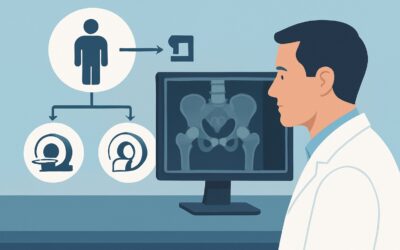
The Radiography trauma series (Adult RRL=☢☢☢ 1-10 mSv) typically includes AP chest, AP pelvis, and lateral C-spine radiographs. This combination is a rapid, low-dose, and widely available method to screen for immediate life-threats like pneumothorax, hemothorax, unstable pelvic ring fractures, and gross C-spine instability. It addresses the “major blunt trauma” aspect of the scenario first.
For the specific “suspected facial injury,” CT maxillofacial without IV contrast (Adult RRL=☢☢ 0.1-1mSv) is also Usually Appropriate and is the gold standard for evaluating complex bony anatomy. It provides exquisite detail of fracture patterns, which is essential for surgical planning. It is performed without contrast because intravenous contrast does not improve the visualization of bone and adds unnecessary risk and cost for this indication.
Similarly, a CT head without IV contrast (Adult RRL=☢☢☢ 1-10 mSv) is Usually Appropriate to rule out the associated intracranial injuries discussed in the differential. In many centers, the CT head and CT maxillofacial are performed in the same session, often with a single acquisition that is reconstructed with both soft tissue and bone algorithms.
Why are other studies rated lower for this initial workup?
- **CT maxillofacial with IV contrast** is rated Usually not appropriate. As mentioned, contrast is not needed for the primary goal of assessing fractures. It should only be ordered if there is a specific concern for a vascular injury, abscess, or other soft-tissue complication, which would typically be a secondary study.
- MRI head without IV contrast is rated Usually not appropriate in the acute setting. MRI is time-consuming, sensitive to motion artifact, and less available in an emergency context. While superior for evaluating soft tissues and subacute brain injury, it is not the correct tool for the initial assessment of acute fractures and hemorrhage.
What’s Next After Initial Imaging? Downstream Workflow
The results of your initial radiographs and CT scans will guide the next steps in management and consultation. The workflow branches based on the findings.
- Positive for Significant Facial Fractures: If the CT confirms displaced or complex fractures (e.g., Le Fort II/III, displaced ZMC, orbital floor fracture with muscle entrapment), immediate consultation with the relevant surgical service is required (OMFS, Plastic Surgery, ENT, or Ophthalmology). These specialists will use the CT data to plan for potential operative repair. If fracture patterns are high-risk for vascular injury (e.g., extending to the carotid canal), a follow-up CTA head and neck with IV contrast (Usually Appropriate) may be ordered to rule out a dissection.
- Positive for Intracranial Injury: If the CT head reveals a bleed (e.g., epidural or subdural hematoma), a neurosurgical consultation is the immediate next step. The patient’s management will pivot to focus on monitoring and potentially intervening on the brain injury, which takes precedence over non-emergent facial fracture repair.
- Negative Imaging but High Clinical Suspicion: If the initial imaging is negative but the patient has persistent, concerning symptoms like malocclusion or diplopia, do not dismiss their complaints. This warrants a direct clinical evaluation by a specialist. Subtle non-displaced fractures, dental injuries, or significant soft tissue injuries may not be fully appreciated on imaging alone.
- All Initial Imaging Negative: If the trauma series and dedicated head/facial CT are negative, and the patient is clinically well without red-flag symptoms, they can often be cleared from a craniofacial and C-spine injury standpoint. Management will then focus on any other injuries identified or on safe discharge planning.
Pitfalls to Avoid (and When to Get Help)
Navigating this scenario requires vigilance for several common pitfalls that can compromise patient care.
- Underestimating Airway Compromise: A patient who is hemodynamically stable on arrival can rapidly deteriorate. Midface fractures and mandibular fractures can be associated with significant swelling, hematoma, and bleeding that can lead to airway obstruction. Maintain a low threshold for airway monitoring and intervention.
- Incomplete C-Spine Clearance: Do not assume the C-spine is clear based on a single lateral radiograph. If the initial trauma series is inconclusive or if there is high clinical suspicion, a CT of the cervical spine is the definitive study.
- Overlooking Ocular Injury: Facial trauma, particularly involving the orbit, can cause globe rupture, retrobulbar hematoma, or entrapment of extraocular muscles. Any visual complaints, proptosis, or limitations in eye movement warrant an urgent ophthalmology consultation.
- Fixating on the Face: Remember that this is a major blunt trauma scenario. The dramatic appearance of a facial injury can distract from more lethal but less obvious injuries to the chest, abdomen, or pelvis. Always complete the full primary and secondary trauma survey.
If you identify red flags like an expanding hematoma, new neurologic deficits, or signs of airway compromise, escalate immediately to your senior resident, attending physician, and the appropriate specialty services.
Related ACR Topics and Tools
For a comprehensive overview of all clinical variants related to major blunt trauma, from unstable patients to those with suspected extremity or bowel injuries, please see our parent guide. The resources below can also help you navigate adjacent scenarios and understand the technical aspects of the recommended imaging.
- For breadth across all scenarios in Major Blunt Trauma, see our parent guide: Major Blunt Trauma: ACR Appropriateness Decoded.
- To look up other clinical scenarios, use the ACR Appropriateness Criteria Lookup tool.
- For technical details on how these studies are performed, consult the Imaging Protocol Library.
- To discuss radiation exposure with patients, the Radiation Dose Calculator can help quantify and contextualize the dose from different scans.
Frequently Asked Questions
Why not just order a whole-body CT (pan-scan) for every major trauma patient with facial injury?
While a CT whole body with IV contrast is rated ‘Usually Appropriate’ for major blunt trauma, it delivers a very high radiation dose (10-30 mSv). The decision to perform a pan-scan should be driven by the overall mechanism of injury and findings from the full trauma assessment, not just the presence of a facial injury. For a stable patient with injuries clinically localized to the head and face, a more targeted approach with a trauma radiography series and dedicated head/face CT can often provide the necessary information with less radiation.
When is a CTA of the head and neck indicated in this specific scenario?
A CTA head and neck with IV contrast is also rated ‘Usually Appropriate’ but is used to answer a different clinical question: the suspicion of a blunt cerebrovascular injury (BCVI). It is not a first-line study for all patients. Specific indications include high-risk fracture patterns (e.g., Le Fort II/III, fractures through the carotid canal, C-spine fractures involving the transverse foramen), neurologic deficits not explained by intracranial findings, or signs of arterial injury like an expanding neck hematoma or bruit.
What is the practical difference between ordering a ‘CT maxillofacial’ and a ‘CT head’?
A CT head is optimized to visualize the brain and intracranial contents, using specific windowing for gray/white matter and blood products. A CT maxillofacial is optimized to visualize bone, using thin slices and special reconstructions (coronal, sagittal) to clearly define the complex, delicate facial skeleton. While they can sometimes be acquired together, it’s important to specify both are needed so the technologist acquires the data appropriately and the radiologist provides reconstructions for both bone and soft tissue.
If the patient is stable, can imaging be delayed?
While the patient’s stability allows for a more deliberate workup compared to an unstable patient, imaging should still be performed expeditiously. A stable patient can become unstable, particularly from a slowly expanding intracranial bleed or progressive airway swelling. Delays in diagnosis can also postpone necessary consultations and interventions, potentially leading to worse outcomes.
Reviewed by Pouyan Golshani, MD, Interventional Radiologist — May 29, 2026