Which Imaging Is Best for Initial Aortic Root Assessment in TAVR Candidates?
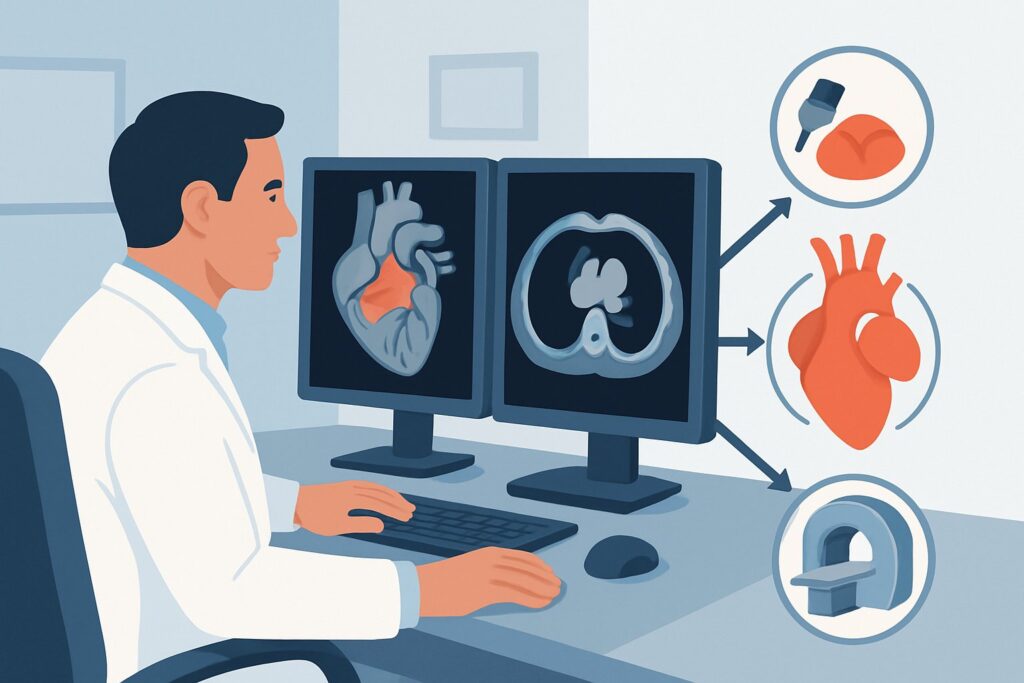
A 78-year-old patient with severe, symptomatic aortic stenosis sits in your clinic, hopeful about the prospect of a transcatheter aortic valve replacement (TAVR). Their transthoracic echocardiogram confirmed the diagnosis, and now the multidisciplinary heart team needs detailed anatomical information to determine if they are a suitable candidate. Your immediate task is to order the initial, focused imaging to assess the aortic root—the critical landing zone for the new valve. You need precise measurements of the annulus, sinuses, and coronary heights. This article details the clinical workflow for this specific decision: the initial imaging assessment of the aortic root for TAVR planning. For this scenario, the American College of Radiology (ACR) rates US echocardiography transesophageal as Usually Appropriate.
Who Fits This Clinical Scenario for Aortic Root Assessment?
This guidance applies specifically to patients with severe aortic stenosis who are being evaluated for TAVR and require initial, detailed imaging of the aortic root anatomy. The primary goal is to acquire the foundational measurements for valve sizing and to identify any high-risk morphological features of the valve and surrounding structures. This workflow is for the first dedicated planning study focused on the aortic valve complex itself.
This article does not apply to several similar-appearing clinical situations:
- Comprehensive Vascular Access Planning: If the primary goal is to evaluate the entire vascular pathway—from the femoral arteries through the iliacs and the full extent of the aorta—that constitutes a different clinical question. While essential for TAVR, that workup falls under the sibling scenario of “assessment of supravalvular aorta and vascular access.” This article is strictly about the initial root assessment.
- Post-TAVR Follow-up: Imaging to assess the function of a previously implanted TAVR valve, check for paravalvular leak, or evaluate for other complications follows a different diagnostic algorithm.
- Initial Diagnosis of Aortic Stenosis: This guidance is for pre-procedural planning, not the initial diagnosis. The diagnosis of severe aortic stenosis is typically established with transthoracic echocardiography (TTE), which precedes this more detailed anatomical assessment.
What Anatomic and Pathologic Features Are You Assessing?
The imaging for TAVR planning is not a search for a single diagnosis but a detailed anatomical survey to answer several critical questions that determine procedural feasibility, device selection, and patient risk. The key is to characterize the complex, three-dimensional structure of the aortic root.
First and foremost is defining the aortic annulus dimensions. This is the single most important factor for selecting the correct TAVR device size. An undersized valve can lead to embolization or significant paravalvular leak, while an oversized valve risks annular rupture. Modern assessment relies on multiplanar analysis to determine the area and perimeter of the non-circular annulus.
Next, the aortic valve morphology must be detailed. This includes identifying whether the valve is bicuspid or tricuspid and characterizing the degree, location, and bulk of calcification on the leaflets. Heavy, asymmetric calcification can interfere with valve seating and increase the risk of post-procedural complications.
The dimensions of the Sinus of Valsalva and the sinotubular junction (STJ) are also crucial. These measurements ensure the selected device will be well-anchored without obstructing other structures.
Finally, and critically, the height of the coronary artery ostia relative to the aortic annulus must be measured precisely. Deploying a TAVR valve too high can obstruct a coronary artery, a potentially catastrophic complication. A low coronary height is a major relative or absolute contraindication to the procedure.
Why Is Transesophageal Echocardiography Usually Appropriate for Initial Aortic Root Assessment?
For the initial, focused assessment of the aortic root, the ACR identifies four imaging modalities as Usually Appropriate: Transesophageal Echocardiography (TEE), Cardiac MRI (with or without contrast), and Cardiac CT with IV contrast. While Cardiac CT is often considered the comprehensive gold standard for full TAVR planning, TEE offers distinct advantages as an initial assessment tool.
US echocardiography transesophageal provides superb spatial and temporal resolution of the aortic valve and root. Its proximity to the heart, without interference from the lungs or ribs, allows for highly detailed visualization of leaflet morphology, calcification, and dynamic function. The use of 3D TEE is essential, as it allows for direct planimetry of the aortic annulus, providing more accurate area and perimeter measurements than 2D-derived diameters. This high-fidelity imaging comes with no ionizing radiation (0 mSv) and can be performed without iodinated contrast.
In contrast, other modalities have different trade-offs for this specific initial step:
- CT heart function and morphology with IV contrast: This study is also rated Usually Appropriate and is indispensable for comprehensive TAVR planning. It provides a complete, static 3D dataset of the entire chest, allowing for precise, reproducible measurements of the root and the entire vascular access route. However, it involves a significant radiation dose (☢☢☢☢ 10-30 mSv) and requires IV contrast, which can be a concern in patients with renal insufficiency. Many centers proceed directly to CT, but TEE remains an excellent, radiation-free initial option for root assessment.
- US echocardiography transthoracic resting (TTE): This study is rated Usually Not Appropriate for the specific task of pre-procedural planning. While TTE is the primary tool for diagnosing aortic stenosis and assessing its hemodynamic severity, its acoustic windows are generally insufficient to provide the precise, high-resolution measurements of the annulus and root needed for device sizing.
Ultimately, TEE provides an outstanding initial evaluation of the key anatomical features of the aortic root, fulfilling the requirements of this clinical scenario without exposing the patient to radiation.
What Is the Downstream Workflow After Initial Aortic Root Assessment?
The results of the initial aortic root assessment, whether by TEE or another modality, guide the subsequent steps in the TAVR workup. The workflow is designed to build a complete anatomical picture before the heart team commits to a procedural plan.
If the initial study shows favorable anatomy: When TEE confirms that the annulus is within a treatable size range, coronary heights are adequate, and calcification is not prohibitive, the next mandatory step is a comprehensive vascular access study. This is almost always a CTA of the chest, abdomen, and pelvis with IV contrast. This single study accomplishes two goals: it provides a definitive, static 3D dataset of the aortic root for measurement confirmation and, crucially, it maps the entire vascular path from the chosen access site (typically femoral) to the aorta, assessing for vessel size, tortuosity, and calcification.
If the study is indeterminate or shows borderline features: In cases where TEE measurements are on the cusp of device size ranges, or if complex features like a bicuspid valve with a heavily calcified raphe are present, a Cardiac CTA becomes essential for definitive characterization and multi-specialist review. The ability to perform multiplanar reconstructions on CT provides the gold-standard measurements that guide final device selection.
If the study reveals a clear contraindication: Occasionally, initial imaging may reveal anatomy that is prohibitive for TAVR, such as an annulus that is too large or too small for available devices, or coronary ostia that are dangerously low. In these instances, the heart team would be prompted to halt the TAVR workup and pivot the discussion toward alternatives like surgical aortic valve replacement (SAVR) or optimized medical therapy.
Common Pitfalls in TAVR Aortic Root Imaging and When to Escalate
Accurate pre-procedural planning is paramount to TAVR success. Avoiding common imaging and interpretation pitfalls can prevent serious complications.
First, relying on 2D measurements for the aortic annulus is a critical error. The annulus is an oval, not a circle. Using a single 2D diameter will lead to inaccurate sizing. Always insist on measurements derived from 3D TEE planimetry or multiplanar reconstructions from a gated Cardiac CT.
Second, failing to meticulously measure coronary ostial height can have devastating consequences. This measurement must be a core part of every TAVR imaging report.
Third, underappreciating the impact of LVOT calcification is another pitfall. Heavy calcification extending from the annulus into the left ventricular outflow tract increases the risk of annular rupture during valve deployment and should be specifically noted.
Escalation is warranted whenever there is a significant discrepancy between measurements from different imaging modalities (e.g., TEE vs. CT) or when dealing with complex or borderline anatomy. In these cases, the issue must be brought to a formal multidisciplinary heart team meeting, including the interventional cardiologist, cardiac surgeon, and imaging specialist, to reach a consensus on candidacy and strategy.
Related ACR Topics and Tools
For a comprehensive overview of all clinical scenarios related to TAVR planning, and for tools to assist in ordering the correct imaging studies, the following resources are available.
- For breadth across all scenarios in Preprocedural Planning for Transcatheter Aortic Valve Replacement, see our parent guide: Preprocedural Planning for Transcatheter Aortic Valve Replacement: ACR Appropriateness Decoded.
- To explore adjacent clinical questions and their recommended workups, use the Imaging Appropriateness Selector.
- For detailed procedural techniques on recommended studies, consult the Imaging Protocol Library.
- To help discuss radiation exposure from different imaging options with your patients, use the Radiation Dose Calculator.
Frequently Asked Questions
Isn’t Cardiac CTA the gold standard for TAVR planning? Why is TEE also ‘Usually Appropriate’?
Yes, Cardiac CTA is widely considered the gold standard for comprehensive TAVR planning because it provides a complete, high-resolution 3D dataset of the root, aorta, and entire vascular access route. However, the ACR rates TEE as ‘Usually Appropriate’ specifically for the initial assessment of the aortic root because it provides excellent, real-time morphological and functional data with no ionizing radiation. The two studies are often complementary, with TEE providing dynamic information and CTA providing the definitive static roadmap.
What should I order if my patient cannot tolerate a transesophageal echo (TEE)?
If a patient has a contraindication to TEE, such as an esophageal stricture or recent surgery, both ‘CT heart function and morphology with IV contrast’ and ‘MRI heart function and morphology’ are excellent alternatives rated as ‘Usually Appropriate’ by the ACR for assessing the aortic root.
Why is a standard transthoracic echo (TTE) considered ‘Usually Not Appropriate’ for this planning step?
While a TTE is essential for the initial diagnosis and grading of aortic stenosis, it generally lacks the image resolution and clear acoustic windows needed to perform the precise, sub-millimeter measurements of the aortic annulus and root required for TAVR device sizing. The pre-procedural planning phase demands a higher level of anatomical detail than diagnostic TTE can provide.
Does this initial aortic root imaging replace the need for a full vascular access assessment?
No, absolutely not. This clinical scenario focuses only on the aortic root. A complete TAVR workup requires a separate or concurrent assessment of the entire vascular pathway, most commonly with a CTA of the chest, abdomen, and pelvis. Evaluating the feasibility of the access route is as critical as sizing the valve itself.
What is the role of Cardiac MRI (CMR) for TAVR planning?
CMR is rated ‘Usually Appropriate’ and is a powerful, radiation-free alternative for assessing the aortic root. It provides excellent anatomical detail and functional information. It is particularly valuable for patients with severe renal dysfunction or a true allergy to iodinated contrast, where CTA may be contraindicated. However, CTA is more commonly used due to its faster acquisition time and superior ability to visualize and quantify calcium.
Reviewed by Pouyan Golshani, MD, Interventional Radiologist — May 26, 2026