Which Imaging Is Best for Low Bone Density Risk in Younger Adults and Premenopausal Women?
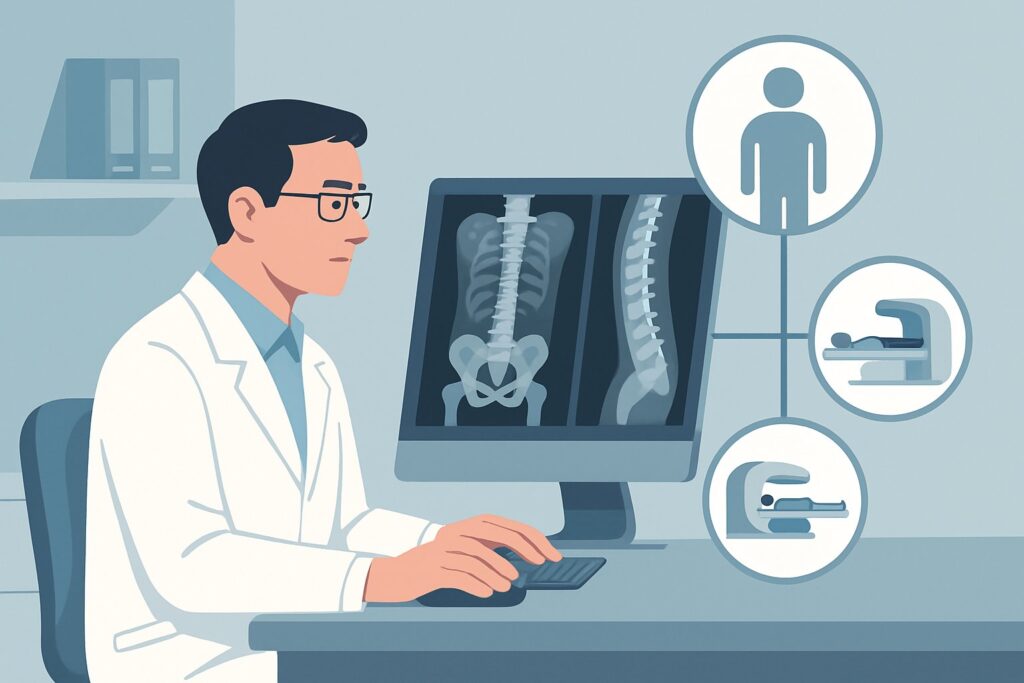
A 42-year-old male with a long history of Crohn’s disease, managed with intermittent courses of high-dose glucocorticoids, is in your clinic for a routine follow-up. He has no history of fractures but is concerned about his long-term bone health. You recognize that his underlying condition and its treatment are significant risk factors for low bone mineral density. The clinical question is clear: what is the appropriate initial imaging study to assess his bone mass? This scenario requires a precise diagnostic tool, not a general screening test. For this presentation, the American College of Radiology (ACR) rates Dual-energy X-ray Absorptiometry (DXA) of the lumbar spine and hip(s) as Usually Appropriate, establishing it as the clear first-line investigation.
Who Fits This Clinical Scenario?
This guidance applies to a specific, high-risk population: premenopausal females or males under the age of 50 who have known risk factors that could negatively impact their bone mineral density (BMD). This is not a screening scenario for the general population. The key determinant is the presence of a comorbidity or exposure known to cause secondary bone loss.
Inclusion criteria include individuals with conditions such as:
- Chronic glucocorticoid use (e.g., for inflammatory bowel disease, rheumatoid arthritis, or asthma)
- Hypogonadism (e.g., premature ovarian failure, androgen deprivation therapy, or hypopituitarism)
- Malabsorption syndromes (e.g., celiac disease, post-gastric bypass)
- Hyperparathyroidism or hyperthyroidism
- History of an eating disorder
- Use of certain medications like aromatase inhibitors or some anticonvulsants
This workflow is distinct from other common scenarios. It does not apply to routine osteoporosis screening in postmenopausal women or men over 50, who are evaluated based on age-related risk. It also differs from the follow-up imaging for a patient already diagnosed with low bone mass, which involves surveillance and monitoring treatment response.
What Diagnoses Are You Working Up in This Scenario?
In this younger cohort, the primary goal is to detect low bone mass before a fragility fracture occurs. Unlike primary osteoporosis seen in older adults, a finding of low BMD in this group strongly suggests an underlying, and often treatable, secondary cause. The imaging workup is aimed at quantifying bone density to guide further investigation and management.
Secondary Osteoporosis: This is the leading consideration. The diagnostic label of “osteoporosis” is applied cautiously in this age group, but significant bone loss due to a specific medical condition is the most common and consequential finding. Glucocorticoid-induced osteoporosis is a classic example, where steroid use directly inhibits bone formation and promotes resorption. Identifying and quantifying this loss is critical to mitigating fracture risk.
Low Bone Mass for Chronologic Age: This is the preferred diagnostic term when a Z-score is -2.0 or lower in this population, as defined by the International Society for Clinical Densitometry (ISCD). It signifies that the individual’s bone density is substantially lower than their age- and sex-matched peers. This finding is a major red flag that triggers a comprehensive workup for secondary causes if one isn’t already known.
Osteopenia: While the term is technically defined by a T-score between -1.0 and -2.5, its application in premenopausal women and younger men is nuanced. A finding in this range still indicates lower-than-peak bone mass and, in the context of significant risk factors, warrants close monitoring and aggressive management of those underlying risks.
Why Is DXA of the Lumbar Spine and Hip(s) the Recommended Study?
The ACR designates DXA lumbar spine and hip(s) as Usually Appropriate because it is the established gold standard for measuring bone mineral density. Its high precision, reproducibility, and extremely low radiation dose make it the ideal tool for both initial diagnosis and subsequent monitoring in this at-risk population.
DXA provides areal bone mineral density (g/cm²), which is the basis for the World Health Organization’s diagnostic criteria. For premenopausal women and men under 50, the resulting Z-score—which compares the patient to an age- and sex-matched reference population—is the critical metric. A Z-score of -2.0 or below is considered low bone mass for chronologic age. The lumbar spine and hip are measured because they are common sites of osteoporotic fractures and are composed of different proportions of trabecular and cortical bone, providing a more comprehensive assessment.
Alternative studies are rated lower for clear reasons in this specific clinical context:
- Quantitative Computed Tomography (QCT) lumbar spine and hip: This is rated Usually not appropriate. Although QCT can provide a true volumetric density measurement, it delivers a substantially higher radiation dose (☢☢☢ 1-10 mSv) compared to DXA (☢ <0.1 mSv). Furthermore, its diagnostic thresholds are less standardized, and it is not the basis for most major society guidelines on diagnosis and treatment.
- Quantitative Ultrasound (QUS) calcaneus: This is also rated Usually not appropriate. While it is portable and involves no ionizing radiation (O 0 mSv), QUS measures different properties of bone and is not a substitute for DXA for diagnosis. Its primary role is as a community-based screening tool to identify individuals who may need a definitive DXA scan, which is not the goal for a patient already identified as having significant clinical risk factors.
When ordering the DXA, no specific preparation like contrast administration is needed. The key is to obtain high-quality measurements at the standard sites (L1-L4 spine, total hip, and femoral neck).
What’s Next After DXA? Downstream Workflow
The results of the DXA scan directly guide the subsequent clinical pathway, which in this younger population is heavily focused on identifying and managing underlying causes.
- If the Z-score is ≤ -2.0 (Low Bone Mass for Chronologic Age): This is a significant finding that mandates a thorough investigation for secondary causes of osteoporosis, if not already evident. This typically includes laboratory testing for vitamin D deficiency, hyperparathyroidism, thyroid disorders, hypogonadism, and malabsorption (e.g., celiac serology). Management will focus on treating the underlying condition, ensuring calcium and vitamin D sufficiency, and counseling on lifestyle modifications. Pharmacologic therapy is considered on a case-by-case basis, often in consultation with an endocrinologist, especially if the patient has a history of fragility fractures.
- If the Z-score is > -2.0 (Within the Expected Range for Age): This result is reassuring but does not eliminate the risk. The focus should be on aggressively managing the known risk factor (e.g., using the lowest possible glucocorticoid dose). Lifestyle optimization, including adequate calcium and vitamin D intake and weight-bearing exercise, is paramount. The timing for a follow-up DXA scan is not standardized but typically ranges from 1 to 3 years, depending on the severity and persistence of the risk factor.
- If the Study is Technically Limited: In cases where spine or hip measurements are compromised by severe degenerative changes, surgical hardware, or other artifacts, a DXA of the distal forearm (May be appropriate) can provide valuable diagnostic information.
Pitfalls to Avoid (and When to Get Help)
Navigating bone health in younger adults requires avoiding several common pitfalls. First, do not use T-scores for diagnosis in premenopausal women or men under 50. The diagnosis of “osteoporosis” based on a T-score of -2.5 is reserved for postmenopausal women and men over 50; in this younger group, the Z-score is the correct metric. Second, never assume low bone mass is idiopathic. A low Z-score is a powerful clinical signal to search for a secondary cause. Overlooking this step can lead to missed diagnoses of treatable systemic diseases. Finally, do not use screening tools like QUS for definitive diagnosis in a patient with known, significant risk factors. If a patient has a low Z-score and/or a history of fragility fractures, referral to an endocrinologist or a specialist in metabolic bone disease is the appropriate next step for comprehensive management.
Related ACR Topics and Tools
For a comprehensive overview of imaging for bone density across all patient populations, refer to the parent topic article. For additional tools to help in selecting the right test and understanding its implications, the following resources are available.
- For breadth across all scenarios in Osteoporosis and Bone Mineral Density, see our parent guide: Osteoporosis and Bone Mineral Density: ACR Appropriateness Decoded.
- To look up appropriateness criteria for adjacent or alternative clinical scenarios, use the ACR Appropriateness Criteria Lookup.
- To explore the technical specifications for various imaging studies, visit the Imaging Protocol Library.
- For discussions with patients about radiation exposure from medical imaging, the Radiation Dose Calculator can be a helpful aid.
Frequently Asked Questions
Why is a Z-score used instead of a T-score for premenopausal women and men under 50?
A T-score compares an individual’s bone density to that of a healthy 30-year-old, which is the point of peak bone mass. This is appropriate for diagnosing osteoporosis in older adults who are losing bone from an established peak. A Z-score compares the individual to their own age- and sex-matched peers. In younger individuals who may not have reached their peak bone mass or who have a condition preventing them from doing so, the Z-score is a more accurate reflection of whether their bone density is abnormally low for their stage of life.
If a 35-year-old female on long-term steroids has a normal DXA, when should it be repeated?
There is no universal consensus, and the decision depends on the clinical context. If the underlying risk factor, such as high-dose glucocorticoid use, persists, a follow-up DXA is often recommended in 1-2 years to monitor for an accelerated rate of bone loss. If the risk factor is resolved, the interval may be longer. The decision should be individualized based on the severity of the risk and the patient’s overall clinical picture.
Can a fragility fracture in a young adult confirm osteoporosis even with a normal DXA scan?
Yes. A fragility fracture (one that occurs from a fall from standing height or less) is a clinical diagnosis of osteoporosis, regardless of the patient’s BMD measurement. In a young adult, such an event is highly abnormal and warrants a comprehensive workup for secondary causes of poor bone quality, even if the DXA Z-score is within the normal range.
Is DXA useful for a patient with spinal hardware from a previous surgery?
Lumbar spine measurements on DXA can be artifactually elevated and unreliable in the presence of surgical hardware, severe osteoarthritis, or compression fractures. In these cases, the hip measurement remains valid and crucial. Additionally, ordering a DXA of the distal forearm (specifically the non-dominant one) is a recommended and appropriate step to get an accurate assessment of bone density when the spine is not evaluable.
What is the role of Trabecular Bone Score (TBS) in this younger population?
Trabecular Bone Score (TBS) is an advanced software analysis of the lumbar spine DXA image that provides an indirect measure of bone microarchitecture. While it can add to fracture risk prediction in postmenopausal women, its role in premenopausal women and younger men is less established. The ACR currently rates TBS as *Usually not appropriate* for the initial imaging workup in this specific scenario, as the primary decision-making relies on the standard BMD measurement from DXA.
Reviewed by Pouyan Golshani, MD, Interventional Radiologist — May 30, 2026