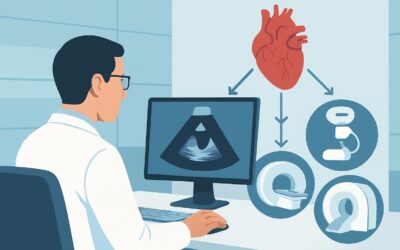
Which Imaging Study Best Finds the Source of an Upper Extremity Arterial Embolus?
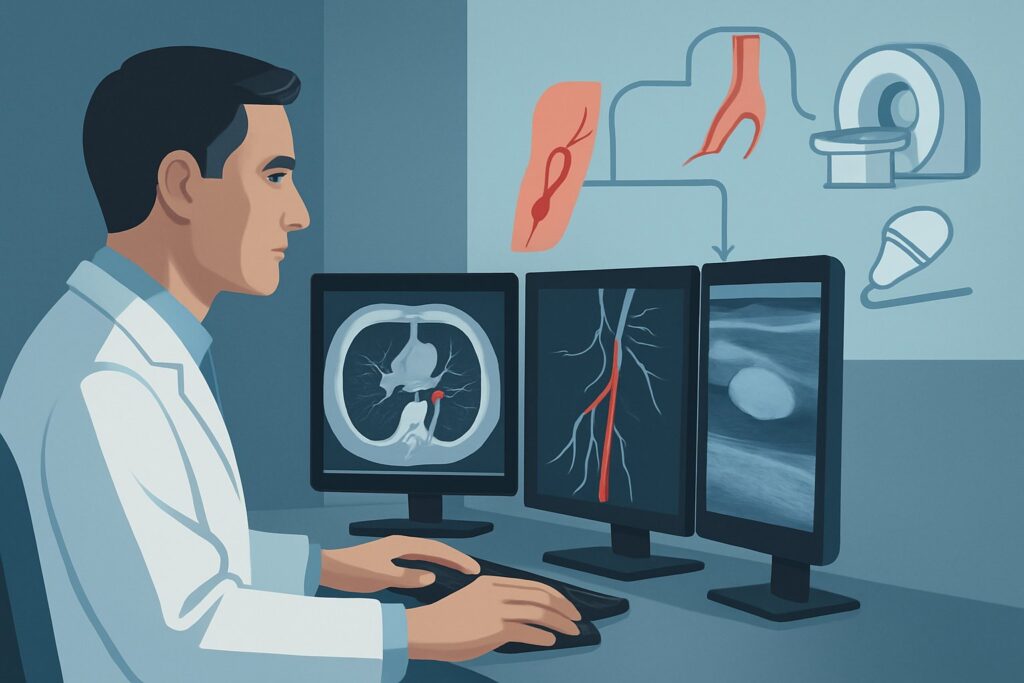
A 58-year-old man with a history of hypertension presents to the emergency department with the sudden onset of a cold, painful, and pulseless right hand. A duplex ultrasound confirms an acute brachial artery occlusion, and the vascular surgery team is consulted for revascularization. The clinical picture is highly suspicious for an embolic event, not local thrombosis. The immediate question for the consulting cardiologist and primary team is: what is the next, most effective imaging study to identify the source of the embolus? This article provides a detailed workflow for this specific scenario, guided by the American College of Radiology (ACR) Appropriateness Criteria, which rate transesophageal echocardiography as Usually Appropriate for this indication.
Who Fits This Clinical Scenario?
This workflow is designed for a specific patient presentation: a confirmed acute arterial occlusion in an upper extremity (e.g., subclavian, axillary, brachial, radial, or ulnar artery) where an embolic etiology is suspected. This suspicion typically arises in patients without a history of local trauma, prior vascular procedures in that arm, or signs of intrinsic arterial disease that would suggest in-situ thrombosis. The patient may have known risk factors for embolism, such as atrial fibrillation, a recent myocardial infarction, or known valvular heart disease, but these are not prerequisites for this workup.
It is crucial to distinguish this scenario from others that require different diagnostic pathways. This guidance does not apply to:
- Known lower extremity arterial occlusion: While also often embolic, the differential for the source can have different probabilities, and the imaging approach may be tailored differently.
- Mesenteric or renal arterial occlusion: These scenarios often prioritize Computed Tomography Angiography (CTA) to rapidly assess for bowel or renal ischemia in addition to identifying the embolic source.
- Occlusion with a clear local source: If the patient has a known subclavian artery aneurysm or severe thoracic outlet syndrome causing local thrombus formation, the workup would focus on characterizing that local pathology rather than searching for a distant cardiac or aortic source.
What Diagnoses Are You Working Up in This Scenario?
When an upper extremity arterial embolus is suspected, the imaging workup is a search for its origin. The differential diagnosis is focused on central sources that can release thrombotic or other material into the systemic circulation. The primary goal of imaging is to interrogate these potential locations.
Cardiac Source: This is the most common origin for systemic arterial emboli. The primary culprits include a thrombus in the left atrial appendage (LAA), strongly associated with atrial fibrillation; a left ventricular (LV) thrombus, often a complication of a recent or prior myocardial infarction with wall motion abnormalities; or septic vegetations on the mitral or aortic valves from endocarditis. Less commonly, a primary cardiac tumor, such as a left atrial myxoma, can be the source.
Aortic Source: The thoracic aorta, particularly the aortic arch, can be a significant source of emboli. Complex, mobile, or ulcerated atherosclerotic plaques (often termed “shaggy aorta”) can shed atheroembolic debris or serve as a nidus for thrombus formation. A thoracic aortic aneurysm may also contain a mural thrombus that can embolize.
Paradoxical Embolus: In this less common but important scenario, a thrombus from the venous system (like a deep vein thrombosis) travels to the arterial circulation through a right-to-left shunt. The most common channel for this is a patent foramen ovale (PFO), but an atrial septal defect (ASD) or pulmonary arteriovenous malformation can also be responsible. This should be considered especially in younger patients without traditional atherosclerotic or cardiac risk factors.
Why Is US Echocardiography Transesophageal Usually Appropriate for This Presentation?
For a patient with a suspected embolic source of an upper extremity occlusion, the ACR designates several studies as Usually Appropriate, including transesophageal echocardiography (TEE), transthoracic echocardiography (TTE), CTA, and cardiac MRI. However, TEE is often the pivotal study due to its superior diagnostic capabilities for the most common and critical potential sources.
The primary advantage of TEE is its unparalleled visualization of posterior cardiac structures. The transesophageal probe’s proximity to the heart, without interference from the lungs or chest wall, provides high-resolution images of the left atrial appendage, the interatrial septum, the mitral and aortic valves, and the thoracic aorta. This makes it highly sensitive for detecting LAA thrombus, small valvular vegetations, and PFOs (when combined with a bubble study)—diagnoses that can be easily missed on a TTE.
While several alternatives are also rated Usually Appropriate, they have specific trade-offs in this context:
- US echocardiography transthoracic resting (TTE): TTE is an excellent, non-invasive first-line test. It can readily identify large LV thrombi or significant valvular dysfunction. However, its sensitivity for LAA thrombus—a leading cause of emboli—is low. A negative TTE does not sufficiently rule out a cardiac source in a high-suspicion case.
- CTA chest with IV contrast: CTA is outstanding for evaluating the entire thoracic aorta for plaque, aneurysm, or dissection. It also provides good, though less detailed, information about cardiac chamber size and can sometimes detect large ventricular thrombi. However, it is less sensitive than TEE for small valvular vegetations or LAA thrombus and involves both ionizing radiation (ACR Relative Radiation Level ☢☢☢, 1-10 mSv) and iodinated contrast.
- MRI heart function and morphology: Cardiac MRI offers excellent tissue characterization and can detect thrombus without radiation. However, it is more time-consuming, less widely available on an emergent basis, and may be contraindicated in patients with certain implants.
Ultimately, TEE is often the most efficient and definitive single test to investigate the highest-yield sources. It carries no radiation risk (ACR RRL O, 0 mSv) and directly visualizes the structures most frequently implicated in cardioembolic events.
What’s Next After US Transesophageal Echocardiography? Downstream Workflow
The results of the TEE will guide the subsequent clinical management and any further diagnostic steps. The workflow branches based on whether a definitive source is identified.
If the TEE is positive: A definitive finding, such as a left atrial appendage thrombus, a mobile aortic arch plaque, or large valvular vegetations, establishes the diagnosis. The downstream path is therapeutic. This typically involves initiating systemic anticoagulation to prevent further embolic events, consulting infectious disease for antibiotic therapy in the case of endocarditis, or planning for surgical intervention, such as valve repair/replacement or myxoma resection.
If the TEE is negative: A negative TEE effectively rules out many of the most common cardiac sources. However, if clinical suspicion for an embolic event remains high, the workup is not complete. The next logical step is to thoroughly evaluate the thoracic aorta, as complex atheroma can be the source. A CTA chest with IV contrast is an excellent next choice, as it is specifically designed to visualize the aortic wall and lumen. This is not a deviation from the guidelines, but a sequential application of another Usually Appropriate study to investigate the next most likely source.
If the TEE is indeterminate: Occasionally, a TEE may be technically limited or reveal an ambiguous finding. In such cases, a complementary imaging study is warranted. For instance, if there is a question of a cardiac mass versus a thrombus, a cardiac MRI with and without IV contrast can be invaluable for its superior tissue characterization. If the aorta was poorly visualized on TEE, a CTA would be the appropriate next step.
Pitfalls to Avoid (and When to Get Help)
In the workup of a suspected upper extremity embolus, several common pitfalls can delay diagnosis or lead to an incomplete evaluation.
- Stopping the workup after a negative TTE: A transthoracic echocardiogram is a screening tool in this context. Given its poor sensitivity for key pathologies like LAA thrombus, a negative TTE in a patient with a confirmed embolus should prompt escalation to a more definitive test like TEE.
- Forgetting the aorta: It’s easy to develop tunnel vision for a cardiac source. If the TEE is negative, actively pivot to imaging the aortic arch. A significant portion of “cryptogenic” strokes and systemic emboli originate from aortic atheroma.
- Neglecting a paradoxical embolus workup: In younger patients or those without other clear risk factors, failing to request a bubble study during the TEE or TTE is a missed opportunity to diagnose a PFO-mediated paradoxical embolus.
- Attributing the event to atrial fibrillation without confirmation: While AFib is a major risk factor, do not assume it is the cause without confirming an LAA thrombus. The patient could have coexisting aortic or valvular pathology that is the true source.
If the source remains elusive after a comprehensive cardiac and aortic evaluation, it is time to escalate. A consultation with a hematologist to investigate for an underlying hypercoagulable state is a critical next step.
Related ACR Topics and Tools
This article covers one specific scenario within the broader topic of identifying embolic sources. For a comprehensive overview of all related clinical variants, including workups for lower extremity and visceral emboli, refer to the parent guide. The following GigHz tools can also support your clinical decision-making:
- For breadth across all scenarios in Workup of Noncerebral Systemic Arterial Embolic Source, see our parent guide: Workup of Noncerebral Systemic Arterial Embolic Source: ACR Appropriateness Decoded.
- ACR Appropriateness Criteria Lookup — To review guidelines for adjacent or alternative clinical scenarios.
- Imaging Protocol Library — For detailed technical parameters of studies like cardiac CTA and MRI.
- Radiation Dose Calculator — To help in discussions with patients about cumulative radiation exposure from different imaging strategies.
Frequently Asked Questions
Why not start with a CTA of the chest for every patient with a suspected upper extremity embolus?
While CTA is an excellent and ‘Usually Appropriate’ test, transesophageal echocardiography (TEE) offers superior visualization of key intracardiac structures like the left atrial appendage and cardiac valves without using ionizing radiation. Since the heart is the most common source of emboli, TEE is often the most direct and highest-yield initial diagnostic test. CTA is a strong alternative, particularly if the aorta is the primary concern or if TEE is contraindicated.
Is a transthoracic echo (TTE) sufficient for the initial workup?
A TTE is a valuable, non-invasive first step and is also rated ‘Usually Appropriate’ by the ACR. It can identify major issues like a large left ventricular thrombus. However, it has well-known limitations in visualizing the left atrial appendage and aortic arch. In a patient with a confirmed embolic event, a negative TTE is often insufficient to rule out a central source, and a TEE is typically required for a complete and definitive workup.
What is the best alternative if my patient cannot tolerate a TEE?
If a patient has a contraindication to TEE (e.g., esophageal stricture, recent surgery) or refuses the procedure, both CTA of the chest with IV contrast and cardiac MRI are excellent ‘Usually Appropriate’ alternatives. These studies can comprehensively evaluate both the heart and the thoracic aorta, providing a robust, non-invasive assessment for an embolic source.
Does this imaging workflow change if the patient has known atrial fibrillation?
The presence of atrial fibrillation significantly increases the pre-test probability of a left atrial appendage (LAA) thrombus, making TEE an even more critical part of the workup. The fundamental imaging choice doesn’t change, but the urgency and focus on meticulously evaluating the LAA are heightened. A TEE is considered the gold standard for ruling out LAA thrombus before procedures like cardioversion and is equally vital in this embolic workup.
This article is about finding the embolic source. What imaging is used for the arm itself?
Correct, this workflow addresses the ‘why’ (the source) not the ‘what’ (the occlusion). Imaging of the affected upper extremity is the first step to confirm the diagnosis and plan treatment. This is typically done with a duplex ultrasound or a CT angiogram of the arm, which localizes the level of the occlusion and assesses the distal runoff vessels. The workup described in this article is the crucial second step: finding where the clot originated to prevent a recurrence.
Reviewed by Pouyan Golshani, MD, Interventional Radiologist — May 30, 2026