Which Imaging Study Is Best for Chronic Chest Pain with Low-to-Intermediate CAD Probability?

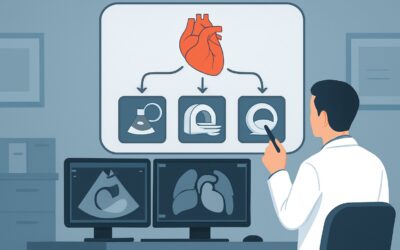
A 58-year-old male with well-controlled hypertension presents to your clinic with a two-month history of intermittent, substernal chest tightness. The discomfort occurs with strenuous activity like climbing several flights of stairs and resolves with rest. His physical exam is unremarkable, and a resting electrocardiogram (ECG) shows no acute ischemic changes. You suspect a cardiac etiology, but his pre-test probability for significant coronary artery disease (CAD) is in the low to intermediate range. This is not an acute coronary syndrome, but a workup for stable ischemic heart disease is warranted. The central question is which initial imaging study will most effectively and safely evaluate for inducible ischemia. For this specific clinical scenario, the American College of Radiology (ACR) Appropriateness Criteria rate US echocardiography transthoracic stress as Usually Appropriate.
Who Fits This Clinical Scenario for Chronic Chest Pain Imaging?
This guidance applies to a specific patient population: adults presenting with chronic, stable chest pain where a cardiac origin is suspected. The key inclusion criteria are:
- Chronic Symptoms: The chest pain has been present for weeks or months, not hours or days. The pattern is stable and predictable.
- Low to Intermediate Pre-Test Probability of CAD: The patient’s risk profile, based on factors like age, sex, symptom characteristics, and comorbidities (e.g., hypertension, dyslipidemia, family history), does not place them in a high-risk category. Validated clinical decision rules can help formalize this assessment.
- Noncardiac Etiology Unlikely: The history and physical examination do not strongly suggest a gastrointestinal, musculoskeletal, or pulmonary cause for the pain.
Conversely, this workflow is not intended for patients with:
- Acute Chest Pain: Patients with suspected acute coronary syndrome (ACS), unstable angina, or evolving myocardial infarction require an emergent evaluation, which follows a different clinical pathway.
- High Pre-Test Probability of CAD: Individuals with typical angina, multiple risk factors, and a high pre-test probability may be candidates for more direct evaluation, potentially including invasive coronary angiography.
- Known Significant Coronary Artery Disease: Patients with a history of myocardial infarction, coronary stents, or bypass surgery who present with new or worsening symptoms are evaluated under different ACR guidelines for post-revascularization assessment.
What Diagnoses Are You Working Up in This Scenario?
When ordering initial imaging for this presentation, the primary goal is to identify or exclude inducible myocardial ischemia and its underlying causes. The differential diagnosis is focused on conditions that produce exertional chest pain.
The most common and critical diagnosis to evaluate is stable angina due to obstructive coronary artery disease (CAD). This occurs when a fixed atherosclerotic plaque narrows a coronary artery, limiting blood flow during times of increased myocardial oxygen demand (i.e., stress). The imaging study is designed to provoke and detect the functional consequence of this flow limitation—myocardial ischemia.
A less common but important consideration is coronary microvascular dysfunction. In this condition, patients experience angina-like symptoms, but no obstructive disease is found in the large epicardial arteries. The problem lies in the smaller coronary vessels. While stress testing can be abnormal in these patients, a definitive diagnosis often requires more advanced techniques.
You are also implicitly evaluating for structural heart disease that can mimic or cause angina. Significant valvular disease, particularly aortic stenosis, can cause exertional chest pain by increasing myocardial workload and limiting coronary perfusion. Similarly, non-ischemic cardiomyopathies like hypertrophic cardiomyopathy (HCM) can present with chest pain, and an echocardiogram is a primary tool for its diagnosis.
Why Is Stress Echocardiography the Recommended Initial Study for This Presentation?
For a patient with low-to-intermediate probability of CAD, the initial test should provide functional information about ischemia safely and effectively. The ACR rates US echocardiography transthoracic stress as Usually Appropriate because it directly addresses this need without exposing the patient to ionizing radiation.
The rationale for this choice is multifactorial:
- Functional Assessment: A stress echocardiogram assesses the heart’s function at rest and immediately after stress (either exercise on a treadmill or pharmacologic stimulation with dobutamine). The interpreting physician looks for new or worsening regional wall motion abnormalities (RWMAs). A segment of the heart muscle that contracts normally at rest but becomes hypokinetic or akinetic with stress is a highly specific indicator of ischemia in that coronary territory.
- Safety and Accessibility: The procedure uses ultrasound and involves no ionizing radiation (0 mSv). It is widely available, relatively inexpensive, and provides a wealth of complementary information, including baseline left ventricular function, valvular integrity, and an assessment for structural abnormalities like HCM.
- Diagnostic Performance: Stress echocardiography has demonstrated good diagnostic accuracy for detecting hemodynamically significant CAD, helping to guide decisions about medical therapy versus further invasive testing.
Several other tests are also rated Usually Appropriate but have different trade-offs. For example, CTA coronary arteries with IV contrast is an excellent anatomic test. It is particularly useful for ruling out CAD due to its high negative predictive value. However, it involves radiation (1-10 mSv) and iodinated contrast, and while it can identify a stenosis, it does not confirm if that stenosis is causing a functional perfusion defect.
A lower-rated alternative, CT coronary calcium (May be appropriate), quantifies the total burden of calcified plaque. A score of zero effectively rules out significant obstructive CAD. However, a positive score confirms the presence of atherosclerosis but does not prove that a specific lesion is causing ischemia, making it less useful for answering the primary functional question in a symptomatic patient.
What’s Next After US echocardiography transthoracic stress? Downstream Workflow
The results of the stress echocardiogram will guide the subsequent clinical pathway. The decision tree typically branches into three main directions.
- Positive for Ischemia: If the study reveals a new, stress-induced regional wall motion abnormality, this indicates a high likelihood of flow-limiting CAD. The next step is typically a referral to cardiology. This may lead to initiation or optimization of anti-anginal medical therapy and consideration for invasive arteriography coronary (Usually not appropriate as an initial test, but appropriate here) to define the coronary anatomy and plan for potential revascularization (stenting or bypass surgery).
- Negative for Ischemia: A normal stress echocardiogram, especially if the patient achieves an adequate level of stress (e.g., >85% of maximum predicted heart rate), carries a very high negative predictive value. This makes significant obstructive CAD unlikely to be the cause of the patient’s symptoms. The focus should shift to aggressive medical management of risk factors and exploring non-ischemic or noncardiac causes of the chest pain.
- Indeterminate or Equivocal: Sometimes, the study is technically limited (e.g., poor acoustic windows) or the findings are ambiguous. In this situation, a second non-invasive test using a different modality is often warranted. An MRI heart with function and vasodilator stress perfusion or a nuclear study like SPECT or SPECT/CT MPI (both Usually Appropriate) can provide excellent functional data and may be less affected by the factors that limited the echocardiogram.
Pitfalls to Avoid (and When to Get Help)
When navigating this clinical scenario, several common pitfalls can lead to diagnostic errors or inefficient care.
First, avoid ordering a resting-only study. A US echocardiography transthoracic resting (May be appropriate) can identify structural issues but will not reveal inducible ischemia, which is the central question. The wall motion of an ischemic segment is typically normal at rest.
Second, be mindful of patient-specific limitations. For patients who cannot exercise due to orthopedic or other medical issues, ensure you order a pharmacologic stress test (e.g., dobutamine stress echo).
Third, do not anchor on a single diagnosis. If a high-quality stress test is negative, resist the urge to order serial or alternative cardiac tests without new clinical indications. Instead, broaden the differential to reconsider musculoskeletal, gastrointestinal, or other causes.
If a patient’s symptoms escalate, become unstable, or occur at rest despite a recent negative stress test, this represents a change in clinical status. Escalate care immediately, as this may signal an acute coronary syndrome requiring hospital admission and a more aggressive workup.
Related ACR Topics and Tools
For a comprehensive overview of all clinical variants and imaging modalities for this condition, please consult the parent topic article. Additional GigHz tools can help refine imaging decisions and facilitate patient communication.
- For breadth across all scenarios in Chronic Chest Pain-Noncardiac Etiology Unlikely: Low to Intermediate Probability of Coronary Artery Disease, see our parent guide: Chronic Chest Pain-Noncardiac Etiology Unlikely: Low to Intermediate Probability of Coronary Artery Disease: ACR Appropriateness Decoded.
- ACR Appropriateness Criteria Lookup: For exploring adjacent or alternative clinical scenarios.
- Imaging Protocol Library: For detailed technical specifications on performing various cardiac imaging studies.
- Radiation Dose Calculator: For discussing cumulative radiation exposure with patients when considering CT or nuclear medicine options.
Frequently Asked Questions
Why not start with a Coronary CT Angiography (CCTA) if it’s also rated ‘Usually Appropriate’?
CCTA is an excellent anatomic test, especially for ruling out disease in lower-risk patients. However, stress echocardiography is often chosen first because it provides functional information (is there ischemia?) rather than just anatomic information (is there a stenosis?). It also avoids radiation and iodinated contrast. The choice between the two often depends on local expertise, patient factors (e.g., renal function, ability to hold breath), and the specific clinical question.
What if my patient cannot exercise on a treadmill for the stress echo?
If a patient cannot exercise due to arthritis, deconditioning, or other limitations, a pharmacologic stress echocardiogram should be ordered. This test uses an intravenous medication, typically dobutamine, to increase the heart rate and contractility, simulating the effects of exercise to unmask potential ischemia.
Is a coronary artery calcium (CAC) score a good first test for this patient?
A CAC score is rated ‘May be appropriate’ by the ACR for this scenario. While a score of zero has a very high negative predictive value for obstructive CAD, a positive score only confirms the presence of atherosclerosis but doesn’t tell you if it’s causing the patient’s symptoms (i.e., causing ischemia). For a symptomatic patient, a functional study like a stress echo is generally more informative for guiding management.
My patient’s stress echo was negative, but they are still having chest pain. What should I do?
A negative stress echo in a patient who achieved an adequate heart rate makes flow-limiting epicardial CAD very unlikely. The next steps should be to ensure optimal medical therapy for risk factors, and to thoroughly investigate non-ischemic cardiac causes (like microvascular dysfunction) and noncardiac causes (such as GERD, esophageal spasm, or musculoskeletal pain), which are common sources of chronic chest pain.
Does a stress echo provide information about heart valve function?
Yes. A key advantage of an echocardiography-based stress test is that the resting portion of the exam includes a complete assessment of cardiac structures, including the size and function of the heart chambers, and a detailed evaluation of all four heart valves for stenosis or regurgitation. This can identify other causes of chest pain, such as significant aortic stenosis.
Reviewed by Pouyan Golshani, MD, Interventional Radiologist — May 29, 2026