Which Imaging Study Is Best for Suspected Shoulder Arthroplasty Loosening?
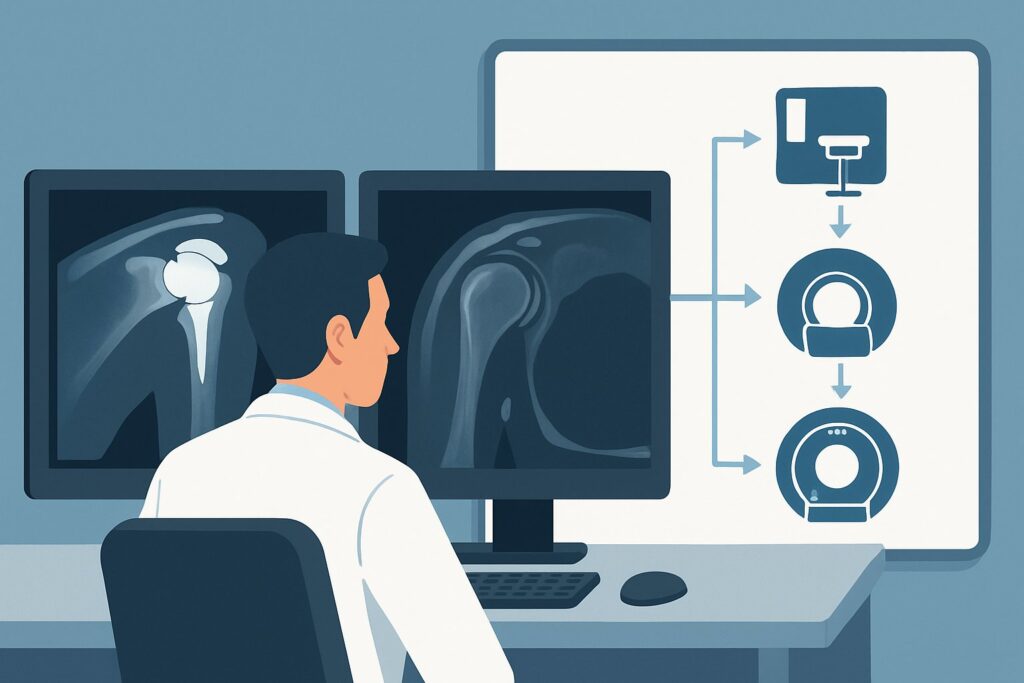
A 68-year-old patient with a primary total shoulder arthroplasty placed five years ago presents to your orthopedic clinic with six months of progressive, deep-seated shoulder pain and a new sensation of clicking with overhead activity. There are no fevers, chills, or signs of systemic illness. Inflammatory markers are normal, and initial radiographs show stable component alignment but are equivocal for periprosthetic lucency at the glenoid. You suspect aseptic loosening, but need advanced imaging to confirm the diagnosis and plan the next steps. This article details the clinical workflow for this specific scenario: a symptomatic patient with a primary shoulder arthroplasty, infection excluded, where additional imaging is needed after inconclusive radiographs.
For this presentation, the American College of Radiology (ACR) finds that MRI shoulder without IV contrast is Usually Appropriate.
## Who Fits This Clinical Scenario?
This guidance is tailored for a very specific patient population. Applying this workflow correctly requires confirming that your patient meets several key criteria.
Inclusion Criteria:
- Symptomatic Primary Arthroplasty: The patient must have a primary (not revision or reverse) shoulder replacement and is now experiencing new or worsening symptoms like pain, instability, clicking, or decreased function.
- Infection Excluded: A thorough clinical and laboratory workup has been performed to rule out infection. This typically includes a normal white blood cell count, C-reactive protein (CRP), and erythrocyte sedimentation rate (ESR). This is a critical branch point; if infection is suspected, the imaging pathway is different.
- Initial Radiographs Obtained: Standard radiographs (e.g., AP, Grashey, axillary views) have already been completed and are non-diagnostic, equivocal, or show subtle findings that require further characterization.
Exclusion Criteria (These Patients Require a Different Workflow):
- Asymptomatic Follow-up: This workflow does not apply to routine, asymptomatic surveillance imaging.
- Suspected Infection: If there is any clinical or laboratory suspicion for periprosthetic joint infection, the imaging workup changes significantly, often involving nuclear medicine studies or joint aspiration.
- Primary Suspicion of Soft Tissue Pathology: If the primary clinical concern is a rotator cuff tear, subacromial impingement, or other soft tissue abnormality, the imaging focus and protocol may differ, even though MRI is often the modality of choice.
- Initial Imaging Workup: This guidance is for additional imaging after radiographs. If the patient has not yet had radiographs, that is the appropriate first step.
## What Diagnoses Are You Working Up in This Scenario?
When ordering advanced imaging for a painful shoulder arthroplasty with infection ruled out, the primary goal is to identify the mechanical cause of failure. The differential diagnosis is focused on the implant and its interaction with the surrounding bone and soft tissues.
Aseptic Loosening
This is the most common long-term complication and the primary diagnosis of concern. It occurs when the bond between the implant and the bone (or the cement and the bone) fails. This can be caused by mechanical stress or a biologic response to microscopic wear particles (particle disease), which triggers osteolysis—the resorption of bone around the implant. Imaging aims to identify periprosthetic lucent lines, component migration, or signs of synovitis related to this process.
Periprosthetic Fracture
While often visible on radiographs, some non-displaced or occult fractures can be missed. Advanced imaging, particularly CT, is highly sensitive for subtle fracture lines around the humeral or glenoid components that can cause pain and instability.
Component Wear or Malposition
Over time, the polyethylene liner of the glenoid component can wear down, leading to instability and pain. Imaging can assess for eccentric wear, component subsidence, or subtle shifts in alignment that are not apparent on plain films. This is a key driver of the osteolysis that leads to aseptic loosening.
Soft Tissue Impingement
Component malposition, subsidence, or the formation of osteolytic lesions can lead to mechanical impingement of the surrounding soft tissues, including the rotator cuff tendons. While a full-thickness cuff tear is a separate clinical question, secondary impingement is a common consequence of implant failure.
## Why Is MRI Shoulder Without IV Contrast the Recommended Study?
The ACR designates MRI shoulder without IV contrast as Usually Appropriate for this scenario because it provides a comprehensive evaluation of both the bone-implant interface and the surrounding soft tissues without using ionizing radiation.
The rationale for this recommendation involves several key factors:
- Superior Tissue Contrast: MRI excels at detecting bone marrow edema, fluid collections, and synovitis, which are often early and sensitive indicators of the inflammatory response associated with aseptic loosening and particle disease. This allows for detection of osteolysis before significant bone loss is visible on other modalities.
- Metal Artifact Reduction: Modern MRI scanners use specialized software sequences (e.g., MARS, MAVRIC, SEMAC) that significantly reduce the signal distortion caused by the metallic implants. When these sequences are used, the periprosthetic tissues can be evaluated with remarkable clarity, allowing for precise measurement of lucent zones and assessment of soft tissue structures.
- Radiation and Contrast Avoidance: MRI avoids the ionizing radiation associated with CT and nuclear medicine scans (0 mSv). Furthermore, for the workup of aseptic loosening, intravenous contrast is deemed Usually Not Appropriate. The intrinsic contrast between synovitis, fluid, and bone on non-contrast sequences is typically sufficient, and adding gadolinium provides little additional diagnostic value while introducing potential risks and costs.
How Do Alternative Studies Compare?
- CT shoulder without IV contrast is also rated Usually Appropriate. It offers a distinct advantage in its superb depiction of bone detail, making it excellent for quantifying bone loss, identifying occult fractures, and precisely measuring component position and version. However, it is less sensitive than MRI for detecting early synovitis and soft tissue pathology. It involves a moderate radiation dose (☢☢☢ 1-10 mSv) and is often considered a strong alternative or complementary study, especially if MRI is contraindicated or unavailable.
- 3-phase bone scan with SPECT or SPECT/CT shoulder is rated May be appropriate. This nuclear medicine study is highly sensitive for detecting increased metabolic activity at the bone-implant interface, a hallmark of loosening. However, its specificity is lower, as increased uptake can also be seen with infection, fracture, or even normal remodeling. The addition of SPECT/CT helps localize the abnormal activity, making it a useful problem-solving tool when MRI and CT findings are equivocal.
Once you’ve decided on MRI shoulder without contrast, our protocol guide covers the technique, contrast, and reading principles: MRI Shoulder Without Contrast.
## What’s Next After MRI? Downstream Workflow
The results of the MRI will guide the subsequent clinical and surgical management. The decision tree typically branches based on whether a clear mechanical cause for the patient’s symptoms is identified.
- If the MRI is positive for loosening: Findings such as extensive periprosthetic T2 signal, synovitis, measurable osteolysis, or visible component micromotion confirm the diagnosis. The next step is a consultation with an orthopedic surgeon specializing in revision arthroplasty. The imaging will be crucial for preoperative planning, helping the surgeon anticipate the degree of bone loss and the complexity of the revision procedure.
- If the MRI is negative: A high-quality MRI with MARS sequences that shows no evidence of loosening, fracture, or significant soft tissue pathology is a powerful negative finding. In this case, the focus should shift to other potential pain generators. This could include referred pain from the cervical spine, a different primary shoulder pathology not directly related to the implant, or a chronic pain syndrome. Further workup may involve a diagnostic injection, physiatry consultation, or pain management referral.
- If the MRI is indeterminate: Sometimes, findings can be ambiguous—for example, minimal periprosthetic fluid that could be reactive but doesn’t definitively indicate loosening. In these cases, the next step often involves a multidisciplinary discussion between the radiologist and surgeon. A ‘May be appropriate’ study like a SPECT/CT could be considered to add functional information about metabolic activity at the interface. Alternatively, if clinical suspicion remains high, the surgeon may proceed with joint aspiration to definitively rule out a low-grade infection before considering revision.
## Pitfalls to Avoid (and When to Get Help)
Navigating the workup of a painful shoulder arthroplasty requires careful attention to detail to avoid common missteps.
- Ordering MRI Without MARS: An MRI performed without dedicated metal artifact reduction sequences is often non-diagnostic. Always confirm with the imaging center that they have an appropriate protocol for evaluating metallic implants.
- Misinterpreting Normal Postoperative Findings: A thin, stable, and well-defined fibrous tissue layer can appear as a lucent line around an implant and is a normal finding. Differentiating this from the progressive, irregular lucency of pathologic osteolysis is key. Comparison with prior imaging is invaluable.
- Prematurely Dismissing Infection: While this workflow assumes infection has been excluded, a negative MRI for loosening in a patient with persistent symptoms should prompt a re-evaluation of the possibility of a low-grade, indolent infection.
- Ignoring Glenoid Wear: On humeral hemiarthroplasty, pain can arise from progressive glenoid cartilage wear (glenoiditis). While not “loosening,” it is a mechanical cause of failure that MRI can help identify.
If the imaging findings are complex, discordant with the clinical picture, or suggest an aggressive process, escalate immediately by initiating a direct conversation between the ordering clinician, the interpreting musculoskeletal radiologist, and the orthopedic surgeon.
## Related ACR Topics and Tools
For a comprehensive overview of all clinical scenarios related to shoulder arthroplasty imaging, or to explore the technical details of the recommended studies, the following resources are available:
- For breadth across all scenarios in Imaging After Shoulder Arthroplasty, see our parent guide: Imaging After Shoulder Arthroplasty: ACR Appropriateness Decoded.
- To explore other clinical questions, use the Imaging Appropriateness Selector.
- To review technical specifications for various studies, see the Imaging Protocol Library.
- To discuss radiation exposure with patients, consult the Radiation Dose Calculator.
Frequently Asked Questions
Why is MRI without contrast preferred over MRI with contrast for suspected loosening?
For evaluating aseptic loosening, intravenous contrast is rated ‘Usually Not Appropriate’ by the ACR. The primary findings, such as periprosthetic fluid, synovitis, and osteolysis, are well-visualized on non-contrast sequences (like T2-weighted and STIR). Adding gadolinium-based contrast does not significantly improve the detection of these features and adds unnecessary cost and potential risk (e.g., nephrogenic systemic fibrosis in at-risk patients).
My patient has a pacemaker. Is CT a good alternative to MRI in this case?
Yes. CT shoulder without IV contrast is also rated ‘Usually Appropriate’ and is an excellent alternative for patients with contraindications to MRI. CT provides superior evaluation of bone stock, component position, and the extent of osteolytic lesions. While it offers less detail of the surrounding soft tissues, it is highly effective for diagnosing the primary concerns of loosening and periprosthetic fracture.
What if the initial radiographs are completely normal? Should I still order an MRI?
Yes, if clinical suspicion for loosening remains high. Radiographs have limited sensitivity for detecting early osteolysis. Significant bone loss must occur before it becomes apparent on a plain film. Advanced imaging like MRI or CT can detect the process much earlier, identifying marrow edema, synovitis, and subtle lucencies that are invisible on radiographs.
Does this guidance apply to a reverse total shoulder arthroplasty (rTSA)?
This specific ACR variant addresses primary shoulder arthroplasty. While the imaging principles are similar for an rTSA, the patterns of failure and mechanical complications can differ. For instance, scapular notching is a unique complication of rTSA. It is best to consult the specific ACR criteria or a musculoskeletal radiologist for nuanced cases involving reverse or revision arthroplasty.
How important is it to specify ‘metal artifact reduction sequences’ when ordering the MRI?
It is absolutely critical. Standard MRI sequences produce significant artifacts around metallic implants, obscuring the bone-implant interface and making the study uninterpretable for this indication. You must ensure the imaging facility uses a dedicated protocol with sequences like MARS, MAVRIC, or SEMAC. It is often helpful to include ‘evaluation for periprosthetic loosening’ in the clinical history on the order.
Reviewed by Pouyan Golshani, MD, Interventional Radiologist — May 26, 2026