Should You Order MRI or CT for an Indeterminate Mediastinal Mass on Chest X-Ray?
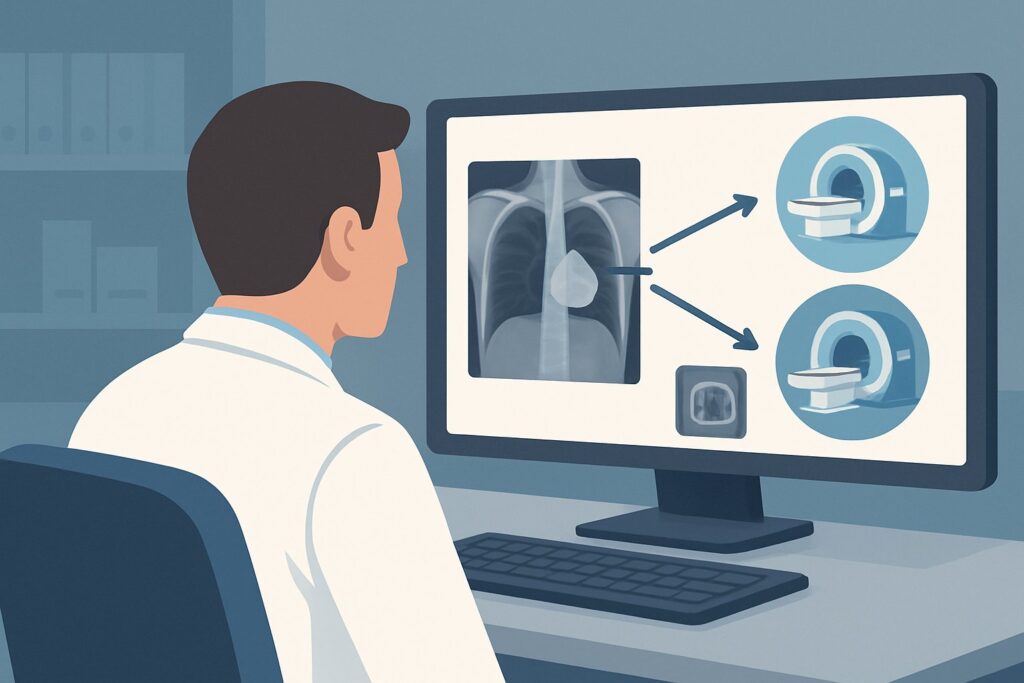
A 45-year-old patient presents with a persistent, non-productive cough. You order a chest radiograph, and the report returns noting “fullness of the aorticopulmonary window” or “widening of the superior mediastinum,” an indeterminate finding. The immediate clinical question is no longer about the cough, but about this unexpected shadow. What is the most effective and appropriate next imaging study to characterize this potential mass, differentiate benign from malignant causes, and guide the subsequent workup? This article provides a step-by-step workflow based on the American College of Radiology (ACR) Appropriateness Criteria. For this specific scenario, MRI of the chest without and with IV contrast is rated Usually Appropriate as the next diagnostic step.
Who Fits This Clinical Scenario for a Mediastinal Mass?
This guidance is for a specific, common clinical situation: a patient who has already had a chest radiograph (often for unrelated symptoms like cough, chest pain, or as a preoperative screen) that reveals a mediastinal abnormality of unclear etiology. The key is that the finding is “indeterminate”—the radiograph can detect the abnormality but cannot characterize it.
This workflow applies to hemodynamically stable adult patients where the goal is tissue characterization. It is crucial to distinguish this from similar, but distinct, clinical scenarios that require a different approach:
- No prior imaging: If you have a high clinical suspicion for a mediastinal mass (e.g., symptoms of myasthenia gravis suggesting thymoma) but have not yet obtained any imaging, the workup starts with the ACR variant for initial imaging, which typically begins with radiography.
- Indeterminate mass on CT: If the mass was initially found or remains indeterminate after a computed tomography (CT) scan, the next step follows a different ACR variant, often involving MRI or PET/CT to further characterize the lesion.
- Known malignancy: If the patient has a known cancer and the mediastinal finding is being evaluated for metastatic disease or staging, the imaging choice is guided by staging protocols for that specific primary tumor, which frequently involves FDG-PET/CT.
This article focuses exclusively on the crucial decision of what to order immediately after an indeterminate chest X-ray.
What Diagnoses Are You Working Up in This Scenario?
The mediastinum is anatomically complex, and the differential diagnosis for a mass is broad, varying significantly by location (anterior, middle, or posterior). The primary goal of the next imaging study is to narrow this list by precisely localizing the mass and characterizing its internal components.
In the anterior mediastinum, the classic differential is often remembered by the “4 T’s.” The most common considerations include Thymoma (or other thymic neoplasms), Teratoma (and other germ cell tumors which can contain fat, fluid, and calcification), ectopic Thyroid tissue or a substernal goiter, and “Terrible” Lymphoma. Each has distinct imaging features that cross-sectional imaging aims to identify.
Masses in the middle mediastinum are frequently caused by lymphadenopathy, which can be reactive, infectious (e.g., tuberculosis, sarcoidosis), or malignant (lymphoma, metastatic disease). Other key considerations include developmental anomalies like bronchogenic cysts or pericardial cysts, which are typically filled with simple fluid.
The posterior mediastinum is the classic location for neurogenic tumors, such as schwannomas and neurofibromas, which arise from nerve sheaths. Esophageal abnormalities, including duplication cysts or tumors, are also part of the differential. The next imaging study must be able to distinguish these solid, cystic, and complex lesions from one another to guide further management.
Why Is MRI of the Chest the Recommended Next Study for an Indeterminate Mass on Radiograph?
When a chest radiograph shows an indeterminate mediastinal mass, both MRI and CT are rated as Usually Appropriate by the ACR. However, MRI offers distinct advantages for initial characterization, making it a preferred choice in many cases, particularly in younger patients or when soft-tissue detail is paramount.
MRI of the chest without and with IV contrast provides superior soft-tissue contrast resolution compared to CT. This allows it to excel at differentiating tissue types. For example, MRI can readily distinguish a simple fluid-filled structure (like a bronchogenic or pericardial cyst) from a solid, enhancing tumor. It can definitively identify fat within a lesion, a key feature for diagnosing a teratoma or lipoma. The use of IV contrast helps assess the vascularity of a mass and can reveal enhancement patterns that help differentiate benign from malignant processes, such as distinguishing a thymic cyst from a solid thymoma.
A critical advantage of MRI is the complete absence of ionizing radiation (adult radiation relative level: O 0 mSv). This is an especially important consideration for younger patients who may require surveillance imaging in the future. Since the diagnostic question is characterization, not an emergency evaluation, the slightly longer scan time for MRI is a reasonable trade-off for its diagnostic strengths and safety profile.
Why are other studies rated lower for this specific step?
- CT chest with IV contrast is also Usually Appropriate and is an excellent alternative, especially if MRI is contraindicated (e.g., incompatible hardware) or less available. It is fast and provides superb spatial resolution. However, its soft-tissue characterization is less detailed than MRI, and it involves a radiation dose (adult RRL: ☢☢☢ 1-10 mSv).
- FDG-PET/CT is rated Usually not appropriate as the immediate next step. PET/CT is a powerful tool for assessing metabolic activity, but it is best used for staging a known malignancy or evaluating a mass that remains indeterminate after anatomic imaging with CT or MRI. Using it for initial characterization can be misleading, as both inflammatory conditions and malignancies can be FDG-avid.
What’s Next After MRI chest without and with IV contrast? Downstream Workflow
The results of the chest MRI will dictate the next phase of management, which can range from reassurance to biopsy and treatment. The goal of the MRI is to provide a confident diagnosis or, at minimum, a very short differential to guide the next action.
- If the MRI is diagnostic of a benign lesion: For findings like a simple pericardial cyst, bronchogenic cyst, or a fat-containing lipoma, the MRI may be definitive. In these cases, the next step is often clinical reassurance and, depending on the specific finding and patient symptoms, conservative follow-up without the need for biopsy.
- If the MRI suggests a likely malignancy: If the findings are highly suspicious for lymphoma, thymoma, or a germ cell tumor, the next step is typically to obtain a tissue diagnosis. This usually involves a CT-guided or ultrasound-guided core needle biopsy, mediastinoscopy, or surgical excision, depending on the mass location and suspected histology. The MRI results are critical for planning the safest and highest-yield biopsy approach.
- If the MRI is indeterminate: In some cases, a mass may have ambiguous features even on MRI. This moves the patient into a different clinical scenario: “Indeterminate mediastinal mass on MRI.” The next step here may involve a different imaging modality, such as FDG-PET/CT to assess for metabolic activity, or proceeding directly to biopsy if the suspicion for malignancy remains sufficiently high.
The MRI serves as a critical decision-making node, effectively triaging patients toward observation, biopsy, or further specialized imaging.
Pitfalls to Avoid (and When to Get Help)
Navigating the workup of a mediastinal mass requires careful attention to detail to avoid common errors. First, do not default to CT without considering the advantages of MRI, especially in younger patients where radiation dose is a concern and soft-tissue characterization is the primary goal. Second, avoid ordering an FDG-PET/CT too early in the workup; it is not a first-line characterization tool and can lead to diagnostic confusion if used before anatomic imaging is complete. Third, ensure the correct MRI protocol is ordered—specifying “without and with IV contrast” is essential for evaluating vascularity and enhancement, which are key to the differential diagnosis. Finally, if the clinical picture suggests an urgent condition, such as superior vena cava syndrome from mass effect, expedite imaging and consult thoracic surgery or interventional radiology immediately, as management may need to precede a full diagnostic workup.
Related ACR Topics and Tools
For a comprehensive overview of all clinical variants related to mediastinal masses, from initial suspicion to post-treatment follow-up, please consult our parent guide. For tools to help with ordering, protocoling, and discussing imaging with patients, see the resources below.
- For breadth across all scenarios in Imaging of Mediastinal Masses, see our parent guide: Imaging of Mediastinal Masses: ACR Appropriateness Decoded.
- ACR Appropriateness Criteria Lookup — for adjacent scenarios
- Imaging Protocol Library — for technique on the recommended study
- Radiation Dose Calculator — for cumulative dose conversations
Frequently Asked Questions
Is CT chest with contrast an acceptable alternative if MRI is not available?
Yes. According to the ACR Appropriateness Criteria, CT of the chest with IV contrast is also rated ‘Usually Appropriate’ for this scenario. It is an excellent and often faster alternative for characterizing a mediastinal mass, though it provides less soft-tissue detail than MRI and involves ionizing radiation.
Why shouldn’t I order a PET/CT scan first to see if the mass is cancerous?
FDG-PET/CT is rated ‘Usually Not Appropriate’ as the *next* imaging study after a radiograph. While it detects metabolic activity, many benign and inflammatory conditions (like sarcoidosis or infection) can be FDG-avid, mimicking malignancy. Anatomic characterization with MRI or CT should be performed first to define the lesion’s structure. PET/CT is best reserved for staging a confirmed cancer or evaluating a mass that remains indeterminate after MRI or CT.
What if my patient has a pacemaker or other contraindication to MRI?
If a patient has an absolute contraindication to MRI, such as a non-MRI-conditional pacemaker or certain metallic implants, then CT of the chest with IV contrast becomes the primary recommended study. Always screen patients for MRI safety before ordering.
Does the location of the mass on the chest X-ray (anterior vs. posterior) change the choice of imaging?
No, for the initial characterization after a radiograph, the recommendation for MRI or CT applies regardless of the compartment (anterior, middle, or posterior). The location is critical for the differential diagnosis, but both MRI and CT are capable of imaging all three compartments effectively. The superior soft-tissue contrast of MRI is beneficial for characterizing the types of masses commonly found in each location.
Is contrast always necessary for the MRI or CT?
Yes, for the purpose of characterizing an unknown mediastinal mass, IV contrast is highly recommended for both MRI and CT. Contrast enhancement patterns provide crucial information about a lesion’s vascularity and internal architecture, helping to distinguish between cysts, benign tumors, and malignancies. Ordering a non-contrast study can severely limit the diagnostic utility and may require the patient to return for a second, contrast-enhanced scan.
Reviewed by Pouyan Golshani, MD, Interventional Radiologist — May 29, 2026