Should You Order Ultrasound or MRI for Acute Elbow Pain with Suspected Soft Tissue Injury?
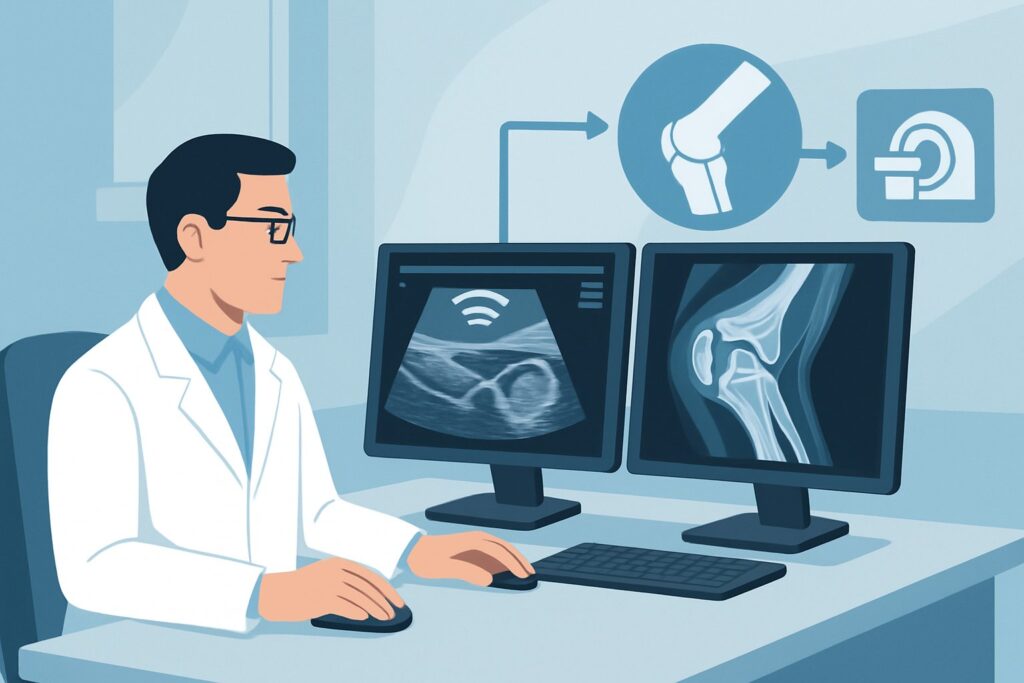
A 45-year-old patient presents to your clinic with acute lateral elbow pain after playing tennis over the weekend. They report no specific “pop” but have significant tenderness to palpation over the lateral epicondyle and pain with resisted wrist extension. You obtained radiographs to rule out a fracture, and the report confirms no acute osseous abnormality. Your clinical suspicion is high for a common extensor tendon injury, but you need to confirm the diagnosis and assess its severity to guide treatment. What is the next, most appropriate imaging study? This article provides a detailed workflow for this exact scenario, grounded in the American College of Radiology (ACR) Appropriateness Criteria. For an adult with acute elbow pain, suspected soft tissue injury, and normal radiographs, US area of interest is rated Usually Appropriate.
Who Fits This Clinical Scenario for Acute Elbow Pain?
This guidance applies to a specific and common clinical situation: an adult patient presenting with acute elbow or forearm pain where the primary clinical suspicion is an injury to a tendon, ligament, or muscle. A crucial prerequisite is that initial imaging with radiographs has already been performed and was either normal or indeterminate, effectively ruling out an obvious fracture or dislocation.
Inclusion Criteria for This Workflow:
- Patient is an adult.
- Pain is acute in onset (days to a few weeks), not chronic.
- Clinical examination points toward a soft tissue injury (e.g., tendinopathy, tendon rupture, ligament sprain, or muscle strain).
- Radiographs of the elbow have been completed and are negative for a definitive fracture.
Exclusion Criteria (These Patients Require a Different Workflow):
- Initial Imaging Needed: If the patient has not yet had any imaging, the workup starts with radiographs. This workflow is for the next step after normal x-rays.
- High Suspicion for Occult Fracture: If the patient has a history of significant trauma, point tenderness over a bone (like the radial head), and an inability to bear weight or fully extend the elbow, the primary concern is an occult fracture. This routes to a different ACR variant where CT or MRI may be prioritized.
- Suspected Infection or Tumor: If there are systemic signs like fever, erythema, or a history of malignancy, the differential diagnosis and imaging workup shift dramatically, often involving MRI with contrast or nuclear medicine studies.
What Diagnoses Are You Working Up with Suspected Soft Tissue Injury?
When radiographs are normal, advanced imaging is used to visualize the soft tissues and confirm a specific diagnosis, which is critical for guiding management—from physical therapy to surgical consultation. The differential diagnosis in this scenario is focused and clinically driven.
Distal Biceps Tendon Rupture
This is a consequential diagnosis that should not be missed, particularly in middle-aged men after a sudden eccentric biceps contraction (e.g., lifting a heavy box). Patients often report a painful “pop” in the antecubital fossa, followed by weakness in forearm supination and elbow flexion. Early diagnosis is key, as surgical repair is typically most successful when performed acutely.
Common Extensor or Flexor Tendinopathy/Tear
This represents the most common cause of elbow pain, colloquially known as “tennis elbow” (lateral epicondylitis) and “golfer’s elbow” (medial epicondylitis). While often a clinical diagnosis, imaging is valuable when symptoms are severe, refractory to conservative care, or if a high-grade tear is suspected. Imaging helps differentiate tendinosis (degeneration) from partial- or full-thickness tears, which can alter the treatment plan.
Ulnar Collateral Ligament (UCL) Injury
A primary concern in overhead athletes (e.g., baseball pitchers), a UCL sprain or tear presents with medial elbow pain, instability, and difficulty throwing. Imaging is essential to confirm the diagnosis, localize the tear (proximal or distal), and determine if it is a partial or complete rupture, which dictates whether non-operative or surgical management is appropriate.
Triceps Tendon Rupture
Less common than a biceps rupture, this injury typically occurs from a fall onto an outstretched hand or a direct blow to the posterior elbow. Patients present with posterior elbow pain, swelling, and a palpable defect above the olecranon. They will have significant weakness with elbow extension. Imaging confirms the extent of the tear and retraction.
Why Is Ultrasound the Recommended Next Step for Suspected Soft Tissue Injury?
For an adult with suspected soft tissue injury of the elbow and normal radiographs, both US area of interest and MRI area of interest without IV contrast are rated as Usually Appropriate by the ACR. However, ultrasound often serves as the ideal first-line advanced imaging modality for several key reasons.
Ultrasound provides superb spatial resolution for the superficial tendons and ligaments around the elbow. Its primary advantage is the ability to perform a dynamic evaluation. A skilled sonographer can apply stress to a ligament to assess for laxity or ask the patient to move their arm to visualize tendon subluxation in real-time—information that a static MRI cannot provide. Furthermore, the examiner can use the transducer to press on the area of concern (“sonopalpation”), precisely correlating the patient’s point of maximal tenderness with the underlying anatomy. This is invaluable for confirming that a visualized abnormality is the true source of the patient’s symptoms.
From a practical standpoint, ultrasound is widely available, less expensive than MRI, and has no contraindications related to implanted hardware or claustrophobia. It involves no ionizing radiation (0 mSv).
How Do Alternative Studies Compare?
- MRI area of interest without IV contrast: Also rated Usually Appropriate, MRI is an excellent problem-solving tool. It offers a more global view of the elbow joint, superior visualization of deeper structures, and is highly sensitive for detecting bone marrow edema that might indicate an occult fracture or stress reaction. It is less operator-dependent than ultrasound. It is often reserved for cases where ultrasound is equivocal, a more complex intra-articular injury is suspected, or for pre-operative planning.
- CT area of interest without IV contrast: Rated Usually Not Appropriate for this indication. While CT is exceptional for evaluating bone, it provides poor soft tissue contrast compared to US and MRI. It would not be the correct test to evaluate for a tendon or ligament tear.
- MRI area of interest without and with IV contrast: Rated Usually Not Appropriate. The addition of intravenous contrast is generally unnecessary for evaluating the acute traumatic and degenerative conditions in this scenario. Contrast is reserved for when there is a specific concern for tumor, infection, or inflammatory arthropathy, which fall outside this clinical variant.
What’s Next After Ultrasound? Downstream Workflow
The results of the ultrasound will directly guide your next clinical steps. The post-imaging workflow depends on whether the findings are positive, negative, or indeterminate.
If the ultrasound is positive for a specific injury:
- Full-thickness tendon rupture (e.g., distal biceps, triceps): This typically requires an urgent orthopedic surgery consultation for consideration of primary repair. The imaging report confirms the diagnosis and can describe the degree of tendon retraction.
- Partial-thickness tendon tear or severe tendinosis: Management is often non-operative, including physical therapy, bracing, and activity modification. A positive imaging finding can reinforce the diagnosis for the patient and justify a more intensive conservative treatment course.
- UCL tear: The management depends on the grade of injury and the patient’s activity level. A low-grade sprain may be managed conservatively, while a high-grade or complete tear in an athlete will likely require surgical consultation.
If the ultrasound is negative or indeterminate:
If the ultrasound is negative but your clinical suspicion for a significant injury remains high, the next step is often to proceed with an MRI without contrast. The ultrasound may have been limited by patient body habitus, or the injury may be in a location better visualized by MRI (e.g., deep intra-articular structures, bone marrow). An MRI can serve as the definitive problem-solver in these cases.
If pain persists despite a negative workup:
If both US and MRI are negative, it is time to reconsider the differential diagnosis. The pain may be referred from the cervical spine or shoulder, or it could be related to a nerve entrapment syndrome (e.g., radial tunnel syndrome) that may require further clinical evaluation or specialized tests like electromyography (EMG).
Pitfalls to Avoid (and When to Get Help)
Navigating the workup for acute elbow pain requires careful attention to the clinical context to avoid common errors.
- Misinterpreting the Scenario: Do not apply this workflow to a patient with high suspicion for an occult fracture. If the mechanism was significant trauma and there is focal bony tenderness (e.g., over the radial head), the “suspect fracture” ACR variant is more appropriate, and CT or MRI may be indicated first.
- Stopping at a “Normal” Radiograph: A normal x-ray does not mean there is no significant injury. For diagnoses like a distal biceps tendon rupture, the clinical exam is paramount, and a normal radiograph should immediately prompt advanced imaging.
- Not Providing a Specific Location: When ordering a “US area of interest,” be as specific as possible in the order history (e.g., “Evaluate for distal biceps tendon tear” or “Assess common extensor tendon at lateral epicondyle”). This helps the sonographer focus the exam.
- Delaying Imaging for a Suspected Rupture: For complete tendon ruptures like the distal biceps or triceps, timely diagnosis and surgical repair lead to better outcomes. Do not delay advanced imaging if this is high on your differential.
If you diagnose a complete tendon rupture or a high-grade ligamentous injury in an active individual, escalate care with a timely referral to an orthopedic surgeon.
Related ACR Topics and Tools
This article covers one specific scenario within the broader topic of acute elbow pain. For a comprehensive overview of all clinical variants, from initial imaging to post-operative evaluation, please consult our parent topic guide. To further refine your imaging orders, explore the tools below.
- For breadth across all scenarios in Acute Elbow and Forearm Pain, see our parent guide: Acute Elbow and Forearm Pain: ACR Appropriateness Decoded.
- To explore other clinical situations, use the ACR Appropriateness Criteria Lookup.
- For detailed procedural techniques, see the Imaging Protocol Library.
- To discuss radiation exposure with patients for other imaging modalities, use the Radiation Dose Calculator.
Frequently Asked Questions
Why is MRI without contrast also ‘Usually Appropriate’ if ultrasound is so effective?
MRI without contrast is also rated ‘Usually Appropriate’ because it provides a comprehensive, non-operator-dependent view of all elbow structures, including bone marrow, cartilage, and deep soft tissues. It is an excellent alternative if ultrasound is unavailable or technically limited, and it serves as the best problem-solving tool if an ultrasound is negative or equivocal despite high clinical suspicion for injury.
If I suspect a distal biceps tendon rupture, should I order an ultrasound or an MRI first?
Both ultrasound and MRI are highly accurate for diagnosing distal biceps tendon ruptures. Ultrasound is often faster and more accessible, making it an excellent first choice. It can dynamically assess the tendon and confirm an empty bicipital tuberosity. MRI is equally effective and is often used for pre-operative planning to precisely measure tendon retraction.
Is an MR arthrogram ever needed for acute elbow pain?
An MR arthrogram, which involves injecting contrast directly into the joint, is generally not indicated for this specific scenario of acute tendon or muscle injury. It is typically reserved for evaluating chronic instability, specifically for subtle partial-thickness tears of the ulnar collateral ligament (UCL) in throwing athletes, or for assessing intra-articular loose bodies or cartilage defects.
What if the patient’s pain is more diffuse throughout the forearm and not localized to the elbow?
If the pain is diffuse and not well-localized, the utility of a focused ultrasound decreases. In this case, an MRI of the forearm without contrast may be more appropriate as it provides a larger field of view to evaluate for muscle strains, interosseous membrane injury, or other less common pathologies. A thorough clinical exam to look for neurologic symptoms (nerve entrapment) is also critical.
When is CT indicated for elbow pain after normal radiographs?
CT is ‘Usually Not Appropriate’ for suspected soft tissue injury. Its primary role in this context is for evaluating bone. If your clinical suspicion for an occult or complex fracture remains very high despite normal radiographs (e.g., a radial head fracture), then a CT without contrast would be the most appropriate next step, as it offers superior osseous detail compared to all other modalities.
Reviewed by Pouyan Golshani, MD, Interventional Radiologist — May 30, 2026