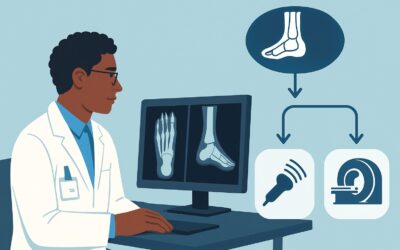
What Imaging Should You Order for Suspected Occult Shoulder Fracture After Negative X-Rays?

It’s a common scenario in the emergency department or outpatient clinic: a 48-year-old patient presents with acute shoulder pain and significant point tenderness over the greater tuberosity after a fall. You obtain a standard series of shoulder radiographs, which come back negative for any definite fracture or dislocation. Despite the reassuring initial images, the patient’s pain and functional limitation seem disproportionate, raising your clinical suspicion for an occult, or radiographically invisible, fracture. This situation requires a definitive next step to confirm or exclude a bony injury that could alter management. This article details the American College of Radiology (ACR) guided workflow for this specific clinical question: an adult with acute shoulder pain and suspected occult fracture following negative or indeterminate radiographs. For this presentation, the ACR rates MRI shoulder without IV contrast as Usually Appropriate.
Who Fits This Clinical Scenario?
This guidance applies to a specific subset of adult patients with acute shoulder pain. The key inclusion criteria are:
- High Clinical Suspicion for Fracture: The patient has a mechanism of injury (e.g., fall, direct blow) and physical exam findings (e.g., focal bony tenderness, ecchymosis, inability to bear weight or initiate abduction) that strongly suggest a fracture.
- Negative or Indeterminate Initial Radiographs: Standard X-ray views have been obtained and do not show a clear fracture line. “Indeterminate” may include subtle cortical irregularity or soft tissue swelling that is non-specific.
- Acute Presentation: The pain is of recent onset, typically within days to a few weeks of an inciting event.
It is crucial to distinguish this scenario from similar presentations that follow different diagnostic pathways. This workflow does not apply if:
- Radiographs are positive for fracture: If a fracture is already identified, the next imaging study (often CT) is for surgical planning, not diagnosis. This is a separate ACR variant.
- The primary suspicion is a labral tear or instability: While an occult fracture can coexist, if the history and exam point primarily to a labral injury (e.g., clicking, popping, history of dislocation), MR arthrography may be considered.
- The primary suspicion is an isolated rotator cuff tear: If the exam points to a cuff tear without a strong suspicion for an underlying fracture, the imaging choice remains MRI without contrast, but the pre-test probability and clinical question are different.
What Diagnoses Are You Working Up in This Scenario?
When ordering advanced imaging after negative radiographs, you are primarily investigating injuries that are subtle or invisible on X-ray but have significant clinical implications. The differential diagnosis is focused on radiographically occult bony and chondral injuries.
Occult Greater Tuberosity Fracture: This is one of the most common occult fractures of the shoulder. It often occurs from a direct fall onto the shoulder or impaction during a dislocation. Patients present with exquisite focal tenderness over the lateral aspect of the shoulder and an inability to initiate abduction. Because the fracture fragments are often non-displaced, they are easily missed on initial radiographs.
Occult Humeral Head or Neck Fracture: Impact-type injuries can cause non-displaced or minimally displaced fractures of the surgical or anatomic neck of the humerus. These are particularly important to identify in older patients with osteopenia, as they can affect stability and long-term function.
Significant Bone Contusion (Bone Bruise): While not a true fracture with a cortical break, a severe bone contusion involves microfractures of the trabecular bone and associated hemorrhage and edema within the bone marrow. This can be a significant pain generator and is only visible on MRI. It confirms a significant traumatic force was applied to the bone.
Occult Glenoid or Acromial Fracture: Less common, but consequential, are fractures of the glenoid rim (often associated with a subluxation event) or stress fractures of the acromion or coracoid process. These can be sources of persistent pain and may require specific management if identified.
Why Is MRI Shoulder Without IV Contrast the Recommended Study for This Presentation?
The ACR designates MRI shoulder without IV contrast as Usually Appropriate because it is the most sensitive non-invasive test for detecting the bone marrow edema that is the hallmark of an occult fracture or significant bone contusion. Standard T1-weighted and fluid-sensitive (e.g., T2-fat-suppressed or STIR) sequences can visualize marrow changes with exceptional clarity, often revealing a fracture line that was completely invisible on both radiographs and even CT.
While CT shoulder without IV contrast is also rated Usually Appropriate, it serves a slightly different purpose. CT provides superior visualization of cortical bone and complex fracture patterns, making it invaluable for surgical planning once a fracture is known. However, for the initial detection of an occult fracture, it is less sensitive than MRI for subtle non-displaced fractures that manifest primarily as marrow edema. Furthermore, CT exposes the patient to ionizing radiation (☢☢☢ 1-10 mSv), whereas MRI has no radiation dose (O 0 mSv), a key consideration in all patients, especially younger ones.
Other imaging modalities are rated lower for this specific clinical question:
- US shoulder is rated Usually not appropriate. While excellent for evaluating the rotator cuff tendons and biceps, ultrasound cannot penetrate bone and is unable to visualize bone marrow. It cannot be used to diagnose or exclude an occult fracture.
- MR arthrography shoulder is rated Usually not appropriate. This invasive procedure involves injecting contrast directly into the joint and is the gold standard for evaluating the labrum and joint capsule. It adds no value for detecting an occult fracture and introduces the risks of an intra-articular injection.
In summary, a non-contrast MRI provides the highest diagnostic yield for the primary clinical question (Is there a fracture?) with no radiation risk. It also offers the significant secondary benefit of comprehensively evaluating the rotator cuff, labrum, and other soft tissues, which may reveal an alternative or coexisting source of the patient’s pain. Once you’ve decided on this study, our protocol guide covers the technique, contrast, and reading principles: MRI Shoulder Without Contrast.
What’s Next After MRI Shoulder Without Contrast? Downstream Workflow
The results of the MRI will guide your subsequent management plan. The workflow typically branches into one of three paths:
1. The MRI is positive for an occult fracture.
If the MRI confirms a non-displaced or minimally displaced fracture (e.g., of the greater tuberosity or humeral neck), the next step is an orthopedic surgery consultation. Management is often non-operative, consisting of sling immobilization for a defined period, followed by a structured physical therapy program to restore motion and strength. The definitive diagnosis allows for appropriate activity modification and provides the patient with a clear prognosis and recovery timeline.
2. The MRI is negative for fracture but positive for a significant soft tissue injury.
The patient’s pain may be caused by an acute, full-thickness rotator cuff tear, a high-grade partial tear, or another significant soft tissue injury. In this case, the clinical pathway shifts. The diagnosis is no longer an occult fracture, and management will be dictated by the specific soft tissue finding. This often involves a referral to orthopedics or sports medicine to discuss treatment options, which may range from physical therapy to surgical repair.
3. The MRI is completely negative.
If the MRI shows no fracture, no significant bone contusion, and no acute soft tissue tear, it provides strong evidence against a significant structural cause for the patient’s severe pain. This is a valuable outcome, as it allows you to confidently reassure the patient and pivot to a diagnosis of a musculoskeletal strain or sprain. Management would consist of conservative measures: a short course of immobilization for comfort, analgesics, and a gradual return to activity. If pain persists, re-evaluation for non-structural or referred pain sources may be necessary.
Pitfalls to Avoid (and When to Get Help)
Navigating this clinical scenario requires careful attention to detail to avoid common missteps. Here are a few pitfalls to watch for:
- Dismissing the Exam for the Radiograph: The most common error is to stop the workup after a negative X-ray despite a highly suspicious physical exam. Persistent, focal bony tenderness is a red flag that should prompt advanced imaging.
- Ordering the Wrong MRI: Defaulting to an MR arthrogram or an MRI with intravenous contrast is unnecessary for this indication. These studies add cost, time, and potential risk without improving sensitivity for detecting an occult fracture.
- Over-reliance on CT: While CT is useful, choosing it over MRI as the first-line advanced imaging modality for this question exposes the patient to radiation and may miss a diagnosis if the primary finding is bone marrow edema without a discrete cortical break.
- Anchoring on Fracture: Even with high suspicion for a fracture, be prepared for the MRI to reveal an alternative diagnosis, like an acute full-thickness rotator cuff tear, which requires a completely different management plan.
If the clinical picture is complex, or if the MRI findings are equivocal, a consultation with a musculoskeletal radiologist or an orthopedic surgeon is the appropriate next step.
Related ACR Topics and Tools
This article focuses on a single, specific clinical scenario. For a comprehensive overview of all variants related to acute shoulder pain, from initial imaging to post-operative evaluation, please refer to our parent guide. It provides a hub-and-spoke model to help you navigate the full ACR guidelines on this topic.
- For breadth across all scenarios in Acute Shoulder Pain, see our parent guide: Acute Shoulder Pain: ACR Appropriateness Decoded.
- To explore other clinical scenarios, use the ACR Appropriateness Criteria Lookup.
- To review technical details for other studies, visit the Imaging Protocol Library.
- To discuss radiation exposure with patients, consult the Radiation Dose Calculator.
Frequently Asked Questions
Why not just get a CT scan since it’s also rated ‘Usually Appropriate’?
While CT is also ‘Usually Appropriate’ and excellent for visualizing cortical bone, MRI is generally preferred as the first step for a suspected occult fracture. MRI is more sensitive for detecting bone marrow edema, the earliest sign of a bone injury, and it does not use ionizing radiation. CT is an excellent alternative if MRI is contraindicated (e.g., incompatible pacemaker) or unavailable, or it may be used as a follow-up to a positive MRI to better define fracture anatomy for surgical planning.
How long after the injury should I wait to order the MRI?
An MRI can be performed at any time after the injury. Bone marrow edema develops very quickly, typically within hours of the trauma, so there is no need to wait a specific period for the findings to become apparent. The decision to order the MRI should be based on the persistence of symptoms and high clinical suspicion despite negative initial radiographs.
What if the patient has a contraindication to MRI, like a non-compatible pacemaker?
In cases where MRI is contraindicated, CT shoulder without IV contrast is the best alternative. It is also rated ‘Usually Appropriate’ by the ACR for this scenario. While it may be less sensitive for pure bone marrow edema, it has excellent spatial resolution for detecting subtle cortical breaks and fracture lines.
If I suspect both an occult fracture and a labral tear, which study should I order?
In this complex situation, a non-contrast MRI is still the best initial study. It will definitively answer the question of an occult fracture. If the MRI confirms a fracture, that typically becomes the primary diagnosis to manage. If the MRI is negative for fracture but the clinical suspicion for a labral tear remains high, a follow-up MR arthrogram could be considered, but this is a separate clinical question.
Does finding a ‘bone bruise’ or bone contusion on MRI change management?
Yes. While not a full fracture, a significant bone contusion confirms a major traumatic impact and is a known source of significant pain and functional limitation. This finding validates the patient’s symptoms, guides a period of protected weight-bearing or activity modification, and provides a clear explanation for a recovery that may take several weeks to months, similar to a non-displaced fracture.
Reviewed by Pouyan Golshani, MD, Interventional Radiologist — May 30, 2026