What Is the Next Imaging Step After a Shoulder Fracture Is Found on Radiographs?
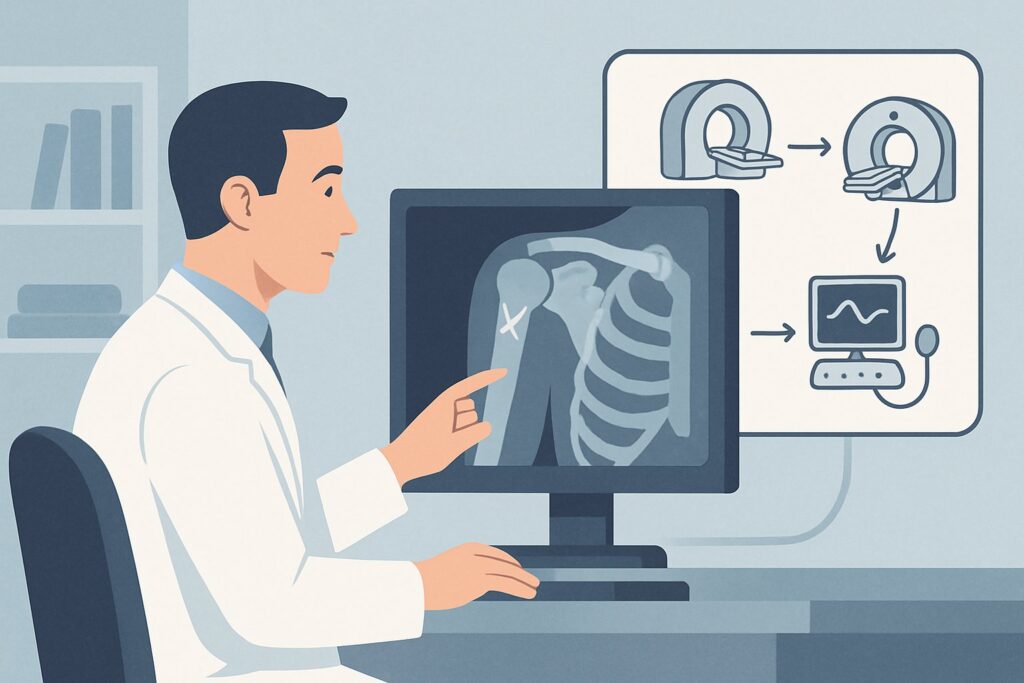
A 72-year-old woman presents to the emergency department after a ground-level fall onto her outstretched arm, complaining of severe left shoulder pain. Initial radiographs are performed, revealing a comminuted fracture of the proximal humerus. The orthopedic surgeon on call needs to determine the precise fracture pattern—specifically the degree of displacement and articular involvement—to decide between non-operative management and surgical fixation. You are tasked with ordering the next, definitive imaging study to guide this critical decision. This article details the American College of Radiology (ACR) Appropriateness Criteria workflow for this exact scenario: an adult with acute shoulder pain and a confirmed fracture on initial radiographs. For this presentation, the ACR designates CT shoulder without IV contrast as Usually Appropriate.
Who Fits This Clinical Scenario for Post-Fracture Shoulder Imaging?
This guidance applies to a specific and common clinical situation: an adult patient who has already undergone initial imaging with radiographs, which have positively identified a fracture of the proximal humerus, scapula, or clavicle. The primary clinical question is no longer “Is there a fracture?” but rather “What is the exact nature of this fracture, and how does it affect management?”
Inclusion Criteria:
- Adult patient
- Acute shoulder pain (typically post-traumatic)
- Initial radiographs are complete and show a definite fracture of the proximal humerus, scapula, or clavicle
Exclusion Criteria (These patients follow a different workflow):
- Negative or Indeterminate Radiographs: If you have a high clinical suspicion for a fracture but the initial X-rays are negative, the patient fits the “Suspect occult fracture” scenario, which has a different set of imaging recommendations.
- Primary Concern for Instability: If the patient’s history and exam are most consistent with a dislocation or instability, even if a small fracture is present (e.g., a Bankart or Hill-Sachs lesion), that clinical context takes precedence.
- Primary Concern for Soft Tissue Injury: If the main clinical question is about a rotator cuff or labral tear and the fracture is minor or incidental, you should follow the guidance for those specific scenarios.
What Key Questions Are You Answering with Advanced Imaging After a Shoulder Fracture?
Once a fracture is identified on radiographs, the purpose of advanced imaging is not to re-diagnose it but to answer specific questions that radiographs cannot resolve. These details are crucial for orthopedic treatment planning, distinguishing cases that can be managed conservatively from those requiring surgery.
Fracture Complexity and Comminution: The most critical question is often the degree of fragmentation. Is this a simple two-part fracture, or is it a more complex three-part or four-part fracture involving the humeral head, greater tuberosity, and lesser tuberosity? CT imaging precisely defines the number and location of fracture fragments, which is a primary determinant of surgical approach.
Articular Surface Involvement: For both proximal humerus and scapular fractures, determining the extent of intra-articular involvement is paramount. Advanced imaging can measure any step-off or gap in the articular surface of the humeral head or the glenoid. Significant displacement can lead to post-traumatic arthritis if not accurately reduced.
Tuberosity Displacement: The greater and lesser tuberosities are the attachment points for the critical rotator cuff tendons. Significant displacement of these fragments is functionally equivalent to a rotator cuff tear and strongly influences the decision to operate and the type of repair needed.
Glenohumeral Alignment: Subtle subluxation or dislocation of the humeral head relative to the glenoid can be difficult to assess on 2D radiographs, especially in the setting of a complex fracture. Cross-sectional imaging provides a definitive assessment of joint alignment.
Why Is CT Shoulder without IV Contrast Usually Appropriate for Characterizing a Known Fracture?
The ACR panel recommends CT shoulder without IV contrast as the Usually Appropriate next step because it directly and efficiently answers the key clinical questions in this scenario. The rationale is based on the modality’s superior ability to visualize complex bone anatomy.
The primary strength of Computed Tomography (CT) is its exceptional spatial resolution for osseous structures. It can delineate subtle fracture lines, precisely measure fragment displacement and angulation, and identify the full extent of comminution in ways that are impossible on overlapping 2D radiographs. Furthermore, the ability to generate multiplanar reformats (MPRs) and 3D volume-rendered images provides an intuitive, comprehensive map of the fracture for the treating surgeon. This pre-operative planning is essential for selecting the appropriate surgical hardware and approach.
Why are other studies rated lower for this specific task?
- MRI shoulder without IV contrast is rated May be appropriate. While MRI is the gold standard for evaluating soft tissues like the rotator cuff, its ability to characterize complex bone detail is inferior to CT. It may be considered if there is an overriding clinical concern for a significant, associated soft-tissue injury that would alter immediate management, but for defining the fracture itself, CT is superior.
- US shoulder is rated Usually not appropriate. Ultrasound is an excellent tool for dynamic assessment of tendons and bursae, but its sound waves cannot penetrate bone. It is therefore unsuitable for characterizing the fracture pattern, displacement, or articular involvement.
From a practical standpoint, this is a non-contrast study, avoiding the risks and time associated with IV contrast administration. However, it does involve ionizing radiation, with a typical effective dose in the ☢☢☢ 1-10 mSv range. This is a key consideration, but in the context of a significant fracture requiring potential surgery, the diagnostic benefit of clarifying the anatomy almost always outweighs the radiation risk.
What’s Next After CT Shoulder without IV Contrast? Downstream Workflow
The results of the shoulder CT will directly guide the next steps in management, typically in consultation with an orthopedic surgeon. The decision tree branches based on the detailed anatomical findings.
If the CT confirms a complex, displaced, or intra-articular fracture:
The findings—such as a four-part proximal humerus fracture, a displaced greater tuberosity fragment, or a significantly displaced intra-articular glenoid fracture—will typically lead to surgical intervention. The 3D reconstructions from the CT will be used for pre-operative planning to determine the best approach, whether it be open reduction and internal fixation (ORIF) or arthroplasty (shoulder replacement).
If the CT confirms a non-displaced or minimally displaced fracture:
If the CT shows that the fracture fragments are in good alignment and the articular surface is congruent, the patient is likely a candidate for non-operative management. This typically involves a period of immobilization in a sling followed by physical therapy. The CT provides the confidence to pursue this course without concern for a missed complex injury.
If the CT is negative for a suspected associated injury:
In some cases, the CT is ordered to rule out a specific concern, such as a glenoid rim fracture in the setting of a clavicle fracture. A negative result for the associated injury simplifies the treatment plan, allowing the clinician to focus on the known fracture.
Pitfalls to Avoid (and When to Get Help)
Navigating post-fracture imaging requires careful attention to the specific clinical question to avoid ordering a suboptimal study.
- Ordering MRI First: A common pitfall is ordering an MRI to “see everything.” For defining bone anatomy to guide fracture surgery, CT is faster, less expensive, and provides superior osseous detail. MRI should be reserved for cases where a soft-tissue question is the primary driver of the next management step.
- Forgetting 3D Reconstructions: When ordering the CT, it is often helpful to specifically request 3D reconstructions. While most modern scanners produce these routinely, explicitly asking for them ensures the orthopedic team receives the images that are most useful for surgical planning.
- Using IV Contrast Unnecessarily: In the vast majority of traumatic fracture cases, IV contrast is not needed and adds unnecessary risk and cost. Contrast is reserved for rare cases where there is a concern for an associated vascular injury, which represents a different clinical scenario.
If the CT reveals an unexpected finding, such as a potential pathologic fracture (a fracture through a bone lesion or tumor) or evidence of significant neurovascular compromise, immediate escalation to the appropriate surgical or oncologic service is warranted.
Related ACR Topics and Tools
For a comprehensive overview of imaging for all acute shoulder pain presentations, from initial workup to specific concerns like rotator cuff or labral tears, please see our parent guide. For other tools to help refine your imaging orders, explore the resources below.
- For breadth across all scenarios in Acute Shoulder Pain, see our parent guide: Acute Shoulder Pain: ACR Appropriateness Decoded.
- To look up other clinical scenarios, visit the ACR Appropriateness Criteria Lookup.
- For detailed technical specifications of imaging studies, see the Imaging Protocol Library.
- To discuss radiation exposure with patients, use the Radiation Dose Calculator.
Frequently Asked Questions
Why not just get an MRI to see the bones and the rotator cuff at the same time?
While MRI can visualize both, it is not the optimal test for either in this specific scenario. CT provides far superior detail of bone, which is the primary question for surgical planning after a fracture. An MRI may be considered a secondary study if there’s a strong, specific suspicion of a rotator cuff tear that would change immediate management, but the ACR rates it as only ‘May be appropriate’ for the initial characterization of the fracture itself.
Is a CT scan always necessary if the radiograph clearly shows a fracture?
Not always. For simple, non-displaced fractures where the radiographs are definitive and the treatment plan is clearly non-operative, a CT may not be needed. However, for most fractures of the proximal humerus and scapula, radiographs underestimate the degree of comminution and displacement. CT is recommended when the fracture characteristics will influence the decision between operative and non-operative management.
Should I order the CT with or without IV contrast?
For the specific purpose of evaluating fracture anatomy, the study should be ordered *without* IV contrast. The ACR rates CT with contrast as ‘Usually not appropriate’ for this indication. Contrast does not improve visualization of the bone and adds unnecessary risk and cost. The only exception would be a rare case with high suspicion for an associated vascular injury, such as a brachial artery transection.
What if the patient has a clavicle fracture instead of a proximal humerus fracture?
This guidance applies to fractures of the proximal humerus, scapula, or clavicle. While many clavicle fractures do not require advanced imaging, a CT is the recommended next step for complex, comminuted, or significantly displaced clavicle fractures, especially those involving the articular ends, to guide surgical planning.
How much radiation is involved in a shoulder CT?
A shoulder CT has a relative radiation level of ☢☢☢, which corresponds to an effective dose of 1-10 mSv. This is a moderate dose, but the detailed anatomical information it provides is considered essential for planning the treatment of a complex fracture, and the clinical benefit generally outweighs the small associated risk.
Reviewed by Pouyan Golshani, MD, Interventional Radiologist — May 30, 2026