What Is the Next Step for Acute Foot Trauma with Negative Ottawa Rules?
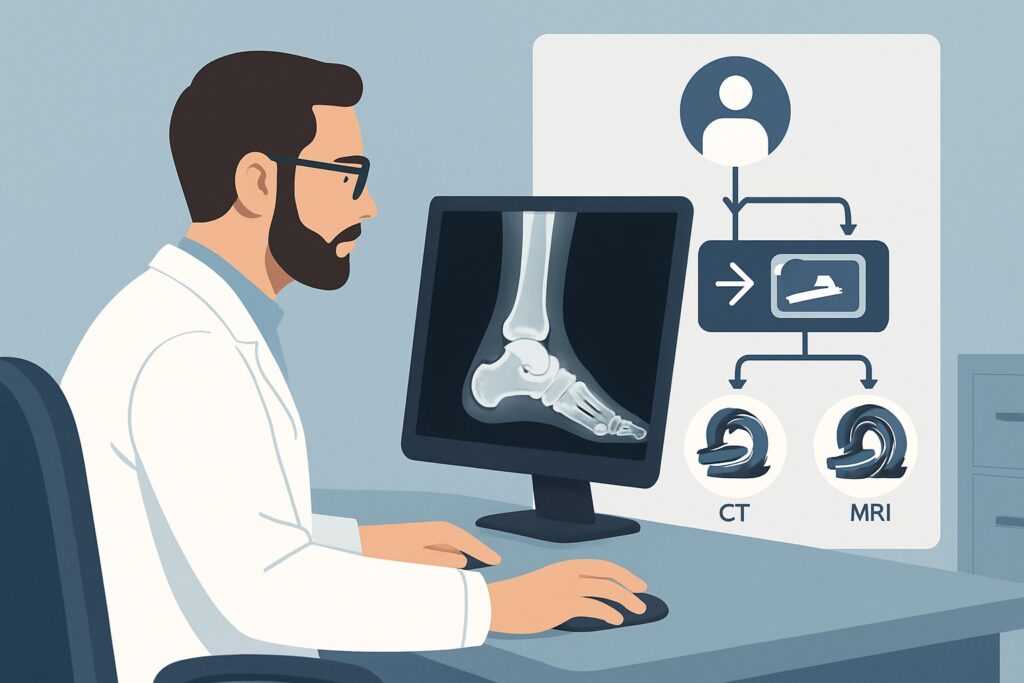
A 28-year-old patient presents to the urgent care clinic on a Saturday afternoon after rolling their foot during a soccer game. They are in pain but can walk four steps into the exam room. On examination, you find no bony tenderness over the posterior edge of the medial or lateral malleolus, the navicular bone, or the base of the fifth metatarsal. The Ottawa Foot Rules are negative. Your clinical gestalt says this is a sprain, but the patient is anxious about a possible fracture. This article addresses the specific imaging decision in this common scenario: an adult or older child with acute foot trauma where the highly sensitive Ottawa rules are negative. For this presentation, the American College of Radiology (ACR) rates all initial imaging modalities, including radiography and ultrasound, as Usually not appropriate.
Who Fits This Clinical Scenario for Acute Foot Trauma?
This guidance applies to a well-defined patient population: an adult or a child older than five years of age who has experienced acute trauma to the foot. The central criterion for this workflow is the successful application of the Ottawa Foot Rules. This means the patient must be alert, cooperative, and without any exclusionary criteria that would invalidate the rules, such as intoxication, significant distracting injuries, or diminished sensation in the feet (e.g., from peripheral neuropathy).
Crucially, this scenario is defined by a negative result from the Ottawa rules. The patient must be able to bear weight for at least four steps (limping is acceptable) and have no bony tenderness at the specific palpation points defined by the rule.
This workflow is distinct from several similar-appearing presentations:
- Positive Ottawa Rules: If the patient is unable to bear weight or has bony tenderness in one of the key zones, they fall into a different ACR variant where radiography is indicated.
- Inability to Apply Ottawa Rules: If the patient has altered mental status, a distracting injury, or other exclusionary factors, the Ottawa rules cannot be reliably used, and clinical judgment must guide the decision, often leading to imaging.
- Suspicion of Specific Injuries: If the mechanism or exam suggests a high-risk injury not explicitly covered by the Ottawa rules—such as a Lisfranc (tarsometatarsal) joint injury, an Achilles tendon rupture, or a penetrating foreign body—this guidance does not apply, and more advanced imaging may be warranted.
What Diagnoses Are You Working Up When Ottawa Rules Are Negative?
When the Ottawa Foot Rules are negative, the pre-test probability of a clinically significant fracture—one that would require a change in management like casting or surgical intervention—is extremely low. The clinical focus shifts from ruling out a major bony injury to diagnosing and managing common soft-tissue injuries.
The primary diagnosis in this setting is a ligamentous sprain. This is the most common outcome of inversion or eversion injuries to the foot and ankle. The injury involves stretching or tearing of the ligaments, most frequently the anterior talofibular ligament (ATFL). Management is conservative and does not require initial imaging.
Another common consideration is a soft-tissue contusion or muscle strain. Direct blows or forceful movements can cause bruising and muscle fiber damage without involving bone or ligaments. Like sprains, these are managed symptomatically based on the clinical examination alone.
While the Ottawa rules are highly sensitive, they are not perfect. It is possible for a clinically insignificant avulsion fracture to be present. These are tiny bone fragments pulled away by a ligament or tendon. However, the key is that the management for these minor fractures is identical to that of a moderate sprain—rest, ice, compression, and elevation (RICE), followed by progressive weight-bearing. Therefore, imaging to identify them does not alter the initial treatment plan and is considered low-value.
Why Is Imaging ‘Usually Not Appropriate’ When Ottawa Foot Rules Are Negative?
The core principle behind this recommendation is the validated clinical power of the Ottawa Foot Rules. These rules were specifically designed to reduce unnecessary radiography by safely identifying patients at very low risk for a significant fracture. For this scenario, the ACR Appropriateness Criteria rate all initial imaging modalities as Usually not appropriate.
The rationale is rooted in diagnostic yield and risk-benefit analysis:
- Radiography foot: This is rated Usually not appropriate. The Ottawa Foot Rules have a sensitivity approaching 100% for excluding clinically significant midfoot and hindfoot fractures. A negative result provides sufficient confidence to defer imaging. Exposing the patient to ionizing radiation, even at a low dose (adult RRL ☢ <0.1 mSv), provides no benefit, as it is exceptionally unlikely to reveal an injury that would alter the conservative management plan.
- CT foot without or with IV contrast: This is rated Usually not appropriate. Computed Tomography (CT) delivers a higher radiation dose than radiography (adult RRL ☢ <0.1 mSv; pediatric RRL ☢☢ 0.03-0.3 mSv) and offers no additional value in this initial, low-risk setting. It is reserved for complex cases where a fracture is already identified or highly suspected and requires further characterization.
- MRI foot without IV contrast: This is also rated Usually not appropriate for initial imaging. While MRI provides excellent detail of soft tissues like ligaments and tendons and uses no ionizing radiation, it is not a first-line tool for acute fracture screening. Its use is better reserved for subacute or chronic settings if the patient fails to improve with conservative care and a significant ligamentous or occult bony injury is suspected.
- US foot: Ultrasound is rated Usually not appropriate. Although it is radiation-free, its utility for fracture detection in the foot is operator-dependent and not its primary application. It is not a validated screening tool in the context of the Ottawa rules.
In summary, when the Ottawa rules are negative, the diagnostic certainty is high enough that the risks, costs, and resource utilization of any imaging modality outweigh the negligible potential benefit.
What Is the Correct Downstream Workflow After a Negative Ottawa Exam?
With imaging appropriately deferred, the workflow shifts entirely to clinical management and patient education. The negative Ottawa exam is not the end of the workup but the beginning of a conservative treatment pathway.
Immediate Management: The cornerstone of treatment is symptomatic care. This typically involves the RICE protocol:
- Rest: Avoidance of aggravating activities. Crutches may be provided for comfort if the patient is limping significantly, but the goal is progressive weight-bearing as tolerated.
- Ice: Apply ice packs for 15-20 minutes every few hours to reduce swelling and pain.
- Compression: An elastic bandage can help control swelling.
- Elevation: Keeping the foot elevated above the level of the heart helps reduce edema.
Over-the-counter analgesics like acetaminophen or nonsteroidal anti-inflammatory drugs (NSAIDs) can be recommended for pain control, assuming no contraindications.
Follow-up and Safety Netting: Clear follow-up instructions are critical. The patient should be advised to return for re-evaluation if they experience:
- Worsening or uncontrolled pain.
- Inability to bear any weight after 3-5 days of conservative management.
- Symptoms that do not show a trend of improvement within the first week.
If a patient returns with persistent symptoms, the clinical scenario has changed. This may prompt a re-evaluation and consideration of imaging (often MRI) to assess for significant ligamentous injury, osteochondral defects, or an occult fracture missed on initial assessment. This would then fall under a different ACR appropriateness variant for subacute or persistent pain.
Common Pitfalls to Avoid in This Low-Risk Foot Injury Scenario
Even in this seemingly straightforward scenario, several pitfalls can lead to diagnostic errors or unnecessary resource use.
- Improper Application of the Ottawa Rules: The accuracy of this pathway depends entirely on performing the exam correctly. Ensure you are palpating the precise bony landmarks: the posterior edge of the distal 6 cm of both the medial and lateral malleoli, the base of the fifth metatarsal, and the navicular bone.
- Ignoring Exclusionary Criteria: The rules lose their validity in patients with altered sensation, intoxication, or significant distracting injuries. Applying them in these cases can provide false reassurance.
- Bowing to Patient Pressure: Patients often equate imaging with thorough care. A common pitfall is ordering an x-ray “to be safe” or to appease an anxious patient, even with negative rules. This reinforces low-value care practices and leads to unnecessary radiation exposure and cost. Clear communication about the high reliability of the clinical rule is key.
- Missing a High-Risk Mechanism: The Ottawa rules are excellent for malleolar and midfoot fractures but less sensitive for other injuries. If the mechanism suggests a Lisfranc injury (e.g., axial load on a plantar-flexed foot) or an Achilles tendon rupture, maintain a high index of suspicion regardless of the Ottawa rule result.
If clinical suspicion for a significant injury remains high despite negative Ottawa rules, especially due to the mechanism of injury or localized pain outside the rule’s palpation zones, it is appropriate to escalate care, potentially to orthopedic consultation or by ordering imaging based on that specific suspicion.
Related ACR Topics and Tools
For a comprehensive overview of all clinical variants related to acute foot trauma, further reading and specialized tools can provide additional context and support for imaging decisions.
- For breadth across all scenarios in Acute Trauma to the Foot, see our parent guide: Acute Trauma to the Foot: ACR Appropriateness Decoded.
- ACR Appropriateness Criteria Lookup — Use this to explore imaging recommendations for adjacent or alternative clinical scenarios.
- Imaging Protocol Library — Access detailed technical specifications for various imaging studies if and when they are indicated.
- Radiation Dose Calculator — This tool helps in discussing radiation exposure with patients when imaging is considered.
Frequently Asked Questions
What are the specific criteria for the Ottawa Foot Rules?
A foot X-ray series is indicated only if there is any pain in the midfoot zone AND any of the following findings: 1) Bony tenderness at the base of the fifth metatarsal, 2) Bony tenderness at the navicular bone, or 3) An inability to bear weight both immediately after the injury and for four steps in the emergency department or clinic. If none of these criteria are met, the rules are negative.
How reliable are the Ottawa Foot Rules in children older than 5 years?
Multiple studies have validated the use of the Ottawa Ankle and Foot Rules in children older than five. They demonstrate high sensitivity, similar to the adult population, for detecting clinically significant fractures, making them a reliable tool for reducing unnecessary radiography in this age group.
What should I do if a patient insists on an X-ray despite negative Ottawa rules?
This is a common situation that calls for patient education and shared decision-making. Explain the high accuracy of the clinical decision rule and the rationale for avoiding imaging, which includes minimizing unnecessary radiation exposure and healthcare costs. Reassure the patient that the recommended treatment plan is the standard of care for their low-risk injury and provide clear instructions for when to return for re-evaluation.
If the patient doesn’t improve, when should I consider follow-up imaging?
If a patient with an initial negative Ottawa exam fails to improve with 5-7 days of conservative management (e.g., persistent inability to bear weight or worsening pain), re-evaluation is necessary. At this point, the clinical scenario has changed from ‘acute trauma’ to ‘subacute pain failing conservative therapy.’ In this new context, imaging such as MRI may become appropriate to evaluate for significant ligamentous injury, an occult fracture, or an osteochondral lesion.
Does a negative Ottawa exam rule out all fractures?
No, it does not rule out 100% of all fractures. Its purpose is to rule out *clinically significant* fractures—those that require specific treatment like a cast or surgery. It is highly sensitive for this purpose. It is possible for a patient to have a very small, stable avulsion fracture that is managed identically to a sprain. The clinical utility of the rule is that it reliably identifies patients who can be safely managed without initial radiography.
Reviewed by Pouyan Golshani, MD, Interventional Radiologist — May 29, 2026