Which Imaging Is Best for High-Risk Thoracic or Lumbar Spine Trauma?
It’s 2 a.m. in the emergency department, and the trauma bay is active. Your patient is a 19-year-old involved in a high-speed motor vehicle collision. They are hemodynamically stable but have an altered mental status and multiple painful extremity injuries. On your secondary survey, you palpate definite tenderness and a step-off over the mid-thoracic spine. The patient is unexaminable due to their altered state and distracting injuries, placing them in a high-risk category for a significant spinal injury. You need to definitively clear their thoracolumbar spine or diagnose an injury, and you need to do it quickly. What is the right initial imaging study to order?
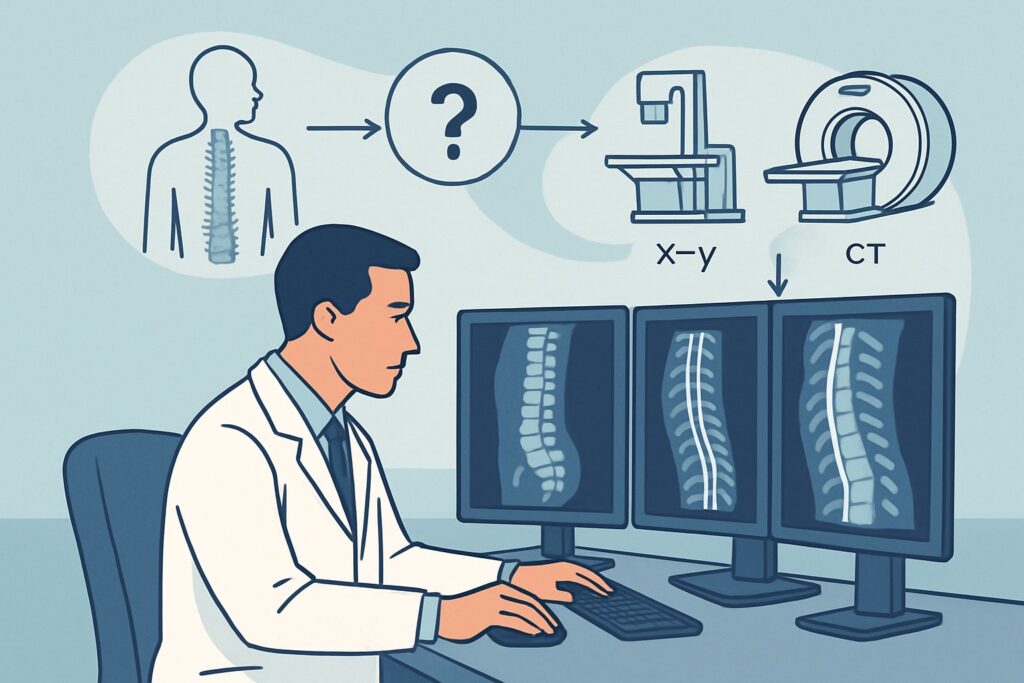
This article provides a detailed workflow for this specific scenario: initial imaging for a patient aged 16 or older with acute thoracic or lumbar spine blunt trauma who is considered high-risk or is unexaminable. For this presentation, the American College of Radiology (ACR) Appropriateness Criteria rate a CT of the spine area of interest without IV contrast as Usually Appropriate.
Who Fits This Clinical Scenario for Thoracolumbar Spine Trauma?
This guidance applies to a specific subset of trauma patients aged 16 and older. The key inclusion criteria are blunt trauma to the thoracic or lumbar spine combined with factors that make a significant injury more likely or a clinical examination unreliable.
Inclusion Criteria:
- High-Risk Mechanism: This includes events like a fall from a significant height (e.g., >10 feet), a high-speed motor vehicle accident (>60 mph), a rollover or ejection, or a direct axial load to the spine.
- Unexaminable Patient: The patient cannot provide a reliable history or participate in a physical exam. Common reasons include altered mental status (e.g., Glasgow Coma Scale <15), intoxication, severe distracting injuries (e.g., long bone fracture, visceral injury), or a pre-existing communication barrier.
- Focal Neurologic Deficit: Any new motor weakness, sensory loss, or reflex change referable to the thoracic or lumbar spine places the patient in this high-risk category.
Exclusion Criteria (These patients follow a different workflow):
- Low-Risk, Examinable Patients: An alert, sober patient with no distracting injuries, no neurologic deficits, and no midline tenderness may not require imaging at all.
- Penetrating Trauma: This guidance is for blunt trauma only. Gunshot wounds or stab wounds follow a distinct evaluation pathway.
- Known Injury, Evaluating for Ligamentous Damage: If a CT has already been performed and shows a fracture, and the clinical question shifts to assessing the spinal cord or ligaments, the next appropriate study is typically an MRI. This is a separate, downstream clinical scenario.
What Diagnoses Are You Working Up in High-Risk Thoracolumbar Trauma?
In a high-risk trauma setting, the primary goal of initial imaging is to rapidly identify or exclude unstable injuries that could lead to catastrophic neurologic damage. The differential diagnosis is focused on conditions requiring immediate immobilization and surgical consultation.
Vertebral Body Fracture
This is the most common and immediate concern. Fractures can range from stable anterior wedge compression fractures to highly unstable patterns like burst fractures (where bone fragments can retropulse into the spinal canal), flexion-distraction (Chance) fractures involving all three columns of the spine, and fracture-dislocations. The morphology of the fracture is critical for determining stability.
Posterior Ligamentous Complex (PLC) Injury
The PLC is a key stabilizer of the spine. An injury to these ligaments can render the spine unstable even without a severe fracture. While MRI is the gold standard for direct visualization of ligaments, CT can show indirect signs of PLC injury, such as widened interspinous distance, facet joint diastasis, or subluxation, which are critical to recognize on the initial study.
Spinal Epidural Hematoma
Bleeding into the epidural space can cause direct compression of the spinal cord or cauda equina, leading to severe neurologic deficits. While large hematomas can be visible on CT, MRI is far more sensitive. The initial CT serves to rule out an associated fracture that may be the source of bleeding.
Spinal Cord Injury
Direct trauma to the spinal cord can cause contusion, transection, or hemorrhage. A patient with clear neurologic deficits but a negative CT may have a spinal cord injury without radiographic abnormality (SCIWORA), though this is more common in the pediatric population. The initial CT is crucial to first rule out a compressive bony lesion before proceeding to MRI for direct cord evaluation.
Why Is CT of the Spine Without IV Contrast the Recommended First Study?
The ACR designates CT of the spine area of interest without IV contrast as Usually Appropriate because it provides the best balance of speed, availability, and diagnostic accuracy for the primary clinical question in this scenario: is there an unstable bony injury?
In the context of a major trauma evaluation, CT is exceptionally fast, often taking only minutes to acquire the images. This speed is paramount when managing a potentially unstable patient with multiple concurrent injuries. Its high spatial resolution provides exquisite detail of the osseous structures, making it highly sensitive and specific for detecting and characterizing fractures. The ability to generate multiplanar reformatted images (sagittal and coronal views) is essential for assessing alignment, canal compromise, and indirect signs of ligamentous injury.
Why are alternative studies rated lower for this initial workup?
- Radiography (X-rays) is rated Usually not appropriate. In a high-risk patient, the sensitivity of plain films for detecting thoracolumbar fractures is unacceptably low. Complex anatomy, patient body habitus, and the inability to obtain perfect positioning in a trauma setting can easily obscure significant injuries. A negative radiograph in this context provides false reassurance and dangerously delays definitive diagnosis.
- MRI without IV contrast is also rated Usually not appropriate as the initial imaging study. While MRI is superior for evaluating soft tissues like the spinal cord, ligaments, and intervertebral discs, it is significantly slower to perform, less readily available in many emergency settings, and more susceptible to motion artifact. The immediate, life-threatening priority is to identify a mechanically unstable bony injury, a task for which CT is superior and faster. MRI is a critical downstream tool, not the first-line screening test.
The recommended CT is performed without intravenous contrast, as contrast is not necessary to visualize acute fractures and adds potential risks (e.g., allergic reaction, contrast-induced nephropathy) without providing additional benefit for the primary question. The radiation dose for a spinal CT is variable (Relative Radiation Level: Varies), but in a high-risk trauma scenario, the diagnostic benefit of identifying a potentially devastating injury overwhelmingly outweighs the radiation risk.
What’s Next After a Thoracolumbar Spine CT? Downstream Workflow
The results of the initial CT scan will dictate the subsequent management path. The workflow is a decision tree based on identifying, or failing to identify, an acute injury.
If the CT is POSITIVE for an unstable fracture:
Findings like a burst fracture with retropulsion, a three-column injury (Chance fracture), or a fracture-dislocation require an immediate consultation with spine surgery (neurosurgery or orthopedic surgery). The patient must remain in strict spinal precautions (e.g., a rigid brace or log-rolling) until a definitive stabilization plan is in place. Further imaging, such as an MRI, may be ordered by the consulting service to assess for associated spinal cord or ligamentous injury prior to surgery.
If the CT is NEGATIVE for fracture, but deficits or high suspicion remain:
A negative CT in a patient with neurologic deficits or in an obtunded patient who cannot be clinically cleared is not the end of the workup. This presentation raises strong suspicion for an occult injury, such as a purely ligamentous disruption, spinal cord contusion, or epidural hematoma. The next step is to obtain an MRI of the spine without contrast. This directly aligns with the ACR scenario for suspected ligamentous or spinal cord injury.
If the CT is NEGATIVE and the patient becomes clinically examinable:
If the patient’s mental status improves and they are alert, sober, neurologically intact, and have no midline thoracolumbar tenderness upon palpation, they can typically be cleared from spinal precautions without further imaging.
Common Pitfalls to Avoid in High-Risk Spine Trauma Imaging
Navigating the workup of a high-risk spine trauma patient requires avoiding several common errors that can lead to delayed diagnosis or iatrogenic injury.
- Stopping at Radiographs: Do not rely on plain films to clear a high-risk or unexaminable patient. The miss rate is too high. Proceed directly to CT.
- Incomplete Imaging: Remember that up to 20% of patients with a spinal fracture have a second, non-contiguous fracture elsewhere in the spine. If a thoracic fracture is found, ensure the lumbar and cervical spine are also adequately evaluated.
- Ignoring Clinical Signs After a “Negative” CT: A CT scan primarily evaluates bone. Do not clear a patient with persistent neurologic deficits or one who remains unexaminable just because the CT shows no fracture. This is a critical pitfall that can miss devastating soft tissue injuries.
If neurologic deficits are present or develop despite a negative CT, the situation requires urgent escalation. This includes obtaining an emergent MRI and consulting the appropriate spine surgical service immediately.
Related ACR Topics and Tools
This article covers one specific scenario in depth. For a broader view of related clinical presentations or to access imaging tools, the following resources are available.
- For breadth across all scenarios in Acute Spinal Trauma, see our parent guide: Acute Spinal Trauma: ACR Appropriateness Decoded.
- To explore other clinical situations, use the Imaging Appropriateness Selector.
- For details on imaging techniques, visit the Imaging Protocol Library.
- To help in discussions about radiation exposure with patients and families, consult the Radiation Dose Calculator.
Frequently Asked Questions
Why not just get an MRI first if it’s better for ligaments and the spinal cord?
Speed and prioritization. In an acute, high-risk trauma setting, the most immediate threat is often a mechanically unstable bony injury that can be rapidly diagnosed with CT. A CT scan takes minutes, whereas an MRI can take 30-60 minutes, is less available, and is difficult to perform on an unstable patient. The standard workflow is to rule out the emergent bony injury with CT first, then proceed to MRI if there is a neurologic deficit or continued suspicion for a soft tissue injury.
What specifically defines a ‘high-risk’ patient for thoracolumbar trauma?
A patient is considered high-risk based on two main factors: the mechanism of injury or their clinical examinability. A high-energy mechanism (e.g., major motor vehicle collision, fall from over 10 feet, axial load) or an unexaminable state (due to altered mental status, intoxication, severe distracting pain, or neurologic deficits) automatically places them in the high-risk category requiring CT imaging.
Is IV contrast ever needed for an acute spine trauma CT?
For the initial evaluation of a bony spinal injury, IV contrast is not necessary and is rated ‘Usually not appropriate.’ However, in a polytrauma setting, contrast may be administered as part of a comprehensive CT of the chest, abdomen, and pelvis to evaluate for vascular or solid organ injury. While the spine is imaged simultaneously, the contrast is for the other indications, not for the fracture assessment itself.
If the CT is negative, can I clear the patient’s spine from precautions?
A negative CT is only part of the clearance process. You can clear the patient from spinal precautions only if they are now awake, alert, sober, neurologically intact, and have no midline tenderness on physical examination. If any of these criteria are not met, the patient cannot be clinically cleared, and further evaluation, often with MRI, or continued observation in precautions is warranted.
Does this ACR guidance apply to penetrating trauma like a gunshot wound?
No. This guidance is specifically for blunt trauma. Penetrating trauma involves different injury patterns and potential for spinal cord injury without bony instability. The imaging algorithm is different and often involves CT to assess the projectile’s trajectory and its relationship to vital structures, but the clinical decision-making follows a separate pathway.
Reviewed by Pouyan Golshani, MD, Interventional Radiologist — May 26, 2026